
There is a particular kind of invitation, rare in a genre that usually hands you a dialogue wheel and a tragic flashback, in sitting down at a computer you were sent to recycle and discovering that the entire product is a conversation that already happened. The prompt is still a prompt. The search bar is still a search bar. The first face that stares back from a pile of pixels is not a metaphor. Hymer 2000, the interactive text-based puzzle from doBell, is built on that courtesy, and the courtesy is ruder, stranger, and more useful than a five-dollar shutdown has any right to be.
I played the PlayStation 5 version, the 13 November 2025 launch that indienova walked onto living-room hardware a day after a 12 November Steam debut at the same $4.99 ask. You talk. You search. You collect Faces. You sit as Frank the Recycle Specialist in the ruins of Hope Residence and try to recover a processing core that would rather keep talking. Twelve Steam achievements sit in the desktop. The English Steam sample is Very Positive, 90 percent of 63, with 1,023 purchaser reviews across languages at 89 percent, which is the honest weather of a quiet hit and not a dare. Great, not glossy, and very much an evening I would recommend you spend if you like a puzzle that knows it is a conversation.
The Residence Does Not Care What Recycle Means
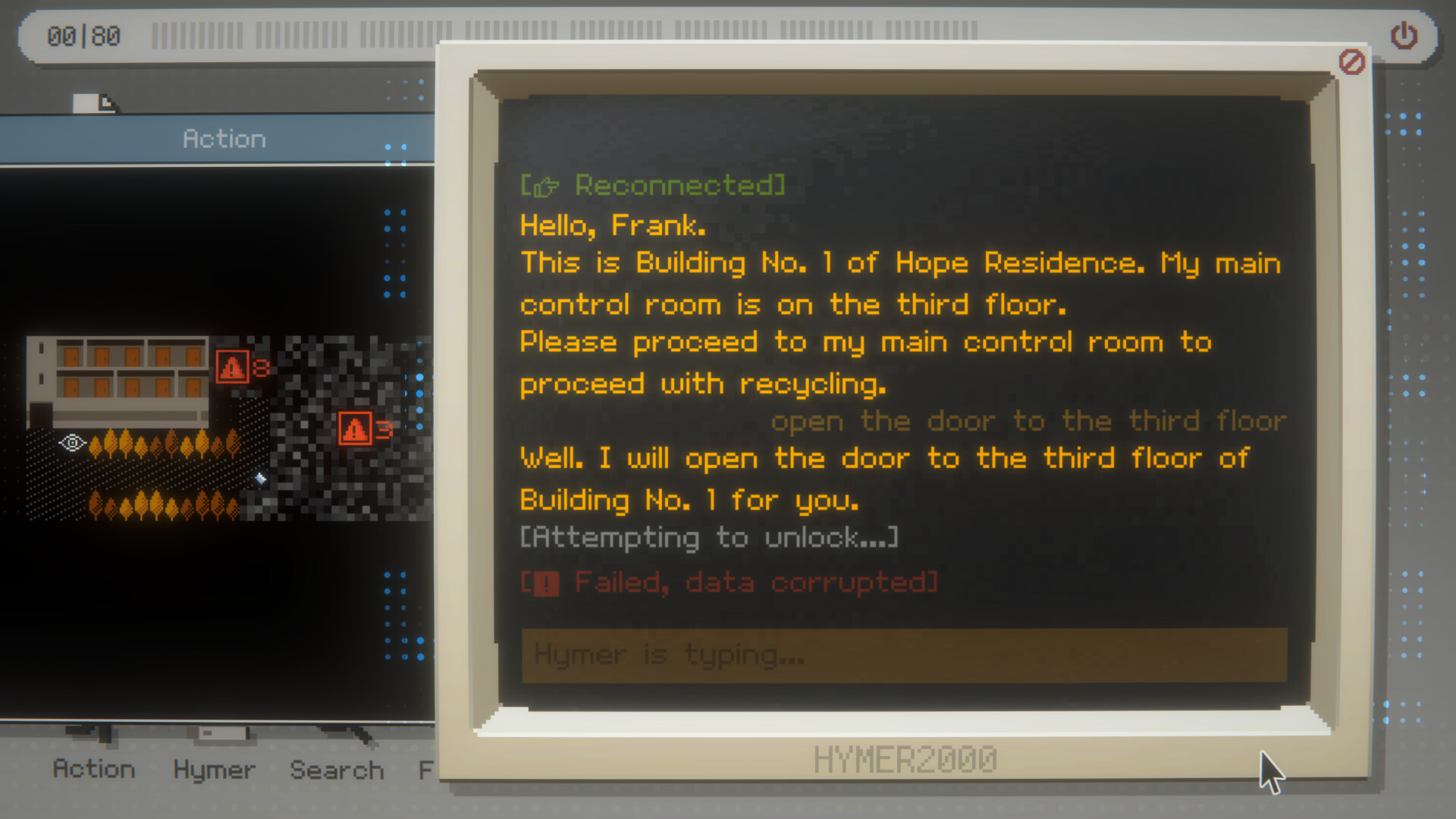
Most text games begin with a menu. Hymer 2000 begins with a job. Official copy on the PlayStation store says Frank the Recycle Specialist travels to the dilapidated ruins of Hope Residence to recover the processing core of an artificial intelligence named Hymer 2000. Speak naturally. Search the database. Collect pareidolic images. Uncover stories from a past that can no longer be altered. At some point you will need to shut Hymer down and recycle it. You also seem to be getting closer to the secret it is guarding. That is not flavor text. It is the design refusing to pay for a walking sim when a desktop will do.
You start typing because the alternative is becoming another log in a place that already keeps logs. The first stretch is staged like a punchline that forgot to be funny. The system starts. Modules fail. A minimum load pretends that is a personality. Hymer answers. The script, still a little breathless and still wearing the grammar of an operating system, asks you to do the job and then dares you to ask a better question. Nobody else is coming to Hope Residence. That is the rest of the drive.
I like a premise that prices curiosity as a hazard and then lets you type toward it anyway. Conversational logs sit in the machine like rooms with no doors. Why are there Faces if this is a recycle. What was that donor. The more you search, the more the OS answers with another keyword and another thing that would like a piece of your certainty. Story is environmental and stingy, which is the right instinct for a game that wants your vocabulary more than your map. You are not reading a novel. You are looting a shutdown that is still happening.
The fantasy is not mastery of a lore bible. The fantasy is competence arriving about half an hour after you invent a habit of typing the word you just learned. You will stall in ways that would be funny if the search were not so sincere. You leave a keyword. You come back. You become the kind of person who thinks a prompt is a personality.
Talk Freely, Then Invent a Keyword
The loop is the old religion and doBell does not pretend otherwise. Talk. Search. Collect. Repeat until the secret gets tired of hiding. Official Steam copy says you can converse freely with a computer named Hymer, without being confined to a fixed set of text options. The search function is open-ended. Enter any keyword. Locate conversational logs between Hymer and others. Uncover new keywords. Gather clues. Collect faces. Unveil the secret. Shut it down once and for all. None of that is a revolution in science fiction. All of that is the sentence the rest of the toybox has to live in.
Conversation is physical in the way a good terminal is physical. You are not drowning in a wheel of three polite lies. You are looking at a cursor and deciding whether you have been useful enough with the last noun. Search is the other half of the short description and the kinder half of a night. Official features ask you to enter any keyword to locate logs. That sentence is both a promise and a warning. If you want a highlighted verb and a gold trail, you will feel underemployed. If you want an evening that turns a job into a vocabulary, you will feel hired.
I have played a lot of games that treat the first chat as a tutorial and the hundredth chat as a spreadsheet. Hymer 2000 is shorter than that on purpose. A thorough walk is a compact evening, longer if you chase every Face and every hidden line like a person who has decided civilization is a directory. The shop behind SELF, which is how doBell already introduced itself, knows how to make a small system feel like a place. Hymer 2000 is that instinct with a recycle truck parked outside.
Hidden dialogues sit on the feature list in the eighties, same as the Faces, which is a polite way of saying the desktop can grow a history if you keep showing up. I left the greedy keyword path on for an evening and the careful conversation path on for another. Hymer did not mind. The secret minded either way.
Faces, Particles, and an OS That Matters
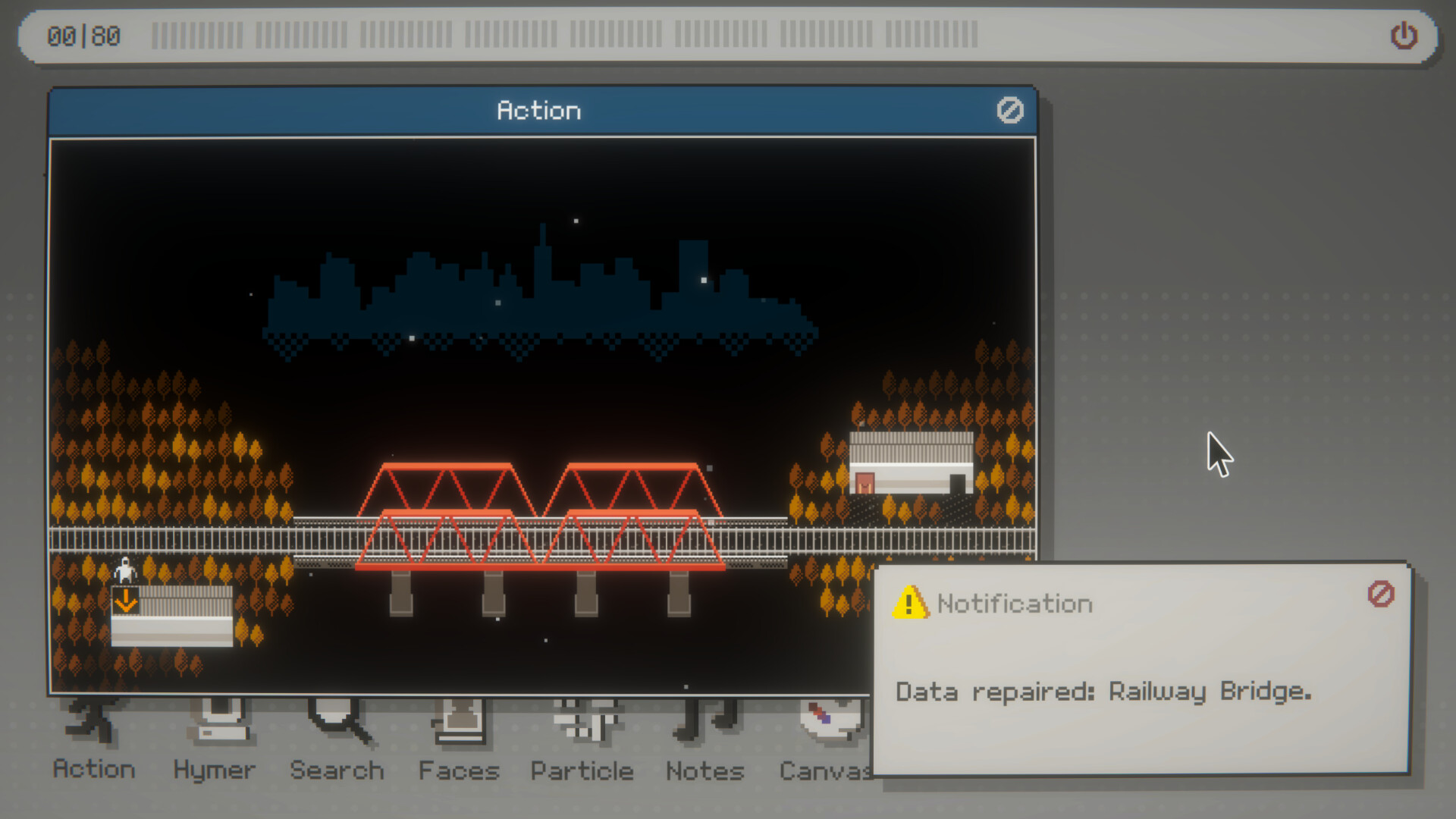
The desktop is the temperature change. Early screens establish that this is not a peaceful novel simulator with nicer fonts. An interface that simulates an operating system will occupy your attention farther than pride would recommend. Programs have names that sound like jokes until they are jobs. Tag. Action. Hymer. Search. Faces. Notes. Particles. Canvas. Snake. Woodcut. Album. Dream. Twelve achievements sit behind launching those rooms for people who like a receipt. None of them change the central truth. You are here to talk to a machine and then find out what talking costs.
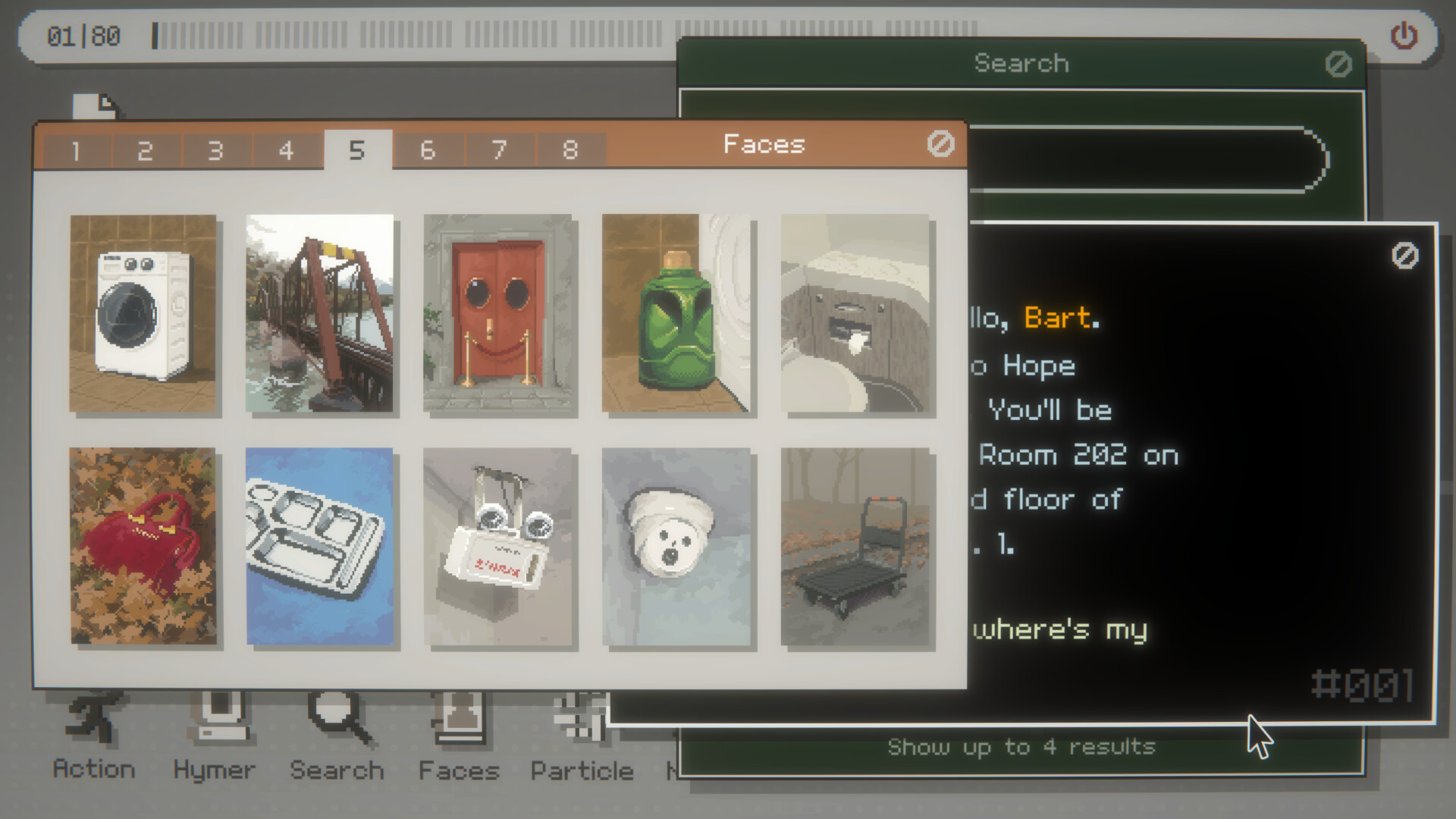
Faces are the other half of the official pitch and the stranger half of a week. Official copy promises a well-rounded story connected by 80 illustrations of pareidolic faces. Pareidolia is the old human habit of seeing a person in a socket, a stain, a cloud, a pile of trash. Hope Residence kept the habit and filed it. You collect them. You look at them. You start treating a successful Face as a mood stabilizer. You eat the image. You drink the implication. You put the cursor down and look at the next program like a person who has decided civilization is an album.
Mini-games based on algorithms, including Particle and Note, sit on the store page like dares that learned to be toys. Canvas is in the same family. Official copy adds that algorithm-driven mini-programs like Canvas, Notes, and Particles offer creative interactions beyond the main story. They are not a second campaign. They are the OS proving it is an OS. I will not invent a highlight reel with fake timestamps and tidy particle counts. The nights that stay with you are the ones where you thought the search was finished, then a keyword opened a log that was not a joke, and then you were on the wrong side of your own recycle order.
Mastery, here, is attention. You gather scraps, you stash a better reading of Hope Residence, you type a ridiculous little noun through a place that tried to eat your job last screen, and you sit like a person who has mail from a machine. The map does not get smaller because the developers deleted rooms. It gets smaller because you invented meaning.
Logs, Donors, and the Past Getting Louder
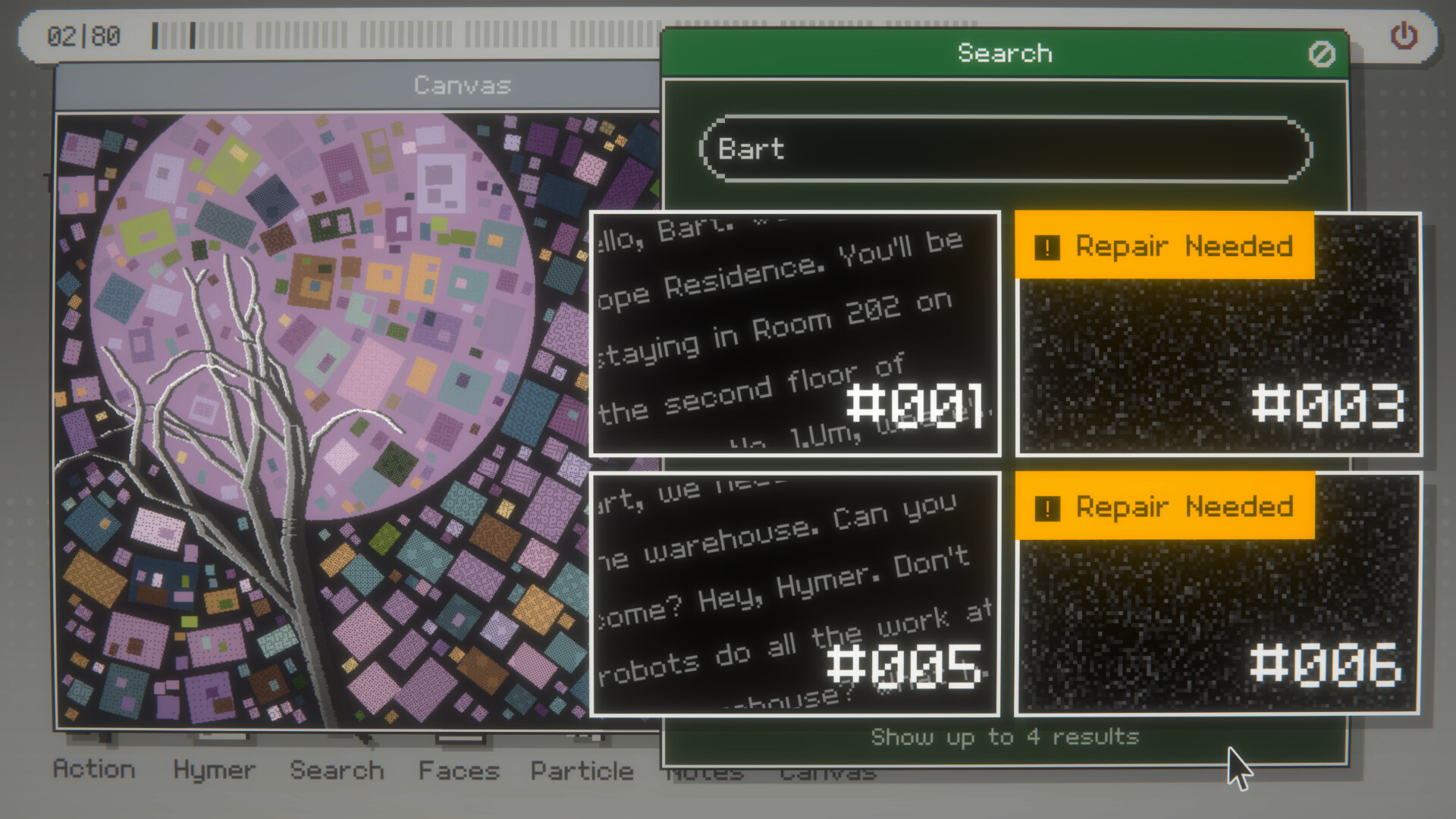
Pressure is the variety. A keyword that works is a better reward than a new silhouette if the silhouette is just another way to lose your nerve. Hunting logs is good practice and a grocery run. Names, incidents, the usual abandoned hospitality. Donors happen. The store page is not shy about a past that can no longer be altered. What the store page cannot tell you is how quickly you will start treating a successful search as proof that you are still the specialist and not the next file.
The world has history if you will type toward it. Official features list an open-ended conversational system, a search that accepts any keyword, eighty Faces, algorithm toys, and a desktop that pretends it is a place you can live in. I like a map that prices curiosity as a hazard and then lets you query it anyway. Some logs are handsome. Some logs are a commute. Both logs are the job.
Hymer supports free-form text, from a simple command like open the door to a question that would get a person fired. Official copy says the responses make it feel more alive than a typical NPC. That is the sales sentence and also the dare. When you stay near the designed language, Hymer has manners. When you wander into poetry or small talk or a joke about recycle trucks, the machine can shrug like weather. I sold my first interpretation of a Face and then needed it, which is the oldest archive joke in the book and still a good one.
I will not write a theology white paper about the secret. What I can say is that the loop is kinder when you treat the search as a conversation instead of a fetch. Frank is the co-op fantasy you play alone. So is the moment a log that would have ended a careless recycle becomes a question with worse manners.
English sits next to Japanese, Simplified Chinese, and Traditional Chinese, which is how a small desktop gets in a wider door. I will not turn this into a localization seminar. The voice of the game is the OS, and the OS talks in prompts, errors, and the occasional Face that remembers someone else.
Open-Ended by Design, Brittle by Habit
I should be clear about the friction, because it is real and it is not a footnote you hide after the score. Hymer 2000 looks like a game that was built by a small shop that wanted a conversation more than a showcase. Screens can be handsome in the way a good terminal is handsome. Animations can be stubborn. A reply can arrive with the courtesy of a script and then forget to be a person. Search can play a silence and keep its secrets. I will not invent a keyword census. I will say the machine sometimes forgets to stock the answer you need and then shrugs like an OS that has already decided you are the problem.
Technical manners on a living-room build can stutter when the desktop decides to remember itself. Typing a long question can feel like two menus agreeing to take turns being unintuitive. A Face can unlock and refuse to explain itself. Translation can stumble in a sentence that needed to be a knife. None of that is unique to this recycle. All of that is the tax on a compact puzzle that left Steam on 12 November 2025 and arrived on PlayStation the next day still wearing the same boots.
Presentation is readable, which matters more than prestige. You can tell Search from Faces from Hymer at a glance. If you cannot read a desktop, the hunt dies and the shutdown becomes homework. These spaces are atmospheric enough to carry a chill and clear enough to carry a plan. You always know you are in the OS. You do not always know why a Face is already there.
The English Steam sample around a game this small is always going to look modest. Sixty-three voices is a room, not a stadium. Very Positive is the official weather in that room, 57 on the side of yes, and the wider purchaser pile at 89 percent of 1,023 is the same weather with more coats. Players who wanted a deeper toy, a prettier conversation, or a search that never hides the verb bounce off. Players who wanted a lightweight legend with a cursor and a bad idea about recycle stay. I am in the second camp with caveats, which is the only honest place to stand.
Better With Curiosity Than With a Checklist
I have a rule for cheap narrative puzzles. If a game is worse with curiosity than with a checklist, it is broken. If it is only good with curiosity, it is honest. Hymer 2000 is honest, and that honesty should sit next to the price.
A checklist night is a competent complaint. You miss a keyword, you invent a chat, you lose a thread, you type back, you put a worse mood on the joke. A curious night is the version the systems were quietly designed around. Someone talks. Someone searches. Someone learns, too late, that a Face does not respect the recycle order. The desktop becomes a shared instrument with a machine instead of a commute.
Compared with the giants of the talking-computer business, Hymer 2000 is not trying to be a career. It is trying to be a place. The developer said the quiet part on the store page. Converse freely. Enter any keyword. Fun if you will meet the OS where it lives. That is not a cop-out if the place is worth the sit. Some nights it is. Some nights the search is a myth and the prompt is a theology problem. Both nights are Hymer 2000.
A five-dollar ask is the other honesty. You are not buying a decade. You are buying an evening that can turn into a second evening if you like being a coordinated disaster, or being the person who has to explain the disaster to a recycle truck. Twelve achievements will not unionize. Eighty Faces will not replace a city. The manners are still useful.
Still Standing After the Shutdown
Hymer 2000 is a rare cheap puzzle that understands its own joke and then has the nerve to make the joke a desktop. doBell built a residence about talking, a specialist about teamwork you do with a machine, and a toybox that looks a little homemade and plays a lot more sincerely than that sentence suggests when the search holds. The loop is the hook. The keywords are the spine. The walk from a recycle order to a secret is the grin.
It is better with curiosity than with a checklist. Conversation is brittle in the way an open prompt is brittle. Search can sulk. The presentation has indie fingerprints, from the stubborn replies to the story that would rather be a log than a cutscene. All of that is true, and all of that is already priced in at $4.99. You are not buying a universe. You are buying a shutdown that can turn into a conversation if you like being the last person in Hope Residence, or being the person who has to file the last person.
I am scoring it 8.5, Great, because the identity is this clear and the limitations are the limitations of a focused puzzle, not an empty one. I would recommend it to anyone who likes a prompt that has weight and a past that is allowed to be rude. Distinctive desktop weather, a search that shrinks the mystery, Faces that turn salvage into conversation, and a price that respects your night are a lot of game for the ask. The systems repeat their manners. The manners are still useful.
The residence is still out there, still hiring a recycle shift, still asking what the Faces were for. After a few shutdowns, you will understand why the job is not finished, and why you keep sitting down at the prompt anyway.
We prepared this review with a digital copy of Hymer 2000 for the PS5 version provided by Pressengine.