
Immortal Pillars does not wait for Age of Mythology: Retold to finish introducing itself. It arrives on the same public morning the PlayStation 5 version opens the door, drops a fifth pantheon on the table, and expects you to already know how a Temple argues with a Town Center.
World’s Edge, Virtuos, Forgotten Empires, and Tantalus share the developer line. Xbox Game Studios publishes it. The public day is March 4, 2025, on Steam, the Microsoft Store, Xbox, and PlayStation 5. Premium owners on PlayStation 5 unlocked the base game on February 27. They did not unlock this. Immortal Pillars waits for the public morning, Premium crate or not. This review is dated to that morning. I played the PlayStation 5 version, a US code that arrived after a Steam early-unlock, because that is the copy they asked for and the copy they sent.
The expansion is $19.99 on its own. Premium folds it in at no extra cost. On PlayStation 5 the Standard edition of Retold is $29.99 and Premium is $49.99. Those are the official U.S. list prices. This is the first expansion. It is the Chinese one.
If you already live in Retold, the pitch is simple. Twelve new gods. A nine-mission campaign called Pillars of the Gods. Seven maps that remember China. A favor system that wants a city, not a shrine. You gather. You age up. You pick a fight with something that has too many legs. Immortal Pillars changes what the town is allowed to become while you do it.
Favored Land Is a Neighborhood Argument
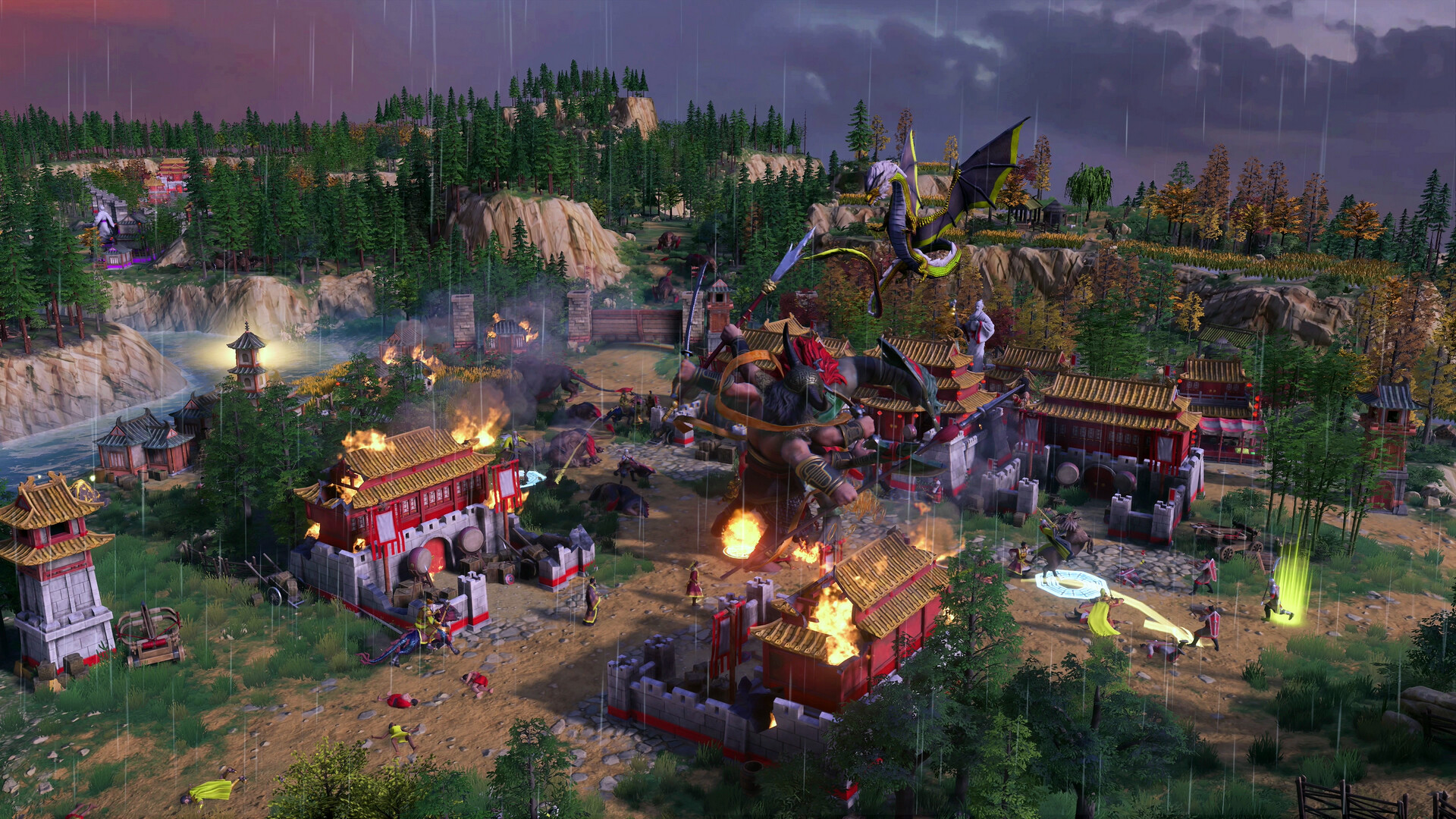
Every other pantheon in Retold can scatter a few houses, park a Temple, and call the job done. The Chinese would like a word with your zoning board. Favored Land starts at the Town Center, then crawls building to building if you place the next one close enough to keep the chain alive. Connected land generates favor and hands out bonuses that change with the major god you picked. Break the chain and the leftover aura goes pale. Pretty buildings that do not touch the neighborhood still look like a city. They just stop paying rent.
That is the whole personality of the pantheon, and it is not a costume. Peasants are slower gatherers than the villagers you already trust. Kuafu, the construction giants, exist because a weaker worker needed a friend who can raise a hall before the raid arrives. Farms, walls, and Titan Gates do not spread the aura. You cannot cheat the neighborhood with a fence.
Fuxi treats that line like a parade route for human soldiers and heroes. Nüwa treats it like a construction site that should finish itself, with foundations on Favored Land crawling toward completion while you look at the army. Shennong treats it like a garden that also happens to be a hospital. His farms appear in the Archaic Age, they snap down on Favored Land almost instantly, and the plow line of technologies researches itself when the age arrives. Myth units standing on his land regenerate. The launch patch already cut that heal from a greedy number to 1.5 a second, then lets it climb by 1.5 each age. Even the official notes admitted the first number was too kind.
Military buildings can grow a Tower or a Training Yard, which is a polite way of saying a Barracks is allowed to have an opinion. Each Town Center can also vomit a handful of Terracotta Riders once, a panic button for the moment a scout finds you with your Kuafu still holding lumber. Favored Land rewards expansion, then punishes the same appetite the moment a raid cuts the street in half. I have built a handsome suburb, watched the aura go white, and realized my favor income had become a museum exhibit. The system is honest. It is also mean to anyone who places buildings the way a tourist places souvenirs.
Nine Missions Against a Cracked Sky
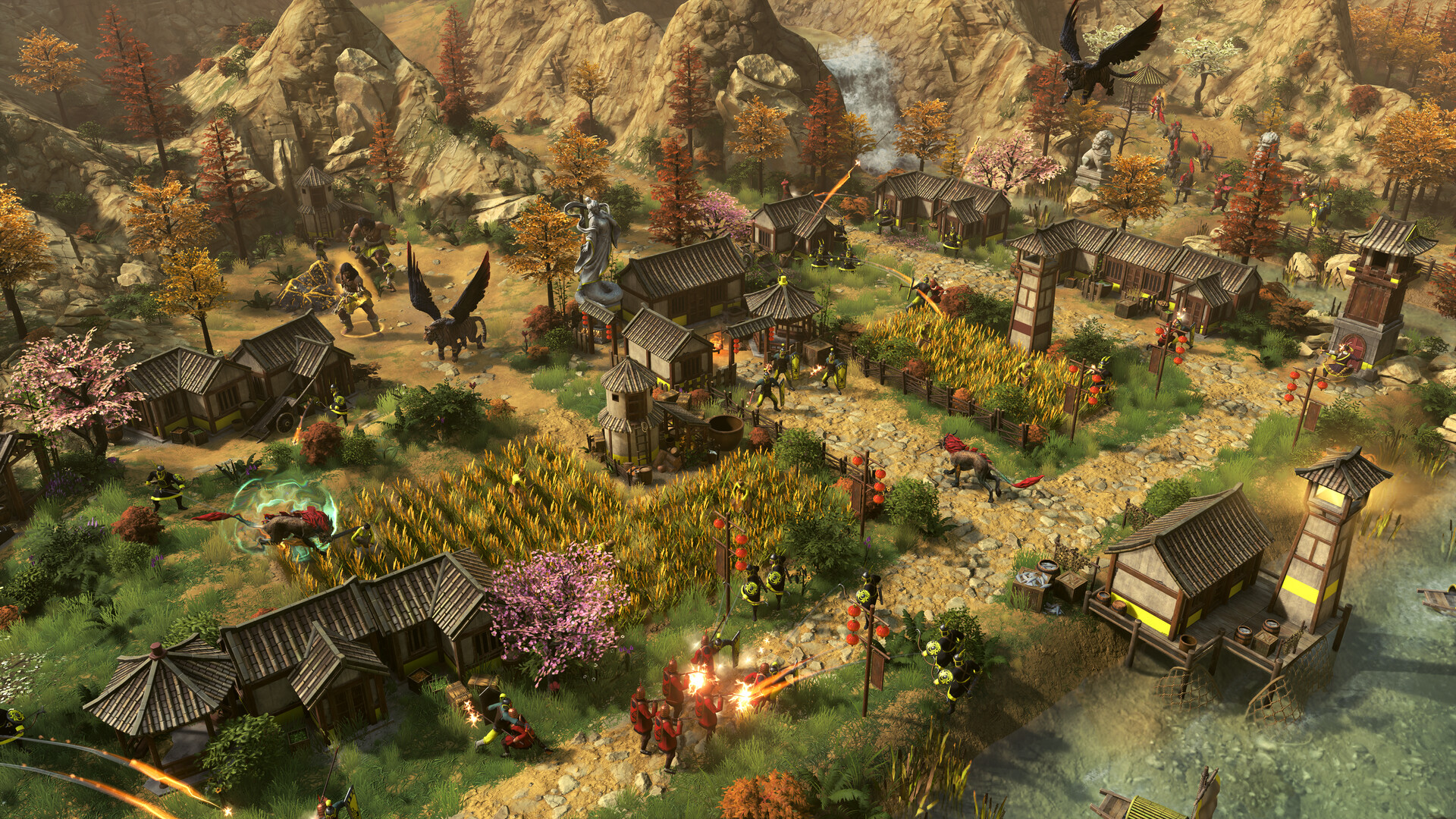
Pillars of the Gods is a nine-mission campaign, and I will not invent a clock for it. The missions are long when they want you to feel a kingdom and short when they want you to feel a dare. Official copy calls the journey narrative-driven. In practice it is a directed set of levels that borrow Chinese myth earnestly, with cinematics, and with a hero who has to keep a Town Center alive while the sky tries to quit.
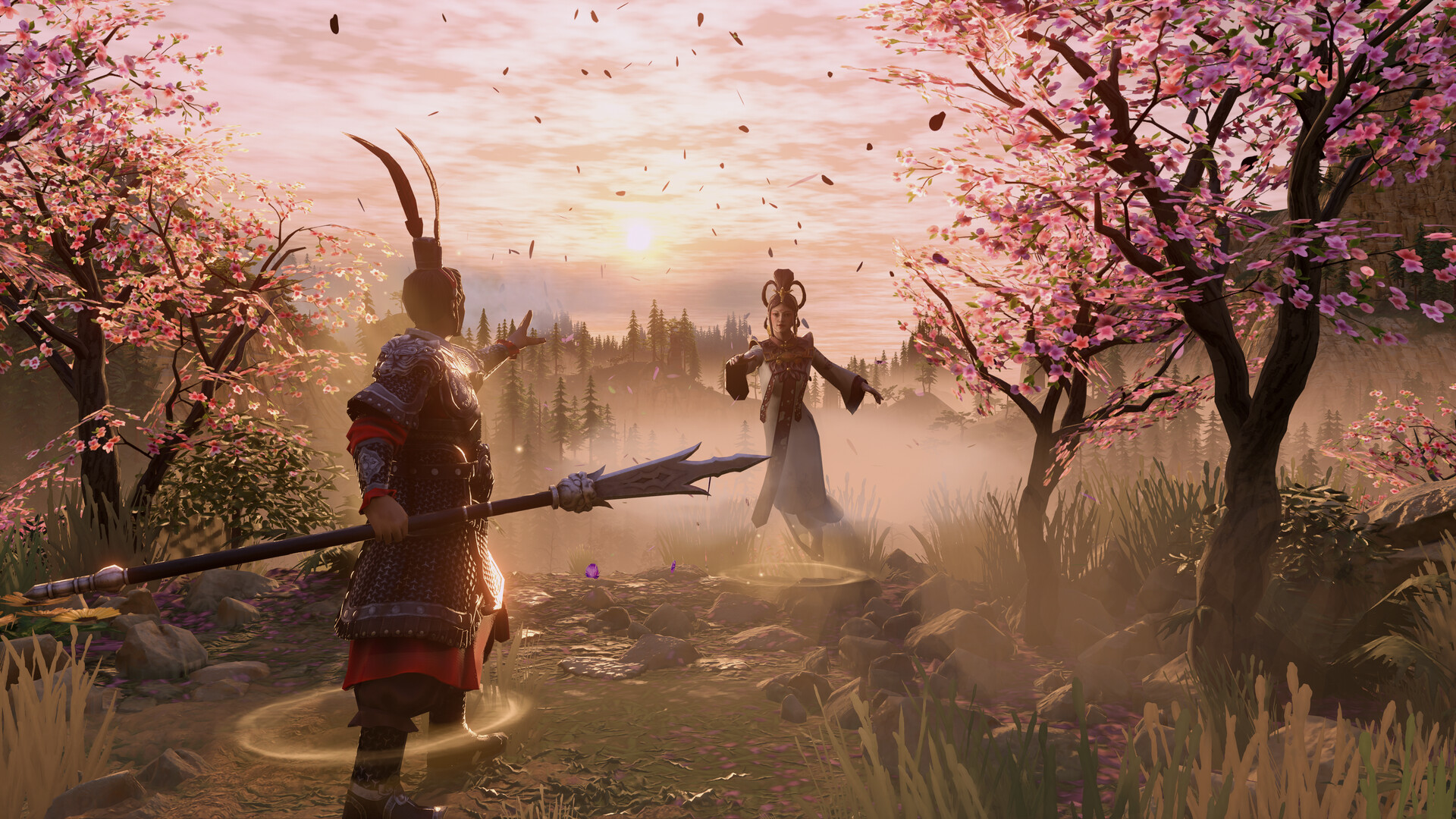
Yan Feifeng is a fallen warrior Shennong drags back into the job. Houyi shows up because a story about a cracked heaven is required to hire a legendary archer. The antagonist is a vengeful immortal who would like the Pillars of Heaven on the floor. You spend the campaign stopping that demolition and learning that Nüwa’s idea of repair work is not a metaphor. Other heroes visit from other corners of the map, which is the campaign’s way of saying Retold is still one neighborhood even when the new gods have the camera.
This is not a documentary. The writing is polished, sometimes a little proud of its own lanterns, and better when a battlefield finishes the sentence. A mission that wants you to understand Favored Land will not hide that behind a tooltip. Skip the campaign for ranked 1v1 if you must, and you skip the only room that remembers why the expansion is named after pillars instead of a ladder.
Nine missions is enough to put Fuxi, Nüwa, and Shennong in your hands without turning the script into a seminar. It is not enough to make every minor god feel like a chapter. Chiyou gets his war face. Gonggong gets his water. Zhurong gets to set a prairie on fire and call it theology. Some of the others wave from a god-select screen and wait for skirmish to give them a real job. That is an expansion campaign doing expansion campaign work. I wanted one more stubborn mission in the middle, the kind that makes a single god power feel expensive. I did not get it. I got a complete story that knows when to leave.
Launch day still had fingerprints. The same update that shipped the expansion had to put music back into the Chinese tutorial cinematic and raise campaign cinematic levels. None of that sinks the script. It does tell you this was a busy morning.
Twelve Gods Who Refuse to Share a Temper
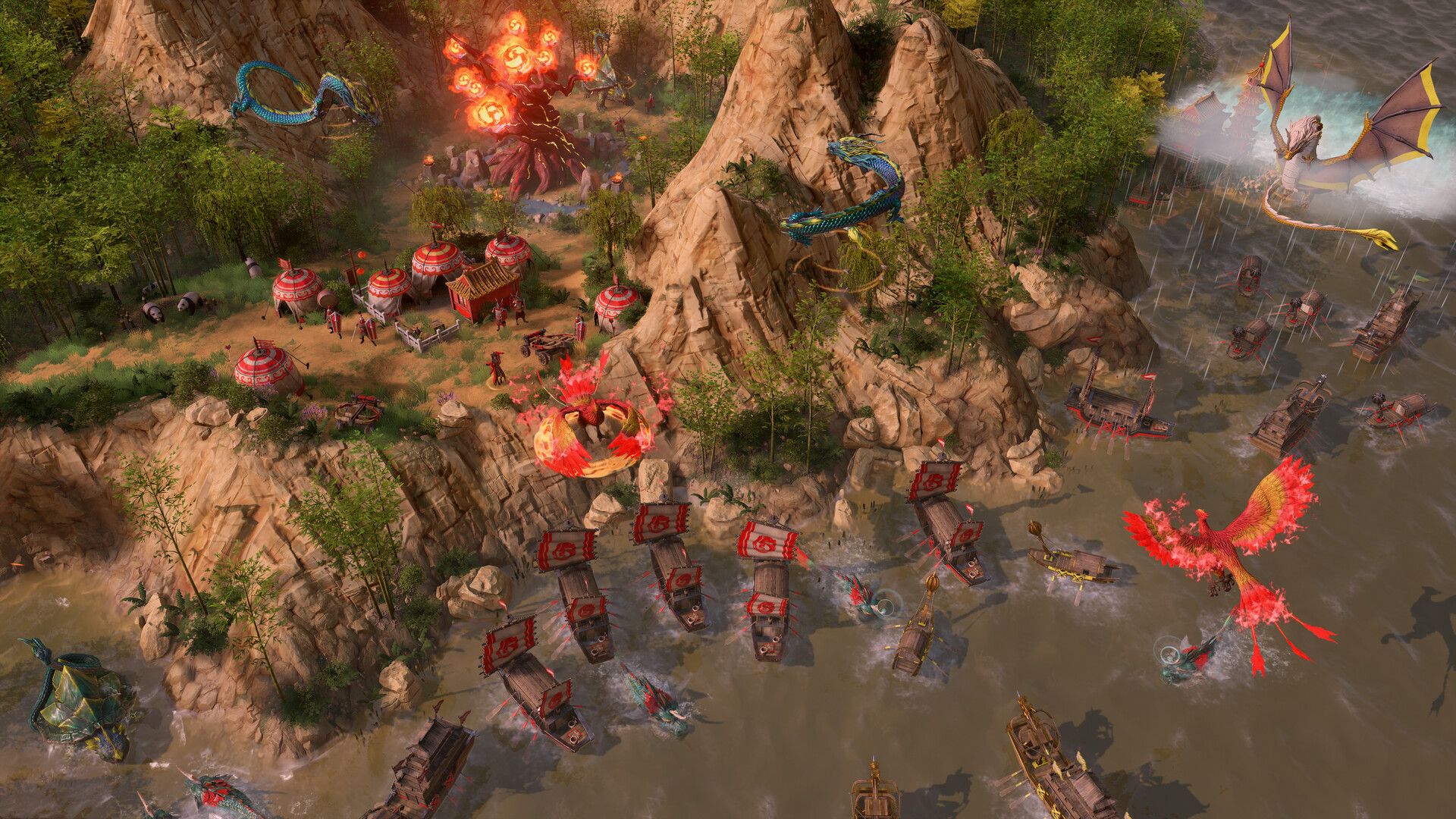
Three major gods. Nine minor gods. Twelve names, and none of them want your Greek opening. Fuxi is civilization, culture, and heaven, which in game language means human soldiers, heroes, and a Peach Blossom Spring that grows a pile of resources until a villager touches it and the miracle clocks out. Nüwa is creation and earth. Her Creation power plants Clay Peasants that last a few minutes and multiply in later ages, which is the closest this series has come to a god saying she will just make more people. Shennong is agriculture and medicine. Prosperous Seeds turns farms into faster food, a heal, and a vanishing act for whoever is standing on the dirt.
Their blessings keep arguing after the power is spent. Nüwa cheapens Peasants and toughens buildings as favor comes in. Shennong eventually hands you a next-age myth unit from the Temple for free if you have been a good neighbor. Fuxi wants the army to feel like the point of the city, not a tax the city pays. You cannot feel any of that until a Clay Peasant finishes a house you forgot you placed.
The Classical shelf is Xuannü, Chiyou, and Houtu. Xuannü is wisdom and military medicine, the calm option if you want production and healing instead of a bull-headed argument. Chiyou is chaos and war. He loans you the Yazi and Lightning Weapons, a power that stuffs thunder into human soldiers and ships until stun becomes a personality. Houtu is earth, economy, defense, and the flying tiger that is not supposed to be in your base. The Heroic shelf is Goumang, Nüba, and Rushou: spring and cavalry, drought and myth units, gold and trade. The Mythic shelf is Gonggong, Huangdi, and Zhurong: flood, the Yellow Emperor’s human machine, and a prairie that catches fire because summer asked nicely.
I will not rank them. Rankings go stale the first time a patch lands, and a patch landed on day one. Yazi came in too fast, too thick, and too happy to delete a raid. The launch notes cut its speed, its hit points, its hack armor, and the bonus on Son of Loong in the same breath. If you take the Chinese into a ladder on launch morning, you are playtesting a temper. That is not a scandal. It is an RTS expansion doing what RTS expansions do when a new myth unit has been waiting in a trailer.
The honest criticism is appetite. Twelve gods is a real roster. It is also a lot of doors for a first expansion. You can spend a week sampling Chiyou’s loot brain, Nüba’s drought, Rushou’s white tiger, and never learn how Favored Land wants a Fuxi city to sit. The pantheon is at its best when a major god stops being a loading-screen painting and starts being a habit. Fuxi wants soldiers in the street. Nüwa wants the street finished. Shennong wants the street edible. Pick one and live there before you tour the rest.
Perils, Beasts, and a Rain Dragon
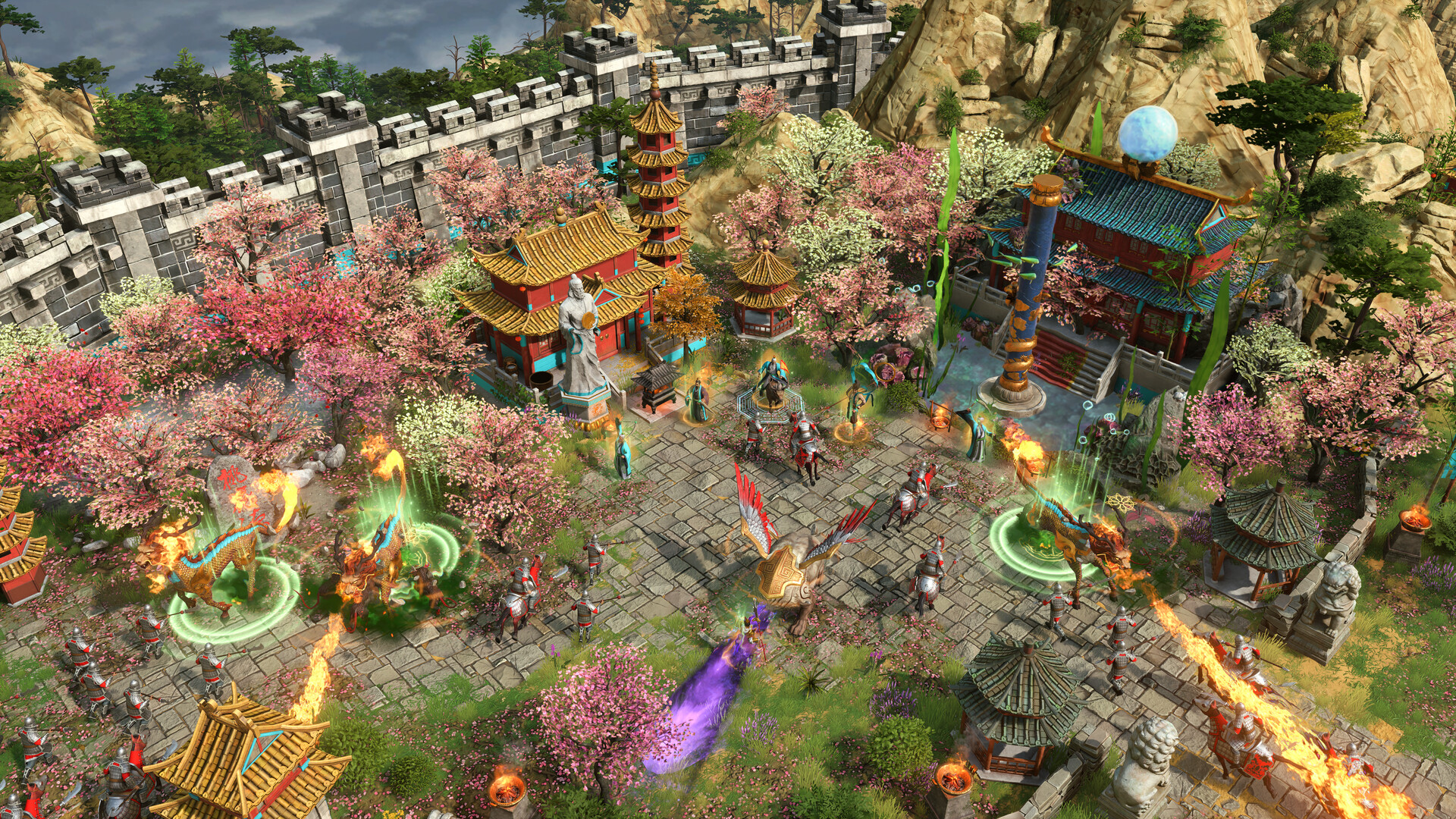
Most of the new myth units come in two family portraits. The Four Perils are the warped ones. The Four Auspicious Beasts are the guardians who got the better lighting. Yinglong, the flying rain dragon from the store copy, and the Qilin, which heals the neighborhood, sit in the gaps and remind you the bestiary is larger than a matching set.
Qiongqi is Houtu’s Classical problem, a winged tiger that walks like homework and flies like a crime. It is slow on the ground, rude in the air, and built to raid a base you thought had a front door. Sinister Defiance thickens its armor for every enemy standing nearby, which is the game admitting you will send it somewhere stupid. Taotie, Nüba’s Heroic glutton, eats human soldiers, grows, then spends the meal as a fiery lane and shrinks again. Eat. Grow. Exhale. Repeat. Taowu is Goumang’s siege animal, stubborn, building-hateful, with a dash that clears a sidewalk the way a cart clears a market. Hundun is Huangdi’s Mythic insult, faceless, too many legs, too many wings. Chaotic Fear sends enemies jogging in nonsense directions. Banish deletes a cone of units into a void and returns them worse. It feels like cheating for a few seconds. That is the point.
The polite family is no less armed. Baihu, Rushou’s white tiger, leaps, pins, and throws the neighbors. Xuanwu is a tortoise with a snake on its back, amphibious, armored, and available to every Chinese god because water should not require a specific minor deity to have a personality. Qinglong is Gonggong’s azure dragon, a flying hose that would like everyone washed. Zhuque is Zhurong’s vermillion bird. It takes its time gathering fire, drops a whirlwind, then shields friends and, with Song of Midsummer, lands to heal instead of doing the Phoenix routine of dying on purpose.
Specials like these are why Immortal Pillars is not a unit pack with nicer roofs. A Taotie that has been fed is a different unit than the Taotie you trained. A Hundun that has banished your front line has not dealt damage so much as edited the fight. Retold already knew how to make myth units feel like verbs. The Chinese roster just arrived with a longer dictionary. The first evening is still a bestiary exam.
Crossbows, Giants, and a One-Time Cavalry
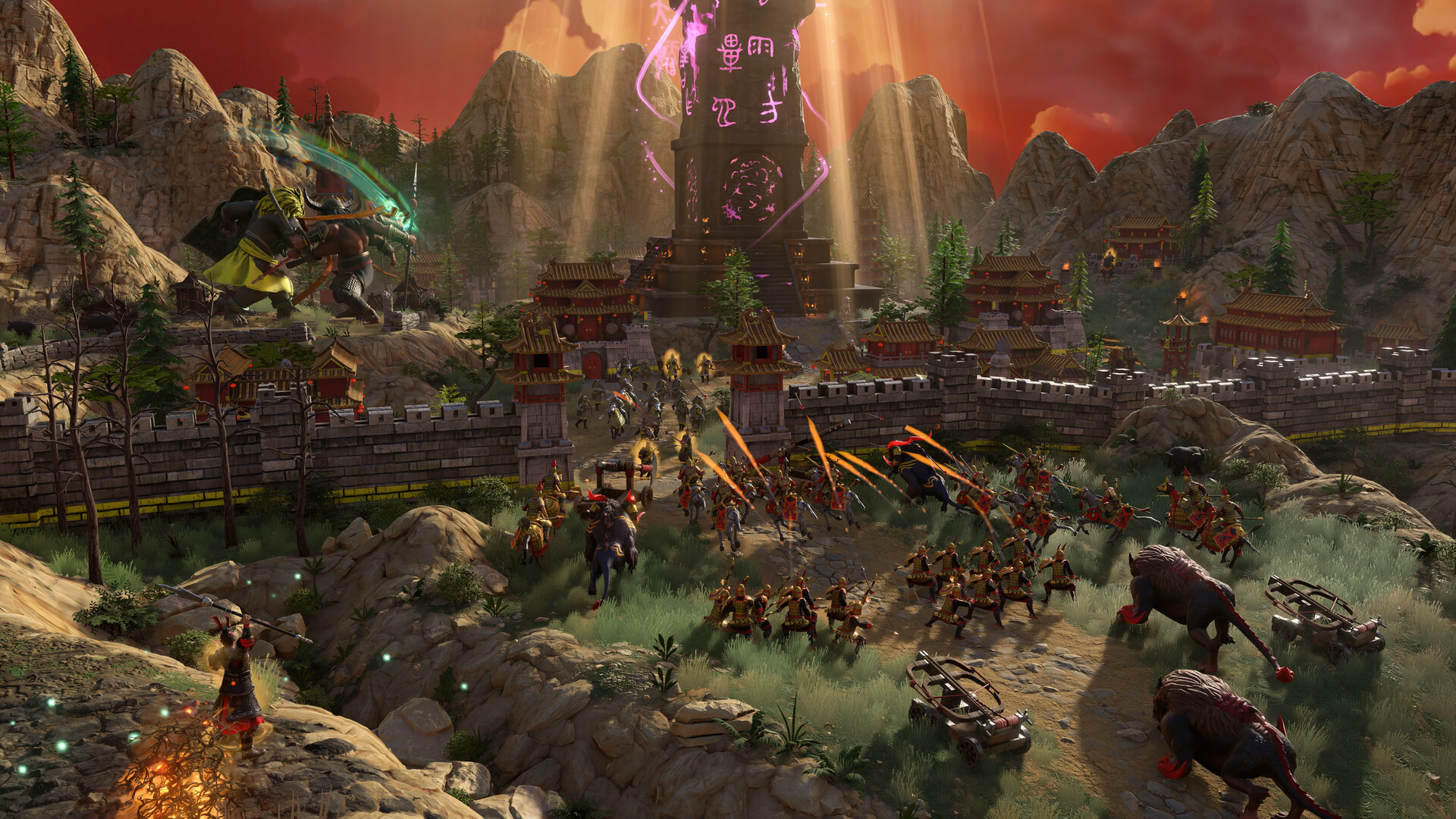
Under the monsters there is still an army that has to win a fight without a miracle. Chu Ko Nu are the repeating crossbows, close-range, fast, and built for a crowd rather than a hero. Dao Swordsmen are cheap, slow, and meant to stand in a mixed line instead of starring in one. Tiger Cavalry arrive later as the heavy answer, and they have the courtesy to stand up and keep swinging after the horse is gone. There is no early cavalry to paper over a bad scout. China spends the first stretch as an infantry and machine culture, then unlocks the horse when the neighborhood can afford pride.
The Machine Workshop is the siege house, which is where the pantheon remembers it is allowed to be rude to walls. Kuafu keep being the best joke in the roster: giants who would rather finish a palace than win a duel. Terracotta Riders remain a one-use siren from the Town Center. I have spent them too early, the way I have lit an Age Up because the button was glowing. They are a fire extinguisher shaped like a horse.
Hero work sits at the Imperial Academy. Pioneers scout and throw Sky Lanterns. Sages heal and occasionally talk an enemy into a worse career. The later demigods are the cutscene faces you actually remember. If you came here from a pantheon that turns every soldier into a hero with a button, the Academy will feel like a queue.
Wonder Age still exists. Build the unique Wonder and the gods pay you in cheaper powers, angrier myth units, and a Titan Gate that can be rebuilt. It is the same late-game bribe the rest of Retold offers. The Chinese Wonder just looks like it belongs on a stamp. The new rule is the street that had to be built before the stamp was allowed.
Seven Maps and a Daily Dare
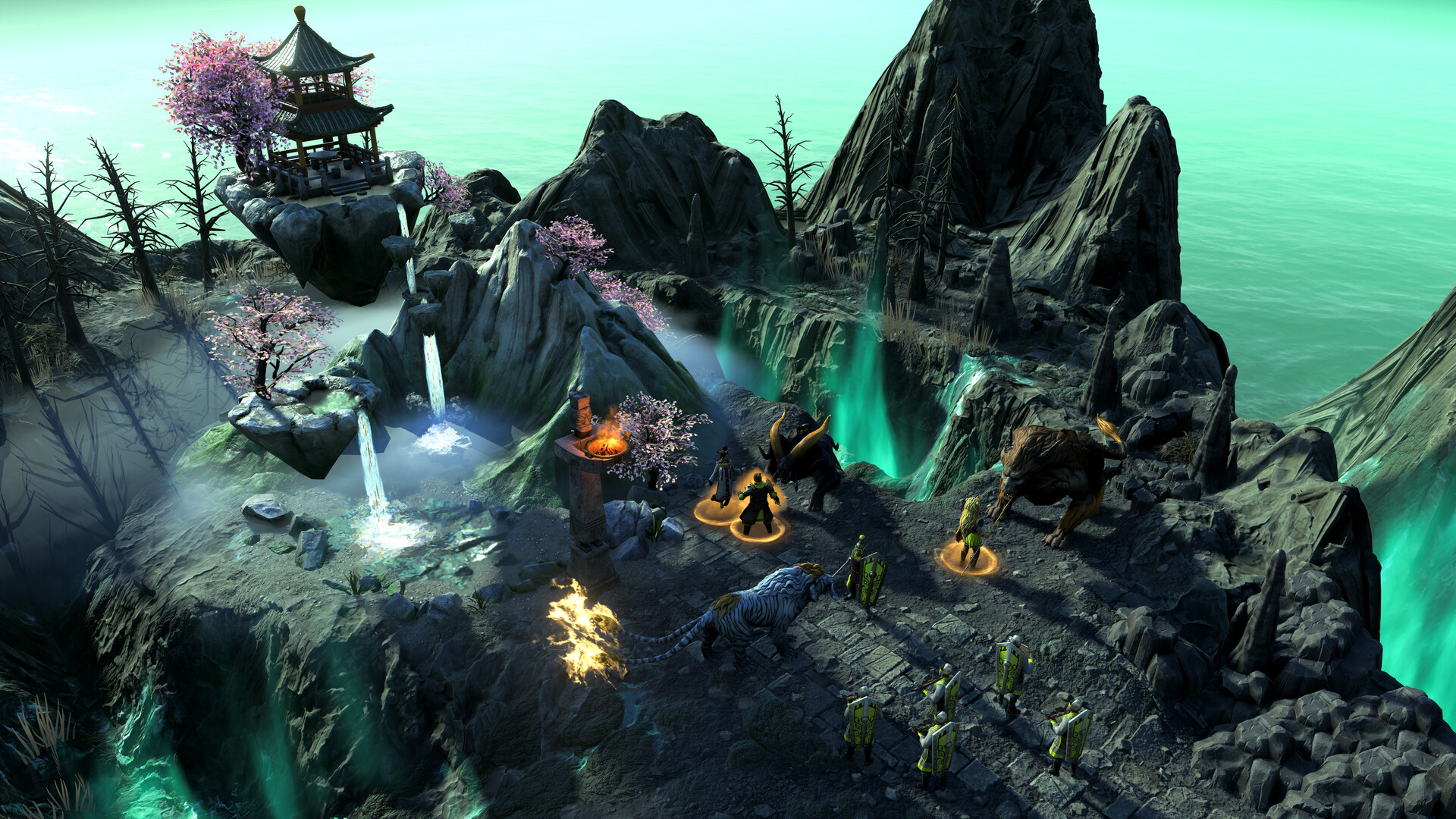
The seven maps are not wallpaper. Bamboo Grove drops you in a narrow pass and tells you the forest is both cover and a muzzle. Great Wall offers a temporary truce, which is a fancy way of saying you are allowed to panic behind masonry until someone decides the masonry is optional. Peach Blossom Land starts everyone in a shared paradise and then makes the resources live outside the poem, so the first person to leave the garden is either rich or dead. Qinghai Lake puts a shrine on water that land units can also wad through, and capturing it pays the economy. Silk Road starves the usual piles and hands you Trading Posts that only stay yours while you hover, which turns the map into a commute. Steppe is a wide, rude grassland that laughs at walls. Yellow River splits the board, forks around an island, and dries out your starting bank so you have to migrate like a person who planned poorly.
Those are the official jobs, and they play like the blurbs. Silk Road is the one that changed my posture. I stopped thinking like a farmer and started thinking like a clerk with a spear. Yellow River is the one that punished a pretty Favored Land line I had aimed at the wrong bank. If you only queue the old Retold maps, you bought a pantheon and left the country in the box.
The same morning also shipped Daily Celestial Challenge, a free skirmish twist with World Twists, Blessings, and a daily leaderboard that resets at 9 AM Pacific. It is not locked to Immortal Pillars. Play it if you want a rule that expires tomorrow. Do not confuse it for campaign meat. The Chinese pantheon is the meat.
Online, the Chinese walk into the same ranked and casual rooms as everyone else. A Microsoft account is still the visa. I will not invent a win rate for Fuxi. A pantheon that generates favor from urban sprawl plays differently in a 1v1 than it does in a team game where three people can cut your street at once. Learn that the hard way.
Final Thoughts
Immortal Pillars is a real first expansion. Not a god pack with a travel poster. Twelve gods, a nine-mission campaign, seven maps with jobs, and a favor rule that makes a city feel like a machine instead of a parking lot. World’s Edge, Virtuos, Forgotten Empires, and Tantalus built a Chinese pantheon that wants to be learned. The $19.99 standalone price is the honest way to buy that pile if you already own the base game. The $49.99 Premium crate is the honest way to buy it if you want the expansion sitting in the receipt from the start.
It is not a flawless morning. The Yazi needed a trim before the paint dried. Shennong’s garden heal needed the same conversation. Favored Land will make a tourist build a suburb and then starve. The campaign teaches the pantheon without becoming the reason the series has a soul. Some minor gods remain doors you will open twice a year. If you wanted a longer epic or a Chinese roster that arrived already balanced, this is not that crate.
I would not sell Immortal Pillars as a weekend sticker. I would sell it as the room Retold was missing, the one where the town has to touch itself to stay holy. Play Pillars of the Gods if you want the new gods to have faces. Play Silk Road if you want the economy to commute. Play Shennong until a farm feels like a plan, then play Fuxi until a Peach Blossom Spring feels like a trap you placed on purpose. At $19.99, or at no extra cost inside Premium, the price is doing the rare thing prices sometimes do. It is describing the object.
Score: 8.0. The aura still wants a neighbor. The peasants are still slower than they look. The sky is still available to be mended, one linked hall at a time.
We prepared this review with a digital copy of Age of Mythology: Retold Immortal Pillars for the PS5 version provided by Edelman.