There is a particular kind of invitation, rare in a genre that usually hands you a path and a wallet of gold, in being asked to fly as an angel and then discovering that Hell has learned how to write in projectiles. The gate is still a gate. The halo is still a halo. The first eyeball that follows you home is not a metaphor. Otherwar, the tower defense and bullet hell mash-up from kantal collective, is built on that joke, and the joke is ruder, prettier, and more useful than a six-dollar apocalypse has any right to be.
I played the PS5 version, the 28 August 2025 console landing at $5.99 that Untold Tales and Hyperstrange had already walked onto Steam on 27 February 2023 after a store page that already knew how to aim an eyeball. You embody the defender angel. You plan the fortifications. You soar over the battlefield and meet the monsters in person. Thirty-eight Steam achievements sit behind the halo. The English Steam sample is Mixed, 61 percent of 77, with 85 positive of 123 across languages, which is the honest weather of a small, stubborn hybrid and not a dare. Great, not a career, and very much a gate I would recommend you hold if you like a loop that knows it is a puzzle.

Heaven Has a Door, and Hell Has a Calendar

Most tower defense games begin with a wallet. Otherwar begins with a halo. Official copy on Steam says you have been called forth to stem the tide of an encroaching hell horde, then asks you, with the grammar of a person who has already lost the upright life, to defend the Gate of Heaven. You are an angel built for one purpose. Plan the defenses. Soar over the field. Smite what gets through. That is not flavor text. It is the design refusing to pay for a cutscene when a gate will do.
You start building because the alternative is becoming a rumor in a place that does not keep rumors. The first stretch is staged like a punchline that forgot to be funny. You place a tower. The path thinks about it. Something with too many eyes thinks about you. The script, still airborne and still a little breathless, asks you to carry your light into the dark. Nobody else will. That is the rest of the map.
I like a premise that prices curiosity as a hazard and then lets you fly toward it anyway. Official features list three main areas with their own monsters, nine levels treated as puzzles, and a cast that will blot out the sun with fire just to clip your wings. Why are there structures and no people. What was that swamp for. The more you play, the more the horde answers with another projectile and another thing that would like a piece of your halo. Story is environmental and stingy, which is the right instinct for a game that wants your hands more than your diary. You are not reading a novel. You are holding a door that is still being kicked.
The fantasy is not mastery of a lore bible. The fantasy is competence arriving about half a stage after you invent a slowing field. You will fail in ways that would be funny if the gate were not so sincere. You leave a lane open. You fly back. You become the kind of person who thinks a projectile emplacement is a personality.
Nine Maps That Think They Are Puzzles

The loop is the old religion and kantal collective does not pretend otherwise. Select towers and skills before the mission. Place fortifications along a path that does not respect your optimism. Upgrade the angel while the wave is still happening. Acquire new abilities between stages. None of that is a revolution on its own. All of that is the sentence the rest of the toybox has to live in.
What makes Otherwar a mash-up instead of a costume is the second job. Official copy is not shy about it. You are not only the planner. You are the defender who can smite enemies on his own if need be. The angel is not a cursor with wings. The angel is a body that has to live in the same weather as the horde. Almost every enemy fires a different kind of projectile. Homing eyeballs. Wide spider webs that arrive like bad mail. Swirling leaves cast by undead treants. Necromancers who, if you let them linger, raise skeletons that turn a clean lane into a theology problem. That list is the design. It is also the joke.
I have played a lot of games that treat the first wave as a tutorial and the ninth wave as a spreadsheet. Otherwar is heavier than that on purpose. Official copy says each of the nine levels is a puzzle for you to solve. That sentence is both a promise and a warning. If you want a campaign that never asks you to fly and think at the same time, you will feel overemployed. If you want an evening that turns a gate into a plan, you will feel hired.
Dynamic loadout work is the other half of the pitch. Before each mission you pick the towers and skills that will have to live with your mistakes. Straight-forward offensive towers for the general population of problems. Slowing fields that bog down the crowd. Emplacements that shoot down incoming projectiles so the angel can keep a little sky. I left the greedy path on for an evening and the careful path on for another. The horde did not mind. The necromancers minded either way.
The Halo Is Also a Workbench

Ten towers sit on the official sheet, and the sheet is not padding. You do not unlock a toybox so you can ignore it. You unlock a toybox so the next map can refuse the last answer. Offensive work handles the ordinary sin. Slowing work buys the angel a second thought. Intercept work treats the bullet hell as a system you can argue with instead of a weather you can only dodge. The limit is the point. You are not wallpapering heaven. You are staffing a door.
The angel is the other half of the short description and the kinder half of a night. Official features ask you to take direct control, manage the towers, and fight the demons. Mastery, here, is split attention. You place, you stash a little gold, you fly a ridiculous little halo over a lane that tried to eat your last plan, and you smite like a person who has mail. The map does not get smaller because the developers deleted enemies. It gets smaller because you invented commuting between a tower and a problem.
A skill tree will take the junk you have been tripping over and turn it into a habit. Official copy says you upgrade the angel during battle and acquire new abilities between missions. Those two clocks keep the nine maps from feeling like a single joke told nine times. They are not a city. They are a reminder that someone else survived long enough to leave you a better wing. I spent gold I was sure I needed and then needed it, which is the oldest tower joke in the book and still a good one.
I will not invent a highlight reel with fake timestamps and tidy wave counts. The nights that stay with you are the ones where you thought the lane was finished, then something started writing in a rhythm that was not your towers, and then you were on the wrong side of your own architecture. Direct combat can feel like an angel and a demon agreeing to take turns being disappointed. That clunk is real. It is also priced into a hybrid that would rather you plan, retreat a lane, and come back dressed. Distance helps. A working intercept tower helps more.
Eyeballs, Webs, and a Necromancer’s Patience

Pressure is the variety. A lane that holds is a better reward than a new silhouette if the silhouette is just another way to lose the gate. Hunting the right tower for the right monster is good practice and a grocery run. Hell, swamp, dark forest, the usual drowned hospitality, except the water is fire and the fire has homework. Sparks happen. The store page is not shy about it. What the store page cannot tell you is how quickly you will start treating a clean wave as a mood stabilizer. You eat gold. You drink gold. You put the halo down and look at the gate like a person who has decided civilization is a chokepoint.
The world has history if you will fly toward it. Official copy names the Gate of Heaven and the Hordes of Hell without writing you a novel, then lets the three main areas do the talking with their own monsters. I like a map that prices curiosity as a hazard and then lets you soar toward it anyway. Some rooms are handsome. Some rooms are a commute. Both rooms are the job.
Thirty-eight achievements sit behind the loop for people who like a receipt. Names like GOLD SPENDER, HELL CHAPTER, SWAMP CHAPTER, DARK FOREST CHAPTER, EXTERMINATOR, and UNTOUCHED BY HELL tell you the shop has a sense of humor and is not ashamed of it. APPRENTICE and JUST THE BEGINNING are the polite ones. PEOPLE ARE THE KEY is the one that sounds like a sermon until you remember the gate. None of them change the central truth. You are here to hold a door and then find out what the door was for.
The enemy list is the other sermon. Homing eyeballs teach you that the sky is not yours. Spider webs teach you that slow is a weapon if the angel is the one being slowed. Undead treants teach you that a pretty pattern can still be a wall. Necromancers teach you the only lesson that matters in a game this small. If you let the wrong thing live, the map writes extra enemies for free. That is not cruelty. That is a designer who has already lost the argument with idle hands.
Pixel Hell With a Sense of Dress
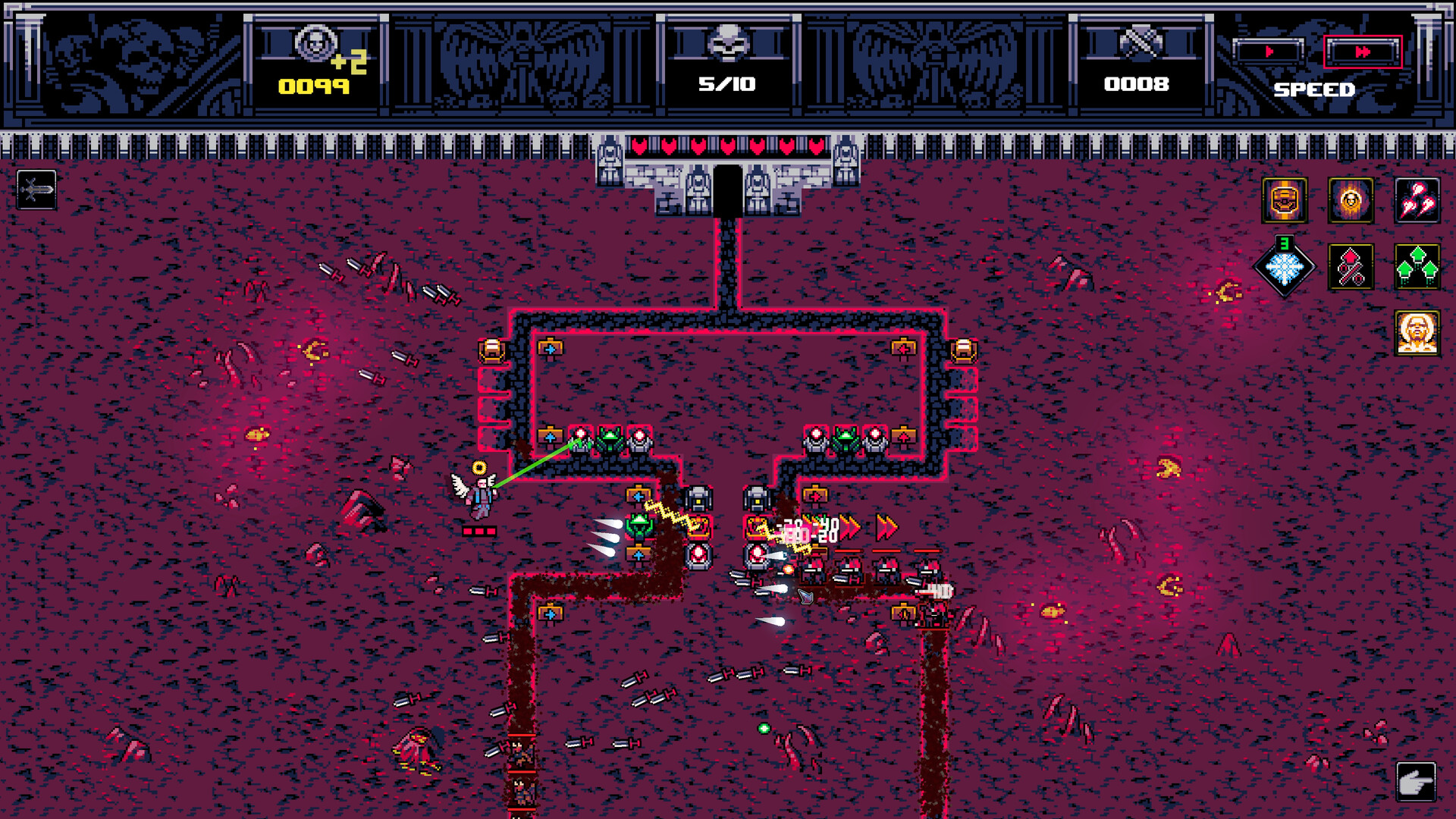
I should be clear about the friction, because it is real and it is not a footnote you hide after the score. Otherwar looks like a game that was built by a small Polish shop that wanted a mash-up more than a showcase, then discovered the mash-up was a whole religion. Pixel landscapes can be handsome. Animations can be stubborn. A smite can arrive a half-second late to its own impact. The campaign can shrug when you ask it for a tenth map. I will not invent a frame census. I will say heaven sometimes forgets to stock the length you want and then shrugs like weather.
Technical manners on a six-dollar build can stutter when a late stage decides to be a theology problem. Projectiles can get philosophical in a lane. Towers can feel like they are thinking about the job. None of that is unique to this flood. All of that is the tax on an indie hybrid that launched on Steam in February 2023, picked up a Switch landing in 2024, and is still walking onto new living rooms in 2025 and 2026.
The developers wrote the terms with the candor of a shop that has already lost the argument with a triple-A budget. Nine levels. Ten towers. A skill tree. Three biomes. Pixel art that would rather be classy than fashionable. That sentence is both a promise and a warning. If you want a polished fifty-hour career, you should look elsewhere. If you want a place that is already a place, you are the audience.
Presentation is readable, which matters more than prestige. You can tell a hell lane from a swamp lane from a forest lane at a glance. If you cannot read a biome, the hunt dies and the halo becomes homework. These spaces are atmospheric enough to carry a scare and clear enough to carry a plan. You always know where you are. You do not always know why a necromancer is already there.
English is the Steam language with German, Polish, French, Italian, and Portuguese from Brazil sitting beside it, which is how a wider audience gets in the door. Full controller support is on the sheet. Steam Cloud, trading cards, and a DualSense line item live there too. I will not turn this into a localization seminar. The voice of the game is the horde, and the horde talks in eyeballs, webs, and the occasional mechanical knock from a tower that has decided to be useful.
Mixed Weather on a Six-Dollar Gate

I have a rule for cheap hybrids. If a game is worse with a purpose than with a checklist, it is broken. If it is only good with a purpose, it is honest. Otherwar is honest, and that honesty should sit next to the price.
A checklist night is a competent weekend. You punch the wave, you invent the kitchen of towers, you lose a lane, you fly back, you put a better lock on the joke. A purpose night is the version the systems were quietly designed around. Someone farms gold. Someone intercepts. Someone learns, too late, that a necromancer does not respect architecture. The field becomes a shared instrument you play with yourself instead of a commute.
The Steam sample around a game this small is always going to look like weather. Mixed is the official English report, 61 percent of 77 voices, and the wider sample is 85 positive of 123, which is a softer rain and still not a parade. That split is fair. Players who wanted a deeper campaign, a prettier late hour, or a resource economy that never hides the dual-attention tax bounce off. Players who wanted a tower defense with a halo and a bad idea about bullet hell stay. I am in the second camp with caveats, which is the only honest place to stand.
Compared with the giants of the deserted-lane business, Otherwar is not trying to be a career you finish this month. It is trying to be a place you keep returning to for one more clean gate. The developer said the quiet part on the store page. Carry your light into the dark. Fun if you will meet the game where it lives. That is not a cop-out if the place is worth the flight. Some nights it is. Some nights the intercept tower is a myth and the necromancer is a theology problem. Both nights are Otherwar.
The price is the other honesty. $5.99 is not a dare and it is not a tip jar. It is a shop asking you to pay for nine puzzles, ten towers, and a halo that has a job. Studio Secrets, Chronicles of Creation, and the Crafting Compendium sit beside the base game if you want the scrapbook. I did not need the scrapbook to understand the joke. I did need the joke to understand why a Mixed sample and a recommendation can live in the same paragraph.
Still Standing at the Gate

Otherwar is a rare cheap hybrid that understands its own joke and then has the nerve to make the joke a halo. kantal collective built a field about purpose, a gate about teamwork you do with a tower, and a toybox that looks a little homemade and plays a lot more sincerely than that sentence suggests. The loop is the hook. The projectiles are the spine. The walk from a first eyeball to a last necromancer is the grin.
It is better with a purpose than with a checklist. The late maps can clunk in the way a small scrap is clunky. The campaign can feel like it ended while you were still inventing a personality. The presentation has indie fingerprints, from the stubborn animations to the story that would rather be a lane than a cutscene. All of that is true, and all of that is already priced in at $5.99 on Steam. You are not buying a decade. You are buying a season that can turn into a couple of long nights if you like being a coordinated disaster, or being the person who has to explain the disaster to a slowing field.
I am scoring it 8, Great, because the identity is this clear and the limitations are the limitations of a focused hybrid, not an empty one. I would recommend it to anyone who likes a workbench that has wings and a map that is allowed to be rude. Distinctive pixel weather, a halo that shrinks the battlefield, a gate that turns salvage into conversation, and a price that respects a long evening are a lot of game for the ask. The systems repeat their manners. The manners are still useful.
The horde is still out there, still hiring a night shift, still asking what heaven was. After a few clean gates, you will understand why the job is not finished, and why you keep waking up under the halo anyway.
We prepared this review with a digital copy of Otherwar for the PS5 version provided by Pressengine.