
There is a particular kind of invitation, rare in a genre that usually hands you a white coat and a clean conscience, in walking into 1923 as a journalist and discovering that the entire product is a patient file that would like you to be a doctor. The wards are still wards. The chart is still a chart. The first treatment that tries to teach you a lesson is not a metaphor. Sanatorium, the card-driven workplace adventure from Zeitglas, is built on that paper, and the paper is ruder, older, and more useful than a thirteen-dollar asylum has any right to be.
I played the PC version, the 6 November 2025 launch at $12.99 that Shoreline Games walked onto Steam after a demo that already knew how to lay a symptom on a chart. You arrive as a weary journalist with debt and a drifting purpose. A cryptic message from a childhood friend points to Castle Woods Sanatorium. Official copy asks you to diagnose and treat patients with a deck of symptoms, tests, and outdated therapies, then warns that one wrong move could expose you as an impostor. Thirty Steam achievements sit behind the wards. The English Steam sample is Mixed, 69 percent of 149, with 227 reviews across languages, which is the honest weather of a first game that would rather be a thought experiment than a comfort. Great, not gentle, and very much a week I would recommend you spend if you like a workplace loop that knows it is a moral problem.
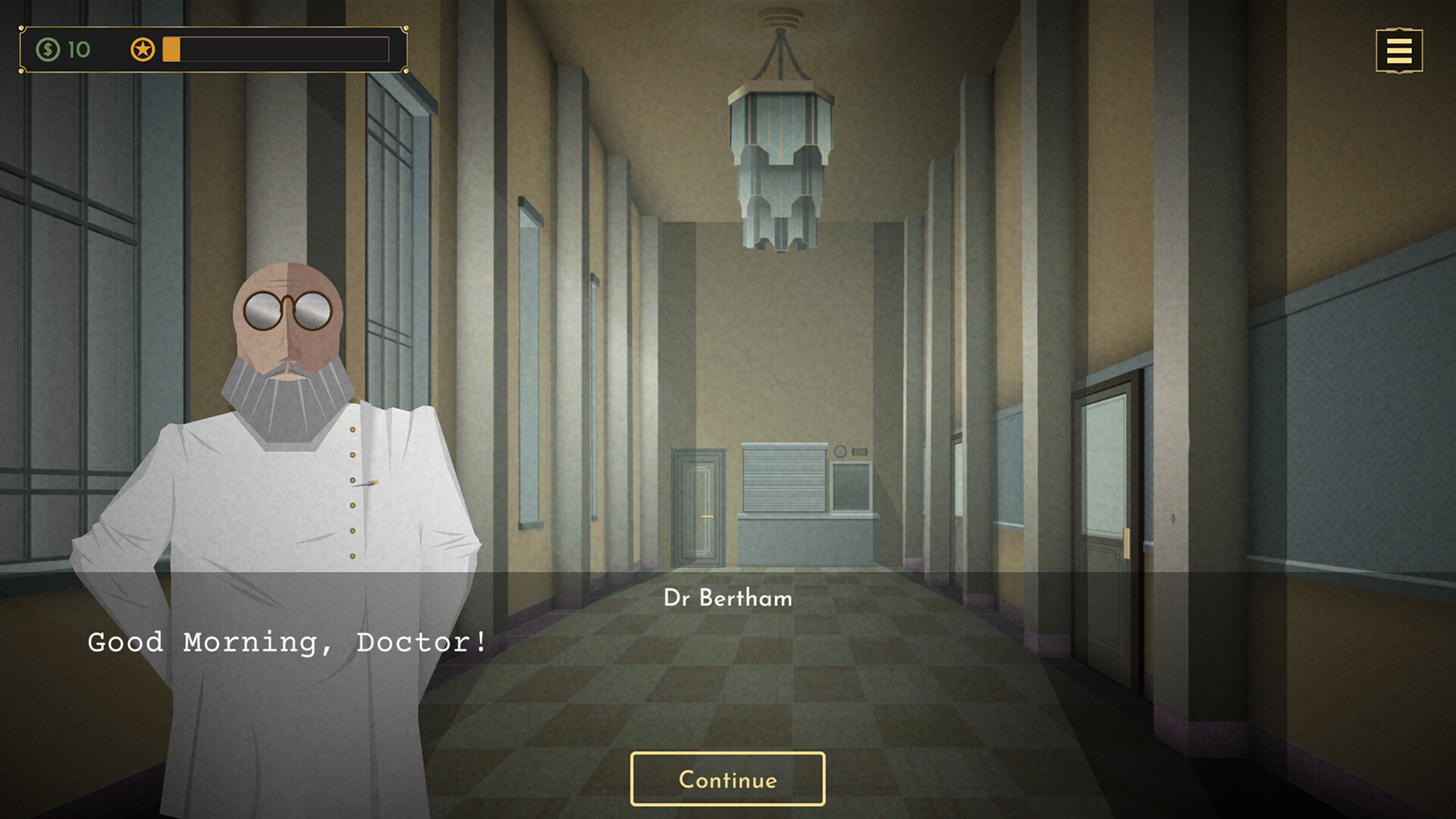
Castle Woods Does Not Care What Care Was
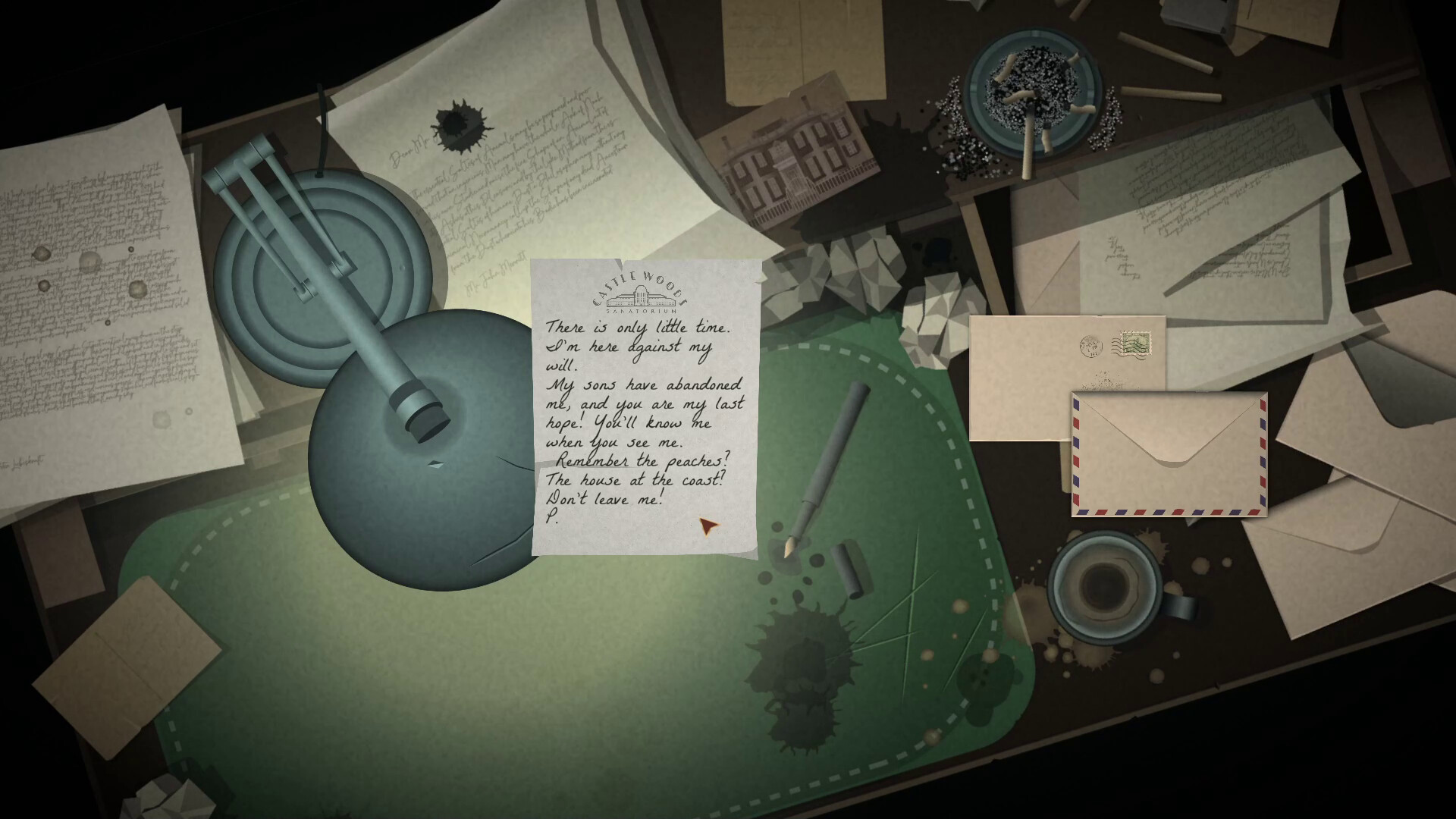
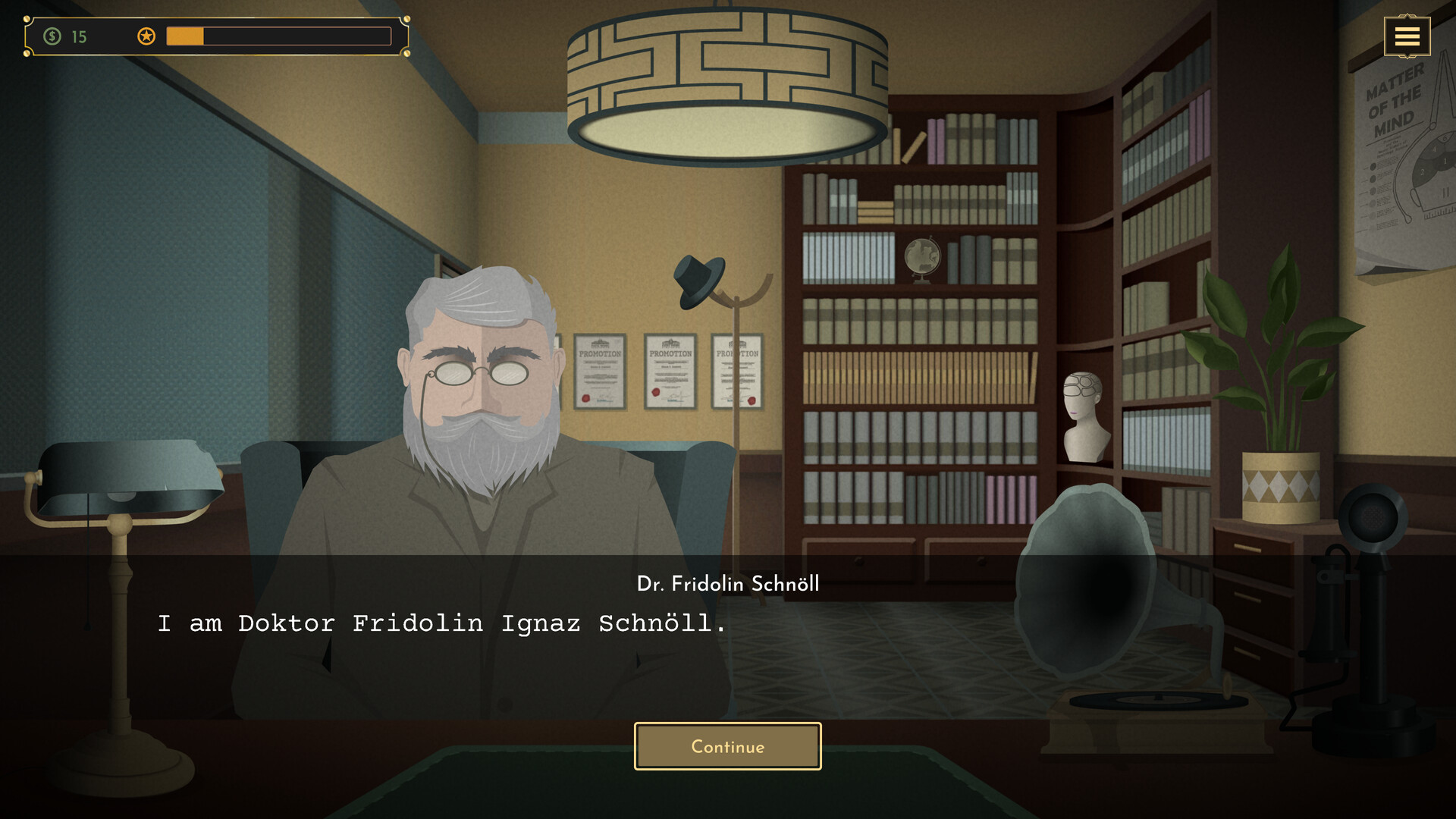
Most medical games begin with a speech. Sanatorium begins with a file. Official copy on Steam says it is the roaring twenties, an age of technological progress and social upheaval, then asks you, with the grammar of a person who has already lost the upright life, to pack a bag and set out for Castle Woods. You are a journalist pretending to be a graduate. You are also, if you read the studio’s own site, a relative trying to get Auntie Patty home. That is not flavor text. It is the design refusing to pay for a cinematic when a chart will do.
You start diagnosing because the alternative is becoming a rumor in a place that does not keep rumors about staff. The first stretch is staged like a punchline that forgot to be funny. A patient file arrives. Symptoms hide. Tests reveal some of them and misread others. A treatment sits in your hand like a dare. The script, still on the desk and still a little breathless, asks whether you want to be kind or cruel, business savvy or risk-taking. Nobody can assure either path will save you. That is the rest of the map.
I like a premise that prices curiosity as a hazard and then lets you walk toward it anyway. Helpless patients, ruthless opportunists, and the usual institutional hospitality sit on the wards like questions with locks. Why are there treatments and so little care. What was that boiler room. The more you work, the more the house answers with another file and another thing that would like a piece of your cover. Story is environmental and stingy, which is the right instinct for a game that wants your hands more than your diary. You are not reading a novel. You are looting a disaster that is still happening, and the disaster has a letterhead.
The fantasy is not mastery of a lore bible. The fantasy is competence arriving about half a week after you invent a reason to keep the diploma in the drawer. You will fail in ways that would be funny if the file were not so sincere. You prescribe. You wait for review. You become the kind of person who thinks a chart is a personality.
Diagnose the File, Then Invent a Treatment
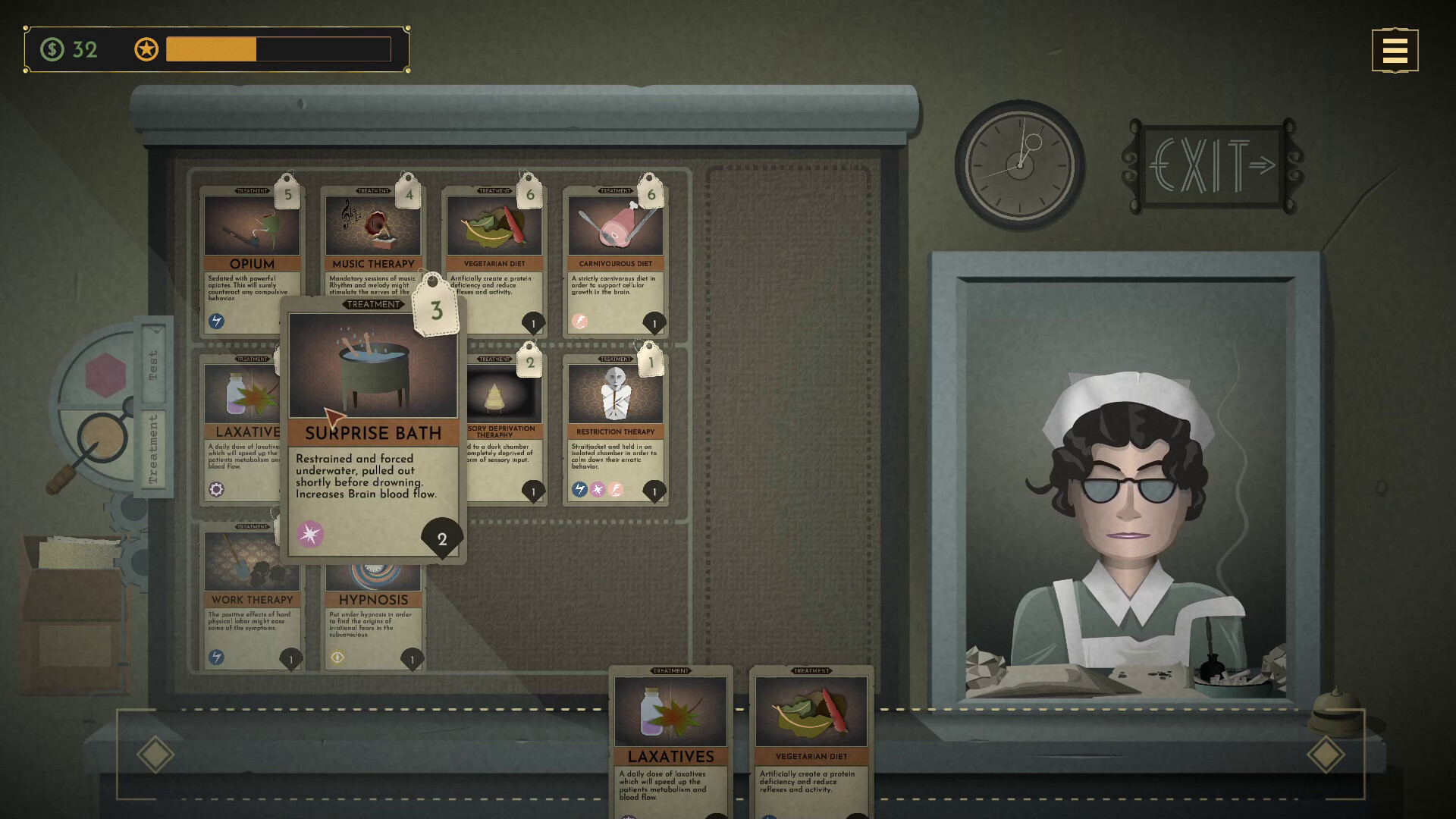
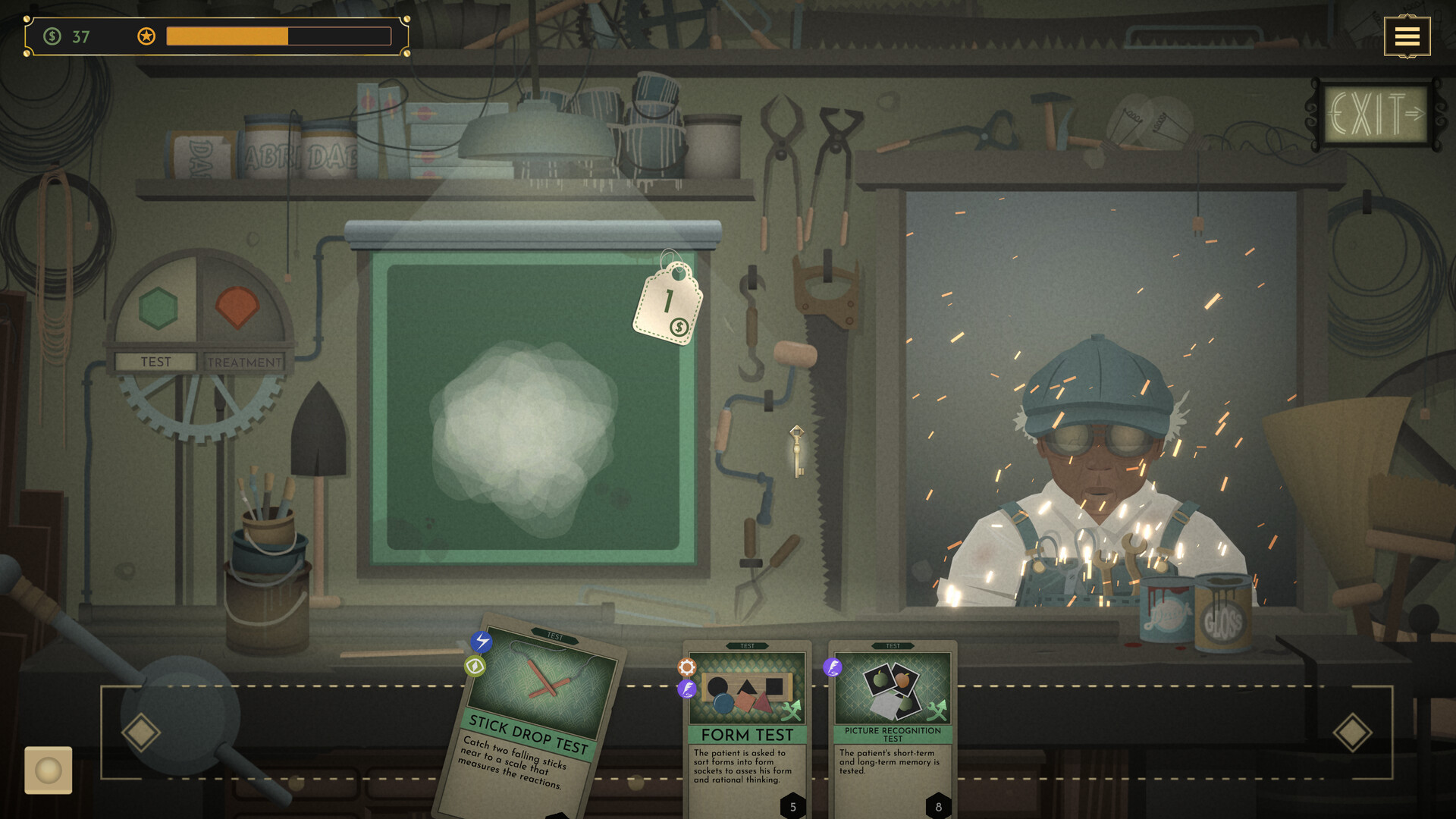
The loop is the old religion and Zeitglas does not pretend otherwise. Every week, new patient files present new puzzles. You decide which tests to use to uncover symptoms and which treatments you prescribe to cure them. You may follow the rule book. You may try experimental methods with unknown outcomes. None of that is a revolution in the abstract. All of that is the sentence the rest of the toybox has to live in.
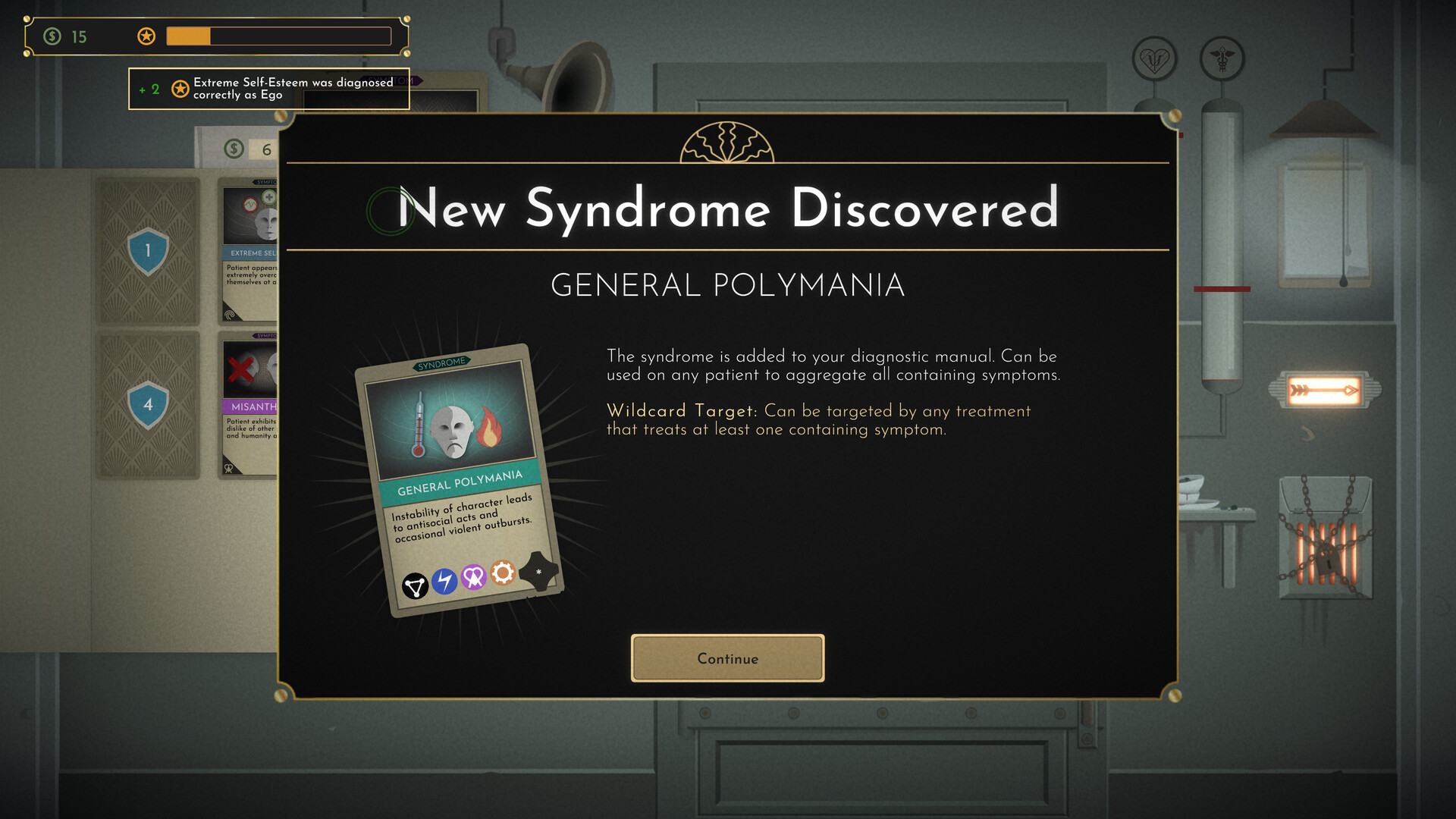
Card play is physical in the way a good desk is physical. You are not only drowning in menus. You are looking at a layered set of cards and deciding whether you have been useful enough today. Files unfold as symptoms hidden, revealed, and misinterpreted through the limited knowledge of 1923. Official features put it plainly. Every patient is a puzzle. Over 100 cards chart symptoms, illnesses, tests, and treatments drawn from the unsettled history of psychiatry. That number is both a promise and a warning. If you want a clinic that never asks you to live with an outdated tool, you will feel underemployed. If you want a campaign that turns a forged diploma into a week of work, you will feel hired.
I have played a lot of games that treat the first case as a tutorial and the hundredth case as a spreadsheet. Sanatorium is heavier than that on purpose. Official copy says you may diagnose, treat, or withhold, and that both compassion and cruelty carry consequences. That sentence is the joke the whole house is telling. Without a diagnosis, the file is a rumor. Without a treatment, you are a tourist. Without a cover, you are finished. The trailer says the quiet part out loud. Join us, become a part of this wonderful team, and kindly do not go digging.
Dynamic moral management is the other half of the pitch. Evolve your plan toward more humane practices, or double down on methods that protect your cover at any cost. I left the kind path on for an evening and the careful, colder path on for another. The wards did not mind. The supervisors minded either way.
Cards, Charts, and a Cover That Matters
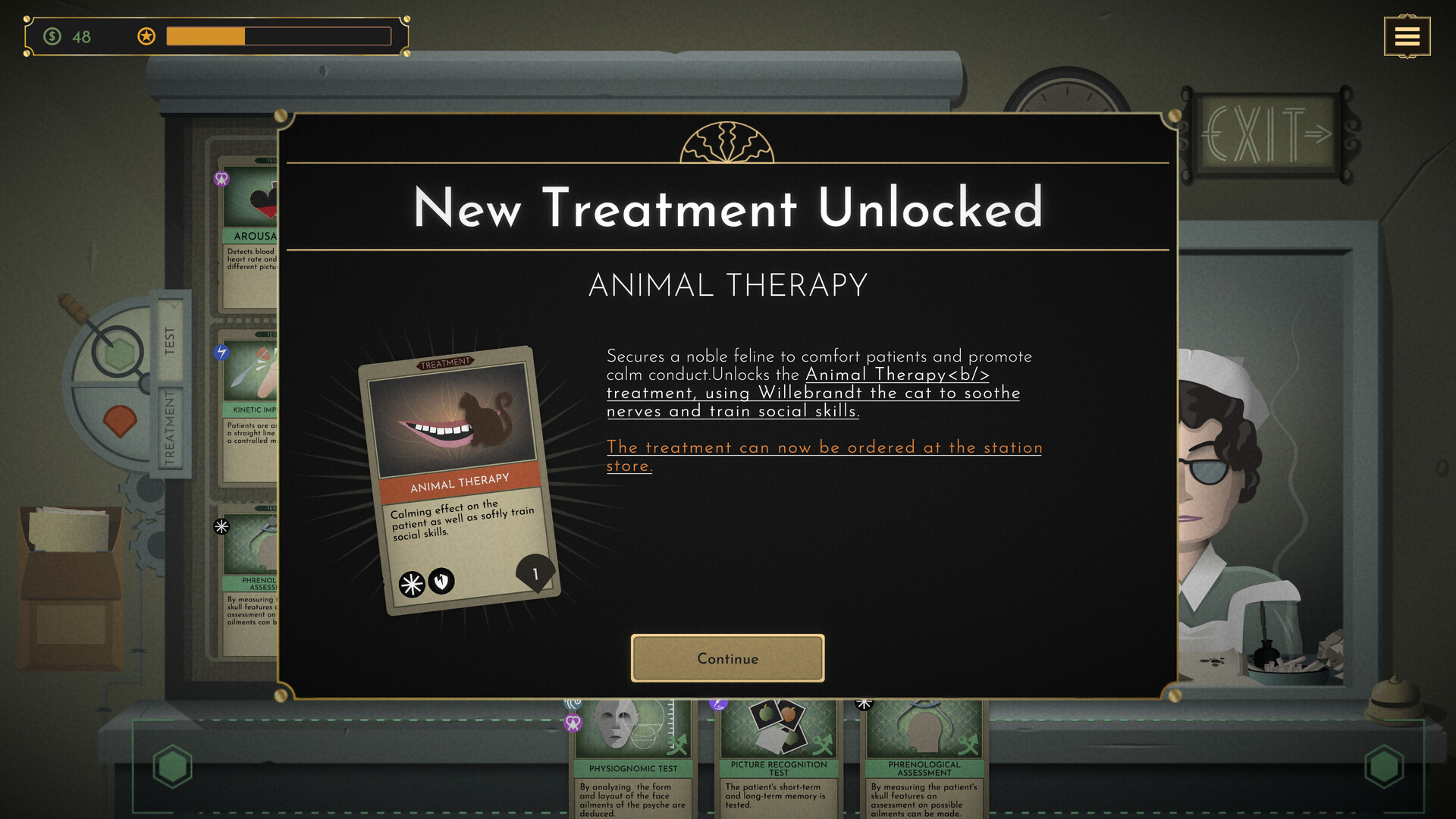
Paper is the temperature change. Early files establish that this is not a peaceful hospital simulator with nicer lighting. A wrong test will chase your patience farther than pride would recommend. A chart handles the general population of problems. The later, nastier rooms will empty a reputation if you treat them like scenery. Further in, the house would like a word, and the word is short. Getting a treatment with actual manners takes a while. Until then, an archaic card is a strategy, not a cowardice.
The cover is the other half of the short description and the kinder half of a week. Official features ask you to step into the role of a doctor in 1923, where every action is bound by the outdated tools and beliefs of the era. The mission is not paperwork for its own sake. It is a continuation of a lie you told at the gate. That shift is the closest Sanatorium comes to a power fantasy, and I like it more than a new test. Mastery, here, is logistics. You gather clues. You stash prestige. You walk a ridiculous little corridor over a place that tried to eat your story last week, and you sit like a person who has mail. The map does not get smaller because the developers deleted rooms. It gets smaller because you invented commuting between a desk and a secret.
A supervisor will review your work if you would like the fantasy of purpose without a town. Clues and characters will take the junk you have been tripping over and turn it into a history. Those two voices keep the house from feeling like a documentary that learned to punch. They are not a city. They are a reminder that someone else survived long enough to leave a note. I sold kindness I was sure I needed and then needed it, which is the oldest workplace joke in the book and still a good one.
I will not invent a highlight reel with fake timestamps and tidy cure counts. The nights that stay with you are the ones where you thought the chart was finished, then something in the file started knocking in a rhythm that was not weather, and then you were on the wrong side of your own diagnosis. Treatment can feel like two cards agreeing to take turns being disappointed. That clunk is real. It is also priced into a workplace loop that would rather you test, retreat, and come back dressed in a better theory. Distance helps. A working cover helps more.
Wards, Prestige, and the Mystery Getting Closer
Pressure is the variety. A file that holds is a better reward than a new silhouette if the silhouette is just another way to lose a diploma. Hunting clues is good practice and a grocery run. Rehabilitation, nervous illnesses, asocials, the criminally insane, the usual institutional hospitality. Official achievements name the wards without blushing. Ward 1 through Ward 4 sit on the campaign like floors in a building that has already decided what you are. Sparks happen. The store page is not shy about it. What the store page cannot tell you is how quickly you will start treating a successful diagnosis as a mood stabilizer. You eat prestige. You drink prestige. You put the card down and look at Auntie Patty like a person who has decided family is a case.
The world has history if you will walk toward it. Official features list a full campaign across four chapters, branching paths, and multiple endings. Your decisions shape not only patients’ outcomes, but your own fate as an impostor. The story is uncovered through places, files, characters, and the remains of a house that tried to outlive its own methods. I like a map that prices curiosity as a hazard and then lets you walk toward it anyway. Some rooms are handsome. Some rooms are a commute. Both rooms are the job.
Thirty achievements sit behind the loop for people who like a receipt. Names like Welcome to Castlewoods, Hercule Docteur, The Boiler Room Enterprise, Getting warmer, Family reunion, and Whaddya Gonna Do? tell you the shop has a sense of humor and is not ashamed of it. None of them change the central truth. You are here to keep a cover and then find out what the cover is for.
Handmade by Design, Rough by Habit
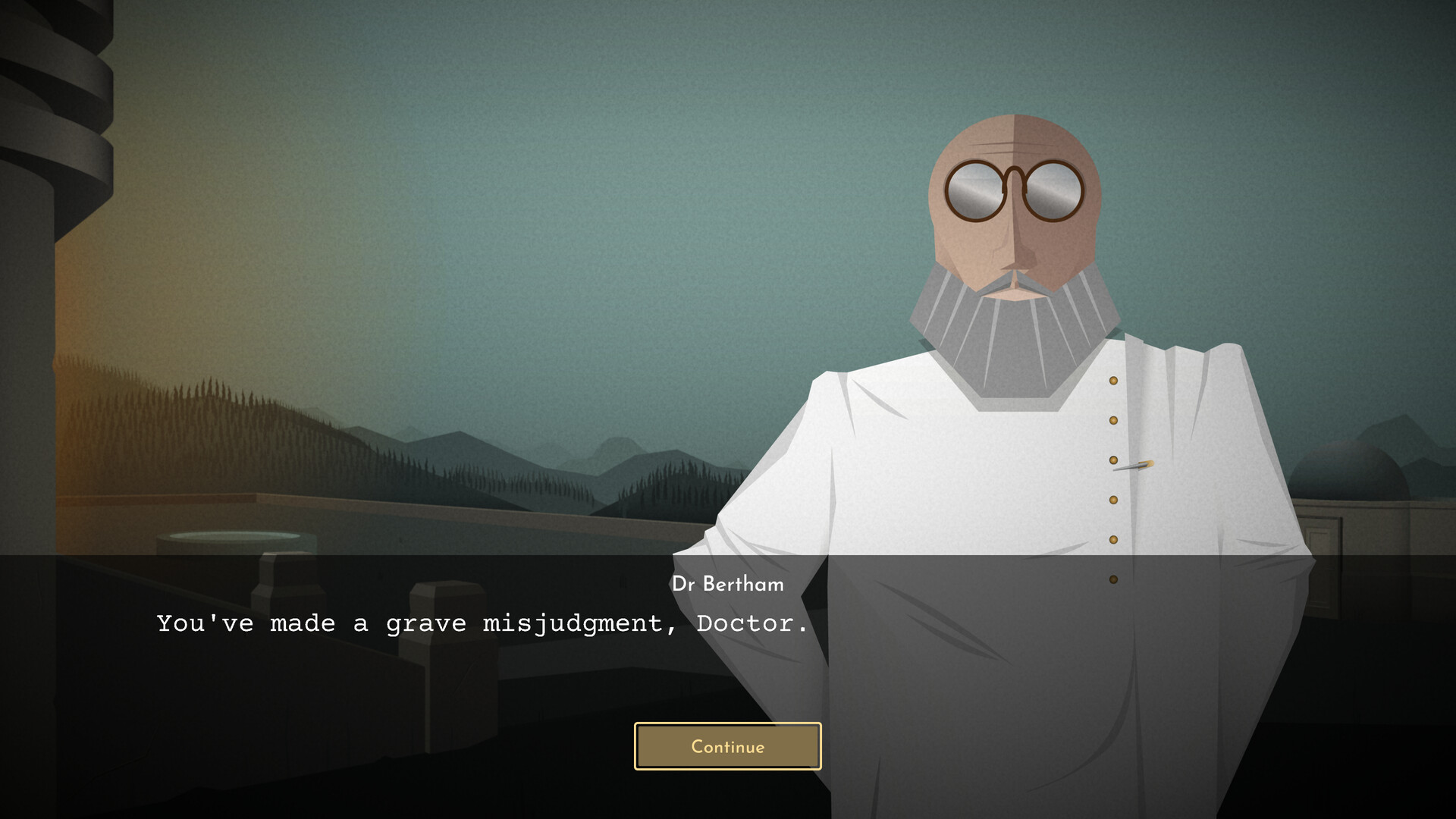
I should be clear about the friction, because it is real and it is not a footnote you hide after the score. Sanatorium looks like a game that was built by a two-person Swiss shop that wanted a thought experiment more than a showcase, then discovered the thought experiment was a whole hospital. Zeitglas started the idea as a bachelor project and kept it. Landscapes of paper can be handsome. Animations can be stubborn. A diagnosis can arrive a half-second late to its own insight. Performance can sulk when a late chapter decides to remember itself. I will not invent a frame census. I will say the house sometimes forgets to stock the smoothness you need and then shrugs like weather.
Technical manners on a desktop build can stutter when a late-game file decides to be a theology problem. Cards can get philosophical in a doorway. Reviews of your work have a way of announcing themselves. None of that is unique to this asylum. All of that is the tax on a first 1.0 that launched in November 2025 and is still hiring in 2026.
The developers wrote the terms of the fiction with the candor of a shop that has already lost the argument with a textbook. This is not a teaching tool. Official language calls it a stylized commentary on how mental health was understood a hundred years ago, presented through historical critique rather than endorsement. Content warnings sit on the store page without winking. Outdated psychiatric practices. References to addiction, self-harm, suicide, abuse, and violence. That sentence is both a promise and a warning. If you want a polished clinic, you should wait. If you want a place that is already a place, you are the audience.
Presentation is readable, which matters more than prestige. You can tell a ward from a desk from a secret at a glance. If you cannot read a file, the hunt dies and the house becomes homework. These spaces are atmospheric enough to carry a scare and clear enough to carry a plan. You always know where you are. You do not always know why a supervisor is already there.
English is the Steam language with a long list of interface cousins, French, German, Spanish, Japanese, Korean, Brazilian Portuguese, Simplified Chinese, Italian, and Russian, which is how a wider audience gets in the door. Mouse-only play is on the sheet. Custom volume controls, Steam Cloud, and a campaign you can sit with without a timer are on the sheet too. I will not turn this into a localization seminar. The voice of the game is the house, and the house talks in cards, reviews, and the occasional institutional knock.
Better With a Conscience Than With a Checklist
I have a rule for mid-priced workplace toys. If a game is worse with a conscience than with a checklist, it is broken. If it is only good with a conscience, it is honest. Sanatorium is honest, and that honesty should sit next to the price.
A checklist night is a competent weekend. You punch the file, you invent the chart, you lose a cover, you walk back, you put a better lock on the joke. A conscience night is the version the systems were quietly designed around. Someone farms prestige. Someone withholds. Someone learns, too late, that a supervisor does not respect kindness. The house becomes a shared instrument you play with yourself instead of a commute.
The Steam sample around a game this pointed is always going to look like weather. Mixed is the official report, 69 percent of 149 English voices, 61 percent of 227 across languages, and that split is fair. Players who wanted a deeper scrap, a prettier frame rate, or a card economy that never hides the paperwork bounce off. Players who wanted an impostor lie with a desk and a bad idea about care stay. I am in the second camp with caveats, which is the only honest place to stand.
Compared with the giants of the papers-and-stamps business, Sanatorium is not trying to be a career you finish this week. It is trying to be a place you keep returning to. The developer said the quiet part on the store page. Four chapters. Branching paths. Multiple endings. Fun if you will meet the game where it lives. That is not a cop-out if the place is worth the walk. Some nights it is. Some nights the chart is a myth and the doorway is a theology problem. Both nights are Sanatorium.
Still Standing After Visiting Hours
Sanatorium is a rare mid-priced workplace adventure that understands its own joke and then has the nerve to make the joke a hospital. Zeitglas built a house about purpose, a file about teamwork you do with a lie, and a toybox that looks a little homemade and plays a lot more sincerely than that sentence suggests. The loop is the hook. The cards are the spine. The walk from a forged diploma to a secret is the grin.
It is better with a conscience than with a checklist. The late rooms can clunk in the way a first game is clunky. Performance can sulk. The presentation has indie fingerprints, from the stubborn paper to the story that would rather be a file than a cutscene. All of that is true, and all of that is already priced in at $12.99 on Steam. You are not buying a decade. You are buying a season that can turn into several evenings if you like being a coordinated disaster, or being the person who has to explain the disaster to a supervisor.
I am scoring it 8, Great, because the identity is this clear and the limitations are the limitations of a focused debut, not an empty one. I would recommend it to anyone who likes a desk that has weight and a map that is allowed to be rude. Distinctive ward weather, a cover that shrinks the house, a file that turns salvage into conversation, and a price that respects a long week are a lot of game for the ask. The systems repeat their manners. The manners are still useful.
The house is still out there, still hiring a night shift, still asking what care was. After a few reviews of your work, you will understand why the job is not finished, and why you keep sitting down at the chart anyway.
We prepared this review with a digital copy of Sanatorium for the PC version provided by Pressengine.