There is a particular kind of invitation, rare in a genre that usually hands you a magnet and a cheerful auto-attack, in taking a sword in both hands and discovering that the entire product is a hunger that used to be a sea. The village is still a village. The blade is still a blade. The first thing that crawls out of the water is not a metaphor. Hordes of Hunger, the 3D action survivors-like arena-slasher from Hyperstrange and Kwalee, is built on that hunger, and the hunger is ruder, heavier, and more useful than a fifteen-dollar flood has any right to be.
I played the PC version, the 12 February 2026 1.0 launch at $14.99 that Hyperstrange and Kwalee walked out of a Steam Early Access that began on 6 May 2025 after a demo that already knew how to swing. You take control of Mirah. You defend a homeland the sea has already eaten. You rescue others from the onslaught. Fifty Steam achievements sit in the ash. The English Steam sample is Mostly Positive, 115 of 152, with 200 positive of 263 across languages, which is the honest weather of a crowded genre and not a dare. Great, not glossy, and very much a night I would recommend you spend if you like a survivors-like that remembers it is also a fight.
The Sea Does Not Care What the Village Was
Most horde games begin with a smirk and a cheerful sprite. Hordes of Hunger begins with a flood. Official copy on Steam says the Beast and its ravenous hordes emerged from the sea and stripped the land bare, then asks you, with the grammar of a person who has already lost the upright life, to stand as Mirah and save what is left. That is not flavor text. It is the design refusing to pay for a chosen-one speech when a village will do.
You start swinging because the alternative is becoming a rumor in a place that does not keep rumors. The first stretch is staged like a punchline that forgot to be funny. You stand. The crowd thinks about it. Something with too many teeth thinks about you. The script, still in third person and still a little breathless, asks you to hold the line. Nobody will hold it for you. That is the rest of the map.
I like a premise that prices curiosity as a hazard and then lets you walk toward it anyway. Official store language names a father racked with guilt, a prisoner who shuns freedom, and a cook covered in blood. Mirah may be the only one who can save her home, but she is not alone if you will do the work of pulling other people out of the weather. Story is environmental and stingy between those voices, which is the right instinct for a game that wants your hands more than your diary. You are not reading a novel. You are looting a disaster that is still happening, and the disaster has a keep.
The fantasy is not mastery of a lore bible. The fantasy is competence arriving about half a run after you invent a reason to mix a light swing with a dodge that has somewhere to land. You will die in ways that would be funny if the restart were not so sincere. You leave your build. You walk back to the Sanctum. You become the kind of person who thinks a Forge part is a personality. Hyperstrange already made Blood West, which is a polite way of saying the Warsaw shop already knew how a swing should feel. If you want a magnet that does the violence for you, you will feel overemployed. If you want a weekend that turns a blade into a plan, you will feel hired.
Take Up Arms, Then Invent a Build

The loop is the old religion and Hyperstrange does not pretend otherwise, then it straps a sword to the religion and asks the religion to think. You enter an arena. Waves arrive. Experience drops. A level-up offers three possible boons. Some add damage types. Some apply buffs when a trigger is met. A handful offer long-term stat growth for every later level. None of that is a revolution on the paper. All of that is the sentence the rest of the toybox has to live in.
What makes Hordes of Hunger a fight instead of a costume is the second job. Official copy is not shy about it. Create your loadout from a range of weapons and special attacks, then gain new abilities in each run to fine-tune your build. The practical sentence is simpler. You swing. You dodge. You parry. You spend Focus on a heavy that has to be earned by hitting things. A special attack charges on its own clock and would like you to save it for the moment the screen becomes a committee. Until then, positioning is a strategy, not a cowardice.
I have played a lot of games that treat the first wave as a tutorial and the hundredth wave as a spreadsheet. Hordes of Hunger is heavier than that on purpose. Official features list dozens of skills per run, a Forge that will take parts out of chests and rewrite a weapon, and a Sanctum that remembers you even when the field does not. Rescue people during a run and they join the hub. A Kitchen will cook meals that last one incursion. Feathers, the Sanctum currency, turn a failed night into a slightly less failed morning. I spent Feathers I was sure I needed and then needed them, which is the oldest meta joke in the book and still a good one. If you want a pure arena that never asks you to cook a meal, you will feel employed by a realtor. If you want a weekend that turns a ruin into a keep, you will feel hired.
Dynamic loadout work is the other half of the pitch. Before a run you pick the weapon and the special that will have to live with your mistakes. A nimble sword for the general population. A heavy hammer for the thing that would like you to stand still. A spear if you would like dinner to start at a polite distance. The 1.0 shop added a Scythe that treats a crowd like a crop. I left the greedy path on for an evening and the careful path on for another. The horde did not mind. The late rooms minded either way.
Swords, Hammers, and a Parry That Matters

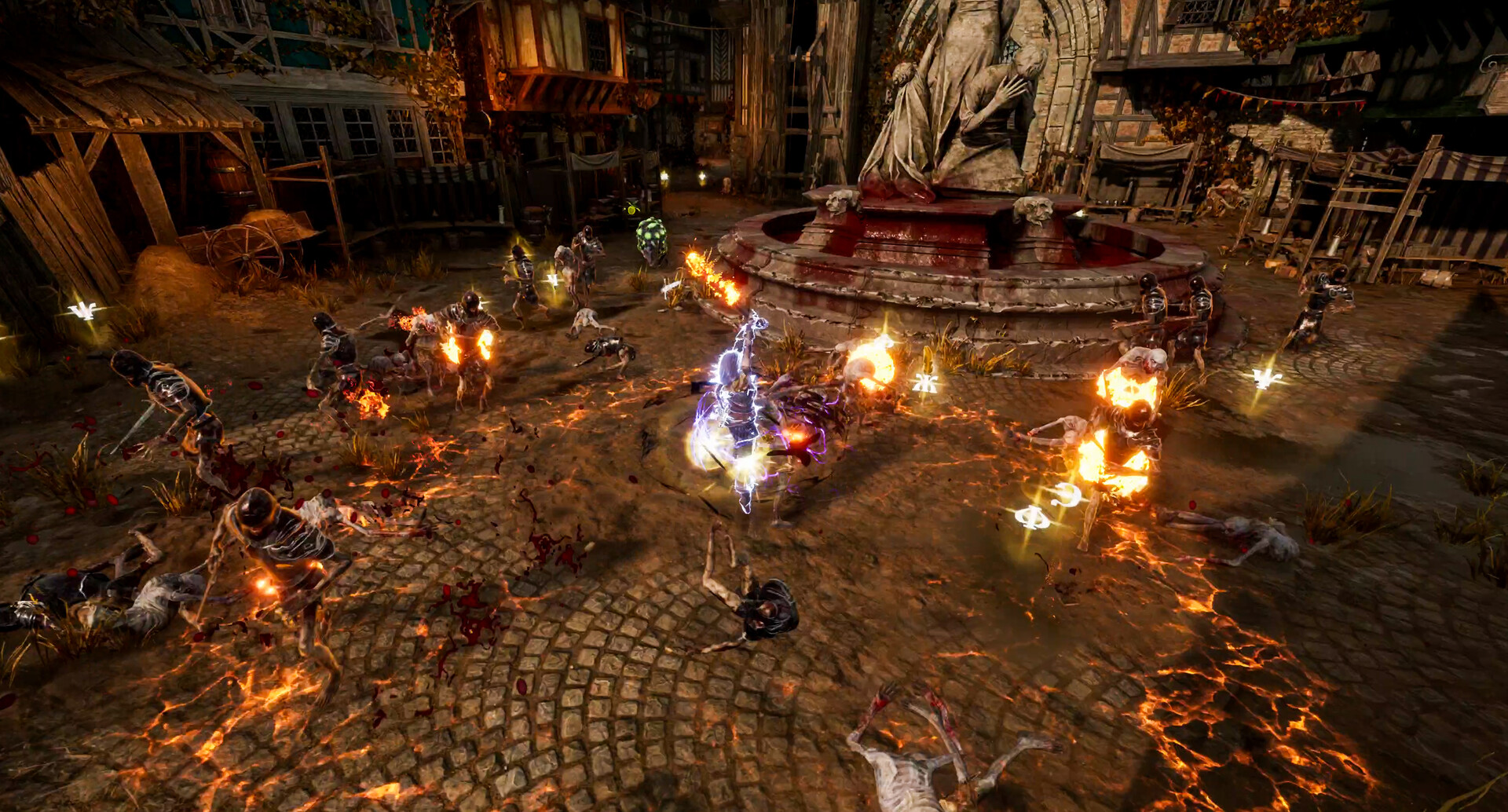
Combat is the temperature change. Early beasts establish that this is not a peaceful walking tour with nicer lighting. They will fill a lane farther than pride would recommend. A starter swing handles the general population. The evolved, exploding, leaping editions will empty a health bar if you treat them like scenery. Further in, a guardian would like a word, and the word is tall. Getting a parry with actual manners takes a while. Until then, a sidestep is a strategy, not a cowardice.
The parry is the other half of the short description and the nastier half of a run. Incoming attacks arrive with a closing circle. A perfect answer is a golden beat. A late answer is about two seconds of recovery that feel like a sermon. Official copy never needed to write that sentence. The design wrote it with your stamina bar. I will not invent a highlight reel with fake timestamps and tidy parry counts. The nights that stay with you are the ones where you thought the timing was finished, then something started writing in a rhythm that was not weather, and then you were on the wrong side of your own recovery.
Weapons do different jobs. A sword walks you across a clearing with a string of light hits if you hold the button like a person who has mail. A hammer asks you to commit. A spear keeps a little sky. The Scythe mows. Forge parts found in chests can rewrite the animation set and the stats, which is a polite way of saying the toybox can grow a brain if you keep showing up. Official store language adds a sword aflame, lightning on a landing, and divine contracts if you would like dinner to stop being a grocery run. I swapped and stayed swapped. Differentiation is real enough that a night with the wrong tool feels like wearing someone else’s coat.
Stamina is a personality. Focus is a personality. The Vampire habit, life back on a kill, becomes almost a second job on Nightmare and Hell, where enemies pick up elemental immunities and the crowd learns to shout. That rigidity is real. It is also priced into a 1.0 that would rather you have a plan than a magnet. Distance helps. A working dodge helps more.
Village, Castle, and a Mountain That Gets Smaller

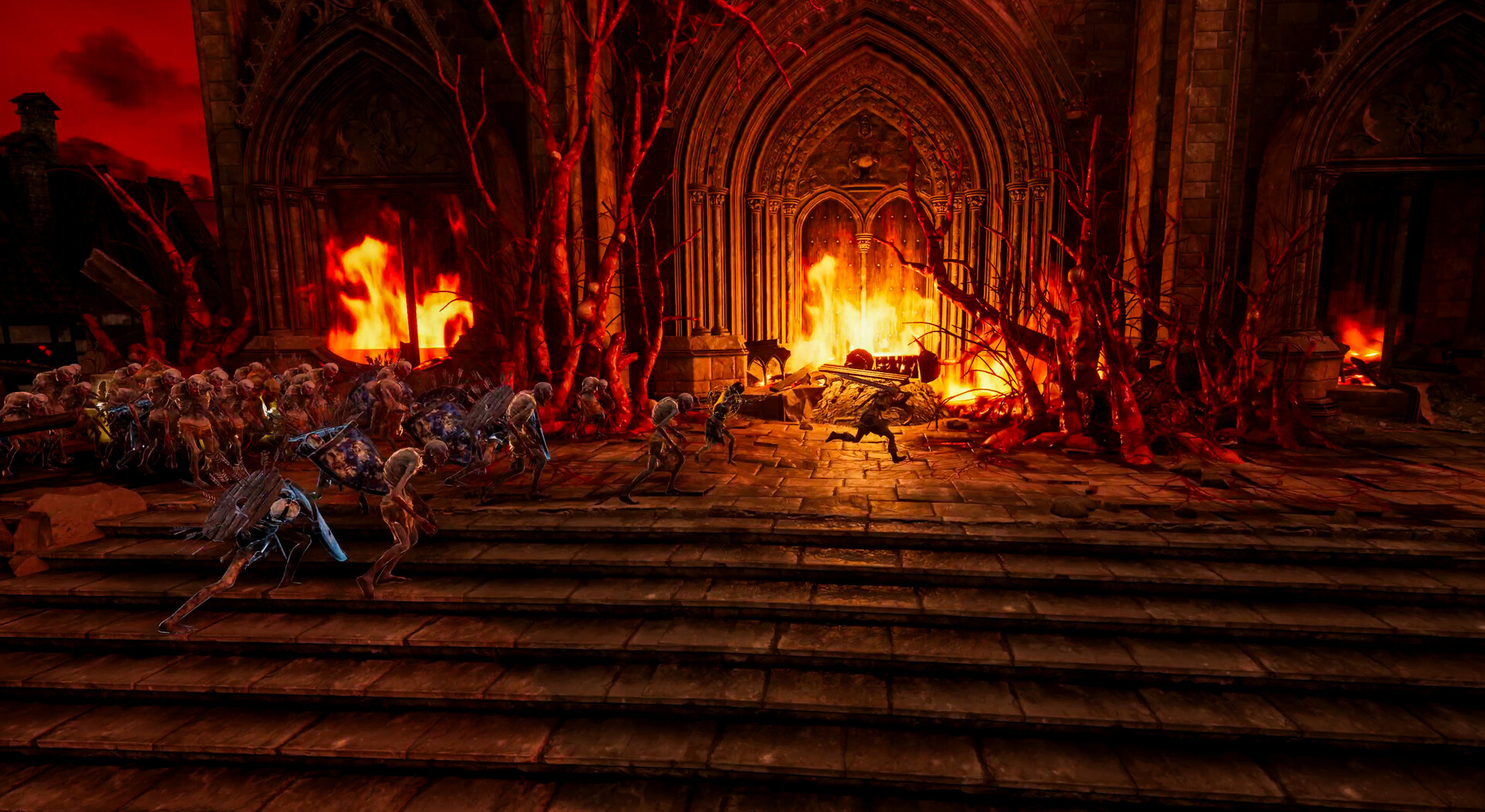
Pressure is the variety. A lane that holds is a better reward than a new silhouette if the silhouette is just another way to lose the run. Hunting the right tool for the right monster is good practice and a grocery run. Official features list multiple 3D levels, each with unique quests and enemy types. Version 1.0 finished the geography. Ruins of the Village. Castle Walls. Mountain Fortress. Three biomes, nine arenas if you will finish every quest in a single sitting, and a final encounter that would like a receipt.
The village is the commute and the introduction. Desolate remains, breakable structures, high ground if you will use it, choke points if you will invent them. Official copy asks you to fight smart and use the environment. That is not a slogan you put on a sticker. It is the design handing you a doorway and daring you to treat it like architecture. Some rooms are handsome. Some rooms are a commute. Both rooms are the job.
Castle Walls change the tense. Verticality becomes a theology problem. The camera, which is otherwise a competent cousin, can get philosophical in a stairwell and then shrug like weather. I will not invent a frame census. I will say a late fight in a tight keep can feel like two people agreeing to take turns being disappointed, and that the disappointment is sometimes the geometry rather than the horde.
Mountain Fortress is the other vehicle. Lava, rock-carved lanes, a map that reduces maneuverability on purpose. Procedural spawns in the third biome keep the commute from becoming a museum. Nightmare increases the crowd. Hell escalates those even further and hands guardians elemental immunities. Objectives during a run are the kinder half of the variety. Survive a wave. Destroy a nest. Escort a person who would like to live. The Sanctuary beat asks whether you will extract or risk the boss. I extracted like a coward and stayed like a person with mail.
Fifty achievements sit behind the loop for people who like a receipt. Names like I’ll get my revenge, Kill ‘Em All, Parry this, Faithful One, and You promised me poems tell you the shop has a sense of humor and is not ashamed of it. None of them change the central truth. You are here to hold a line and then find out what the line is for.
Active by Design, Grounded by Habit

I should be clear about the friction, because it is real and it is not a footnote you hide after the score. Hordes of Hunger looks like a game that was built by a shop that wanted a fight more than a showcase, then discovered the fight was a whole religion. Landscapes can be handsome. Animations can be stubborn. A swing can arrive a half-second late to its own impact when the screen decides to remember itself. Progression can sulk. Buying passive buffs and crafting weapons between runs can feel like a commute that forgot to be a grin. I will not invent a Feather census. I will say the Sanctum sometimes forgets to stock the inspiration you need and then shrugs like weather.
Technical manners on a desktop build can stutter when a late room decides to be a theology problem. Crowds can get philosophical in a doorway of particles. The camera can collide with a wall at the exact moment a golden circle would like your attention. A bright flash on a Sanctuary transition has a way of announcing itself. None of that is unique to this flood. All of that is the tax on a 3D horde that launched into Early Access in May 2025, hired all year, and walked onto 1.0 in February still wearing some of the same boots, plus a Scythe.
Presentation is readable, which matters more than prestige. You can tell a village from a keep from a mountain at a glance. If you cannot read a biome, the hunt dies and the Sanctum becomes homework. These spaces are atmospheric enough to carry a scare and clear enough to carry a plan. You always know where you are. You do not always know why a guardian is already there.
English is the Steam language with full audio, and a long list of interface cousins keep the door open. Full controller support is on the sheet. A demo if you would like to swing before you pay. I will not turn this into a localization seminar. The voice of the game is the horde, and the horde talks in circles, Feathers, and the occasional knock from a Forge that has decided to be useful.
The Steam sample around a game this loud is always going to look split. Mostly Positive is the official weather, 76 percent of 263 on the side of yes, 115 of 152 in English, and that split is fair. A crowded genre is a rude room. Hordes of Hunger does not pretend it invented the room.
Better With a Greedy Run Than With a Checklist

I have a rule for cheap-to-mid horde games. If a game is worse with greed than with a checklist, it is broken. If it is only good with greed, it is honest. Hordes of Hunger is honest, and that honesty should sit next to the price.
A careful night is a competent weekend. You pick the safe boon, you invent the kitchen of a build, you lose a bag of Feathers, you walk back, you put a better lock on the joke. A greedy night is the version the systems were quietly designed around. Someone forges. Someone parries. Someone learns, too late, that a Hell guardian does not respect architecture. The night becomes a shared instrument instead of a commute, even when you are the only person in the Sanctum.
Compared with the giants of the bullet-heaven business, Hordes of Hunger is not trying to be a magnet. It is trying to be a place where a swing still has a job. The developer said the quiet part on the store page. Vanquish an onslaught. Save others from the advancing hordes. Fun if you will meet the game where it lives. That is not a cop-out if the place is worth the walk. Some nights it is. Some nights the parry is a myth and the doorway is a camera problem. Both nights are Hordes of Hunger. $14.99 is not a dare. It is a shop asking you to pay for three biomes, a Forge, a voiced story, and a 1.0 that added Nightmare, Hell, and a Scythe. Players who wanted a deeper novel or a prettier late hour bounce off. Players who wanted a blade and a bad idea about doing the violence themselves stay. I am in the second camp with caveats, which is the only honest place to stand.
Still Standing After the Beast

Hordes of Hunger is a rare mid-priced survivors-like that understands the genre is a union and then has the nerve to apply with a sword. Hyperstrange and Kwalee built a night about a homeland, a Sanctum about upgrades, and a crowd that looks a little familiar and plays a lot more hands-on than that sentence suggests. The loop is the hook. The swing is the spine. The trip from a lonely blade to a keep that has furniture is the grin.
It is better with greed than with a checklist. The field can clunk in the way a busy screen clunks. The camera can sulk. Progression can feel like a commute. All of that is true, and all of that is already priced in at $14.99 on Steam. You are not buying a career. You are buying a weekend that can turn into several weekends if you like being a coordinated disaster, or being the person who has to explain the disaster to a Forge.
I am scoring it 8, Great, because the identity is this clear and the limitations are the limitations of a focused horde, not an empty one. I would recommend it to anyone who likes a swing that has weight and a map that is allowed to be rude. Distinctive grimdark weather, a parry that shrinks the horizon, a Forge that turns two parts into conversation, and a price that respects your week are a lot of game for the ask. The systems repeat their manners. The manners are still useful.
The sea is still out there, still hiring a night shift, still asking what the village was. After a few keeps, you will understand why the job is not finished, and why you keep waking up in the Sanctum anyway.
We prepared this review with a digital copy of Hordes of Hunger for the PC version provided by Pressengine.