Zoe is a triangle. That sentence should not work as a pitch, and yet it is the most honest way into ZOE Begone!, the debut from Glasgow animator Graeme Hawkins and his one-person studio Retchy Games. She is a little wedge of a heroine with one modest wish, peace and quiet, and one catastrophic problem. Someone just off the edge of the frame, the Animator, keeps drawing her world back into chaos. Every time she looks ready to settle, a pencil, a knife, a finger, some other tool of restless imagination scribbles a new threat onto the reel. You are not saving a kingdom. You are trying to get a cartoon back to sleep.
I played the PlayStation 5 version published by PM Studios, the same September 17, 2025 launch that also put the game on PC, Switch, and Xbox. At $9.99 it is priced like a night at the arcade, which is the right instinct. ZOE Begone! is a frenetic, hand-drawn bullet hell that folds run-and-gun movement into classic shmup arenas that loop on themselves. It looks like someone painted jazz directly onto celluloid, then dared you to keep a combo alive inside the mess. This is a distinctive, tightly made arcade toy with a real author’s fingerprint, and a loop that can start to rhyme with itself if you live in one mode too long. Great, not flawless, and very much worth the ten dollars.
A Triangle, a Nap, and a Very Rude Pencil
The premise is a joke with teeth. All Zoe wants is a nap. The Animator wants a show. You are not pushing a ship through a corridor of incoming fire so much as reclaiming a picture that someone else keeps vandalizing. Destroy the Animator’s tools, blast the creations they scribble into being, collect Apples for the shop, keep the multiplier honest, and return the surroundings to something that looks like rest. Serenity is the fiction. The leaderboard is the truth.
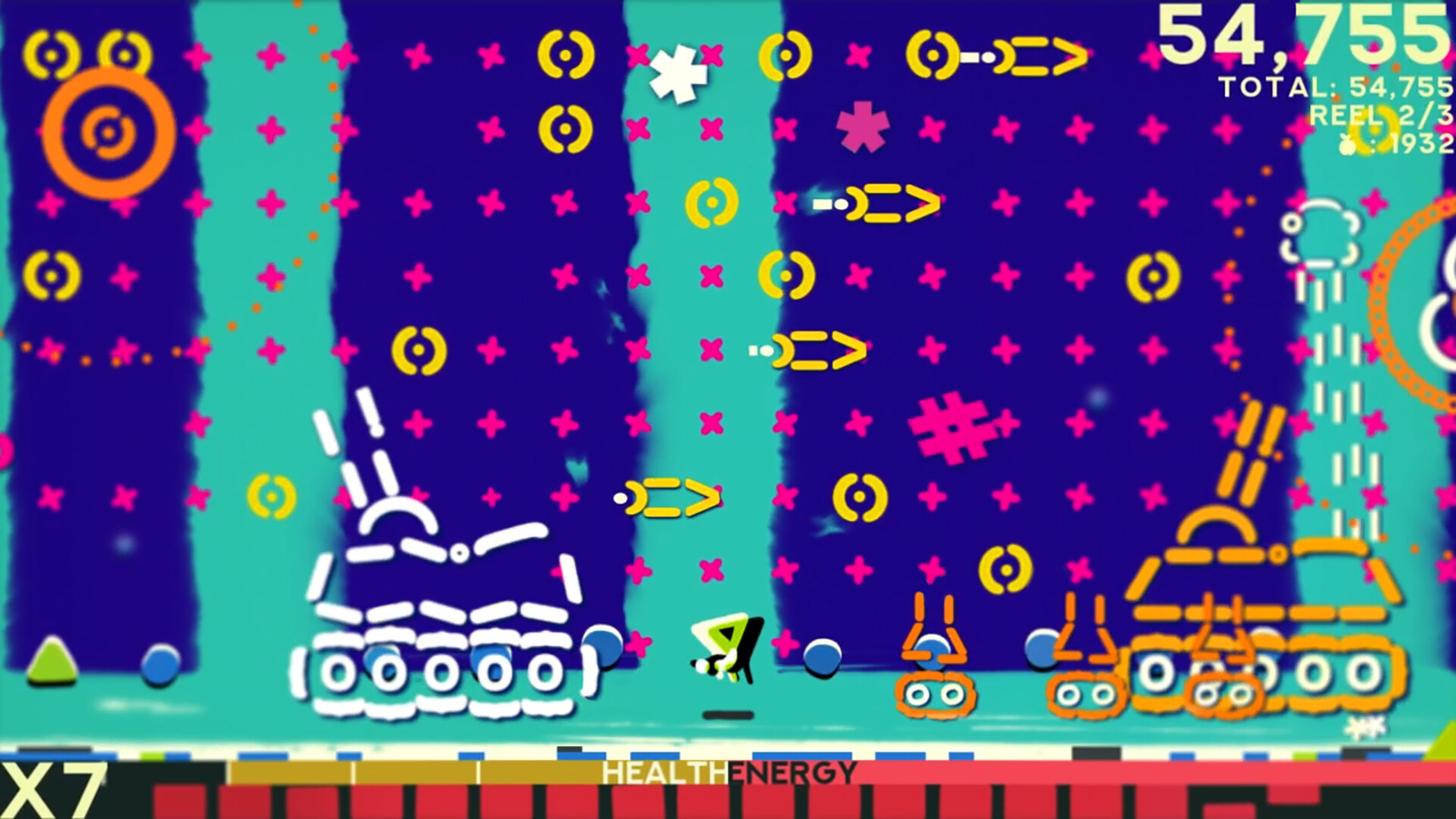
Hawkins has spent more than a decade in experimental animation, and you can feel that history before the first boss has a name. The look is not a filter slapped on sprites. It is drawn-on-film thinking, the 1930s and 1940s tradition of scratching and painting straight onto the stock, the lineage that runs through Norman McLaren. The title winks at Begone Dull Care, the 1949 jazz film McLaren made with Evelyn Lambart, and at the old word zoetrope, which is where “ZOE” started before a publisher needed something you could trademark. Every jitter of ink, every ragged edge, every enemy that looks like a heat-seeking arrow or a wiggly line, feels authored rather than assembled from a marketplace pack.
Zoe is a terrific lead for this kind of work. She is not a mascot with a lore bible. She is a shape with a temperament, tired, stubborn, and slightly offended that the universe will not leave her alone. The Animator is a third-wall pest with a toolkit. Pens, pencils, knives, even fingers, all of them used to sketch danger into her path. Frame by frame the reel twists. Your job is to un-draw it faster than it can be drawn.
That setup could have been cute and thin. It is not, because the game treats the Animator as a mechanical presence, not a cutscene villain. Tools appear as objectives. Creations appear as patterns. By the time a Film’s boss arrives, you have been arguing with the same imagination for three reels, and the argument has a score attached. You do not restore a pastoral scene by being gentle. You restore it by being faster and ruder than the person holding the pencil.
Looping Reels and the Discipline of Motion
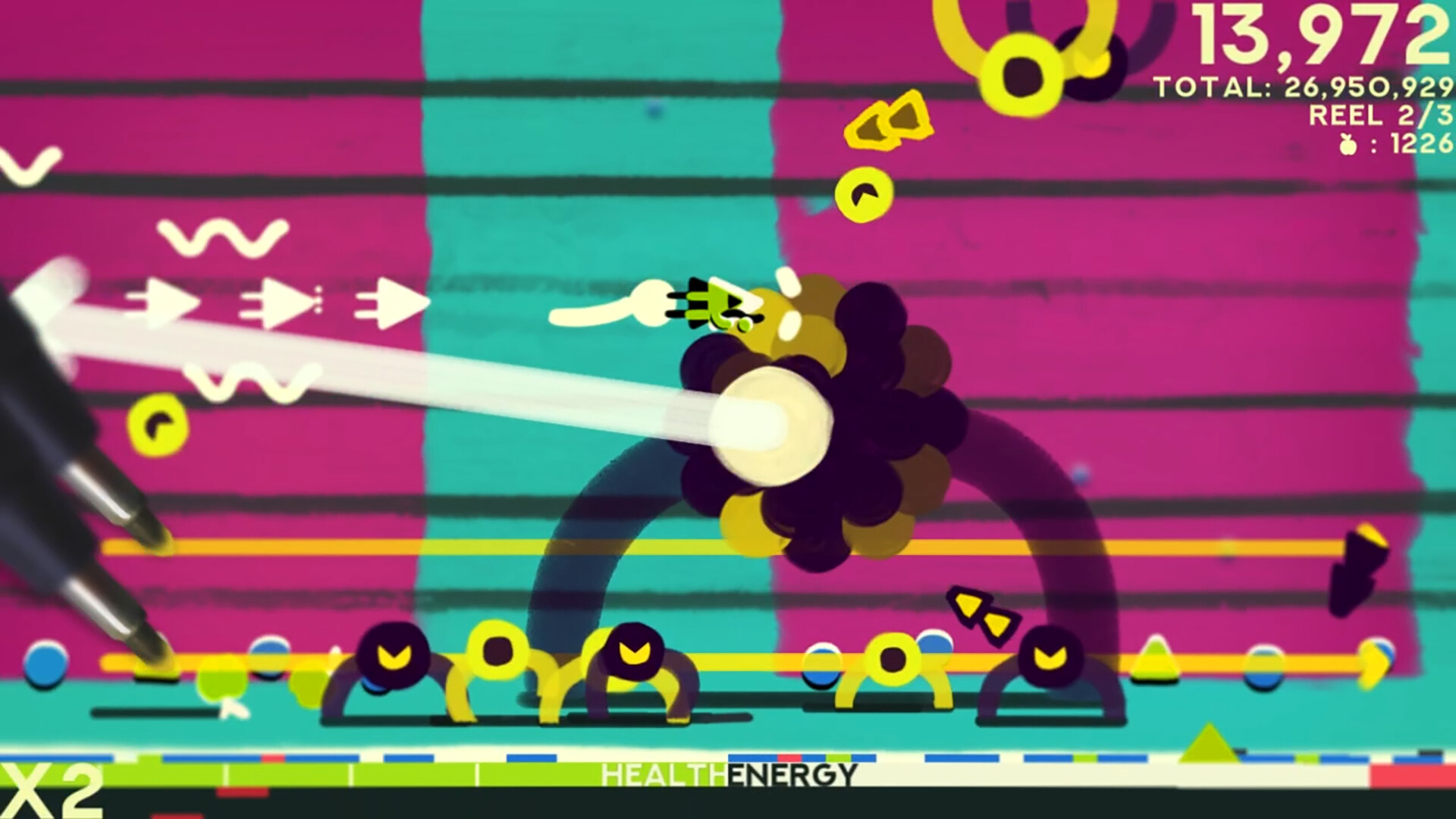
The arenas loop. If you keep flying in one direction you will meet yourself coming the other way, a design that nods at Defender and at later arena shmups that understood a screen is a cylinder, not a hallway. Each campaign Film is built from three reels and a boss. Across a standard run you are looking at five Films, fifteen reels, five bosses, a compact arcade novel rather than an epic. Clear the Animator’s enemies quickly, reclaim the territory, and do not let the chain die because you got polite.
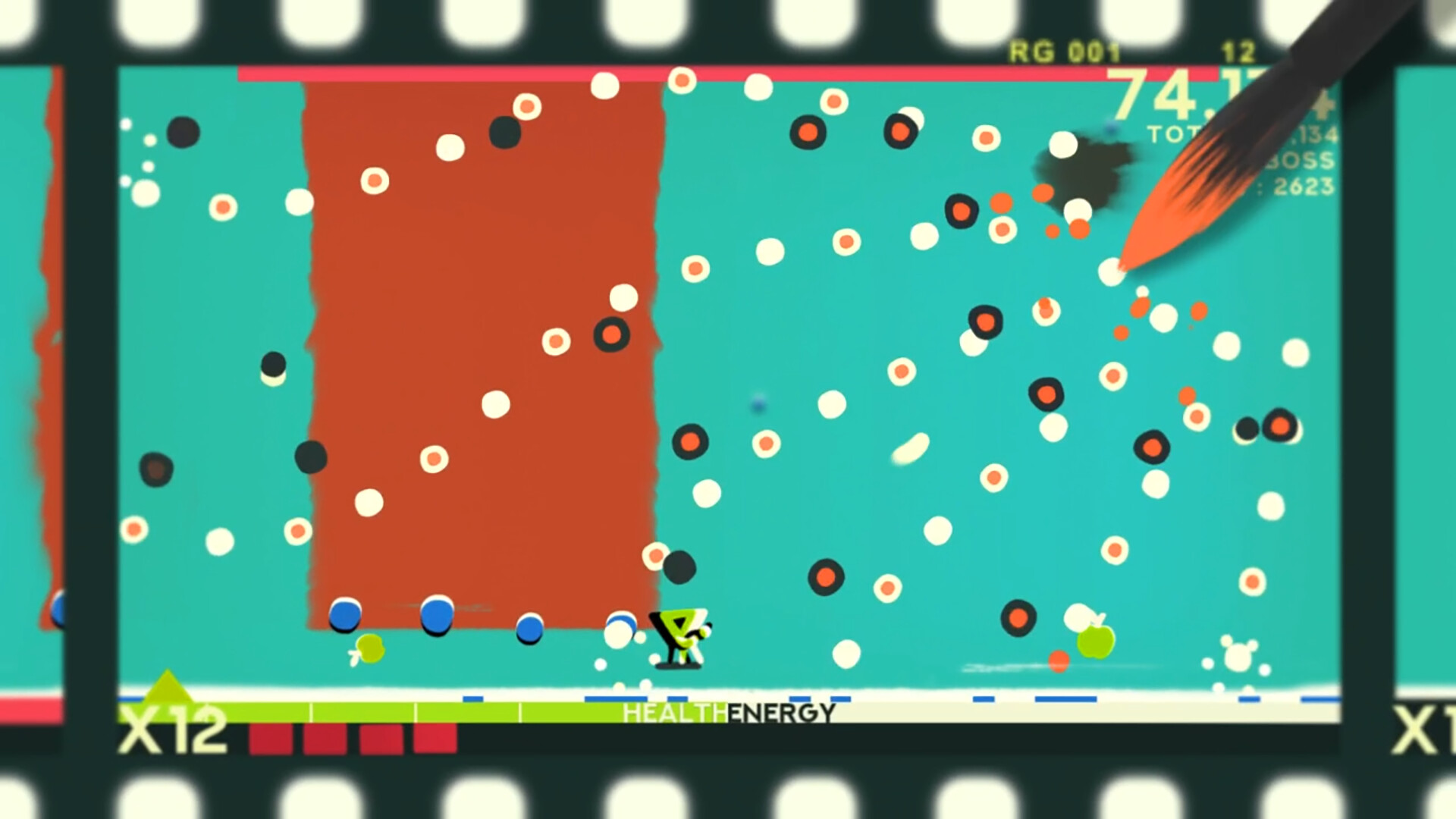
Zoe’s kit is shoot, dash, and pound, with twin-stick intent and a body that behaves differently on the ground than in the air. On foot she can fire in five directions, a run-and-gun stance with real coverage and less mobility. In the air she is faster and meaner with dash and pound, but her shot narrows, typically left and right, so the picture asks you to choose a posture. Energy is the tax on that freedom. Dashing, flying, and the hungrier special weapons all drink from the same well. Blue dots sit along the floor of a reel. Pop them and the well refills. Miss them in a panic and you become a triangle who can still shoot but can no longer dance.
I spent my first hour playing it like a conventional side-scroller, hugging the ground, spraying in five directions, treating the air as an escape hatch. That is a viable way to survive Easy, and a poor way to score. The game wants aggression. Dash through a cluster, pound to snap Apples toward you, immediately find the next body, keep the multiplier from cooling off. Once that clicked, the looping arenas stopped feeling like a gimmick and started feeling like a racetrack that also shoots back.
Difficulty is the other lever. Easy, standard, and hard are not just thicker health bars. Patterns tighten, scoring potential shifts, and the same reel becomes a different conversation. I did most of my serious time on standard, dipped into hard when I wanted the Animator to be rude, and used Easy to learn a Film’s visual dialect. Each level has its own art style and its own hand-animated menagerie. You are not fighting reskins. You are learning a new handwriting.
The loop can repeat on you. After enough standard runs, the rhythm of reel, shop, reel, shop, boss becomes familiar in a way that is both comforting and a little samey. That is the game’s real limitation. The hours after you have seen every Film once are hours you spend chasing a cleaner line, not discovering a secret sixth act. I do not mind that. I do mind if I forget to switch modes, because the game has answers for familiarity and I occasionally ignored them out of stubbornness.
Apples, Energy, and the Bargain Between Frames
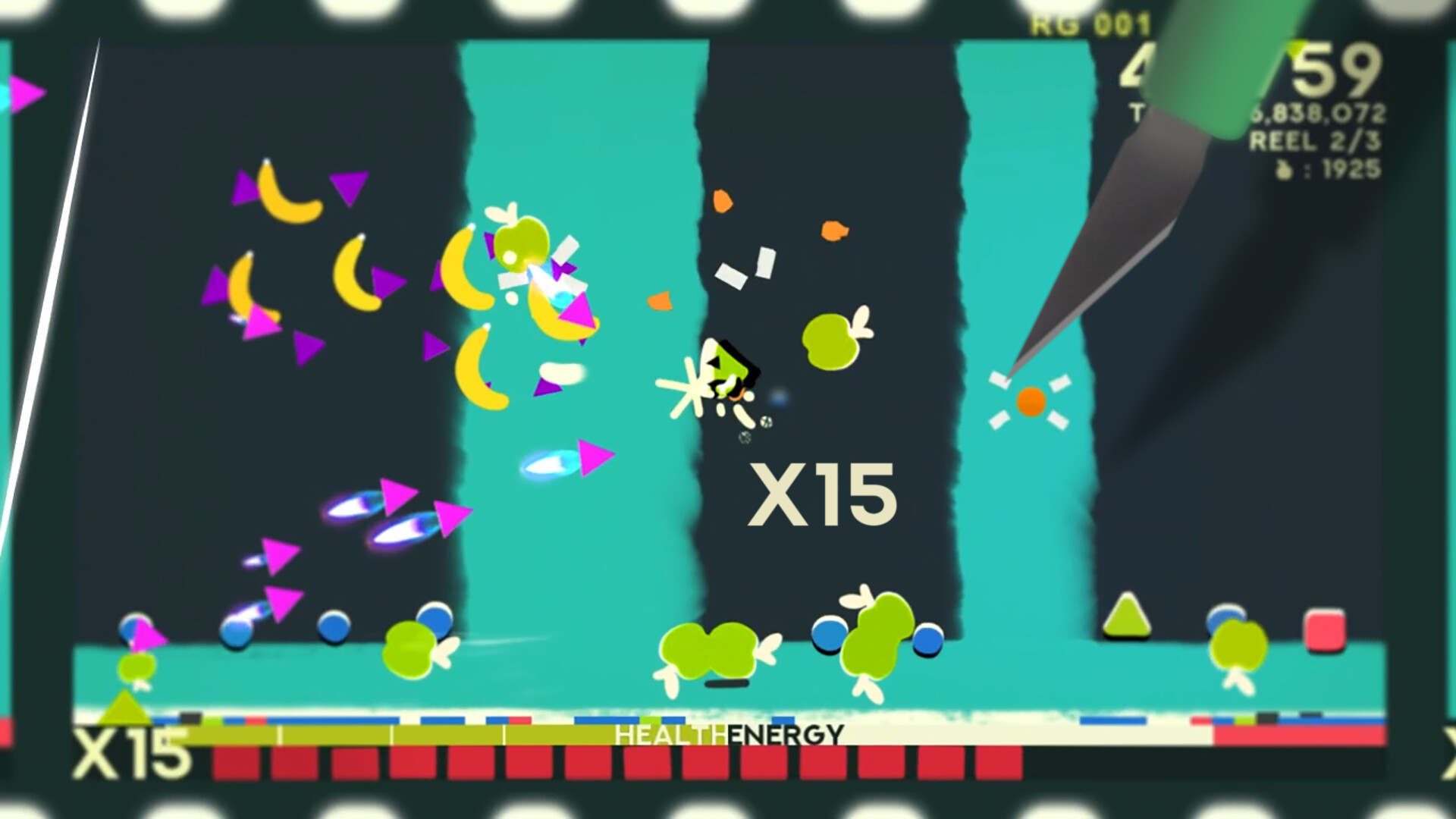
Apples are the economy, and they are rude about it. Enemies drop them, they do not linger, and their value thins if you treat them like scenery. A pound pulls them in, a magnet flick that turns a messy screen into a grocery run. Between reels, a shop appears, and this is where a run grows a personality. You can feed the base gun, buy special weapons that hit like a tantrum and then ask you to keep their ammo honest, buy speed for chain uptime, buy a shield for a little more stubbornness, or widen the apple suck range so the next shop is better funded. None of this is a sprawling buildcraft tree. It is a compact arcade bargain, and the compactness is the point.
Special weapons are the temptation. They make a reel feel solvable, then they remind you that energy and ammo are cousins. Spend too freely and you will be back on the floor, watching a chain expire because you could not afford the dash that would have saved it. I liked runs that upgraded the base gun early and treated specials as punctuation. I also liked greedy runs that bought the loud toy and then had to play like a thief.
Scoring is where the shop and the motion system shake hands. Dash and pound are the high-value verbs. Kill in succession and the multiplier climbs. Break the succession and you are a tourist again. At the end of a level, the game pays you for reclaiming territory and for rushing the boss. I have finished reels cleanly and scored worse than a messy, fast reel where I stayed greedy. That is the correct arcade morality. Safety is a consolation prize. Speed is the point.
Energy management is the quiet skill test. The dots are not hidden. They are simply easy to ignore when the Animator is being theatrical. I lost more runs to a dry energy well than to a pattern I failed to read. The pound that refills you is also the pound that gathers Apples, so a good player is always doing two jobs with one button. There is a demo if you want to test the language first. Fifty-five achievements sit in the background. I chased a handful and ignored the rest. The real checklist is the leaderboard, online and local, split across modes and difficulties.
Three Modes, One Restless Imagination
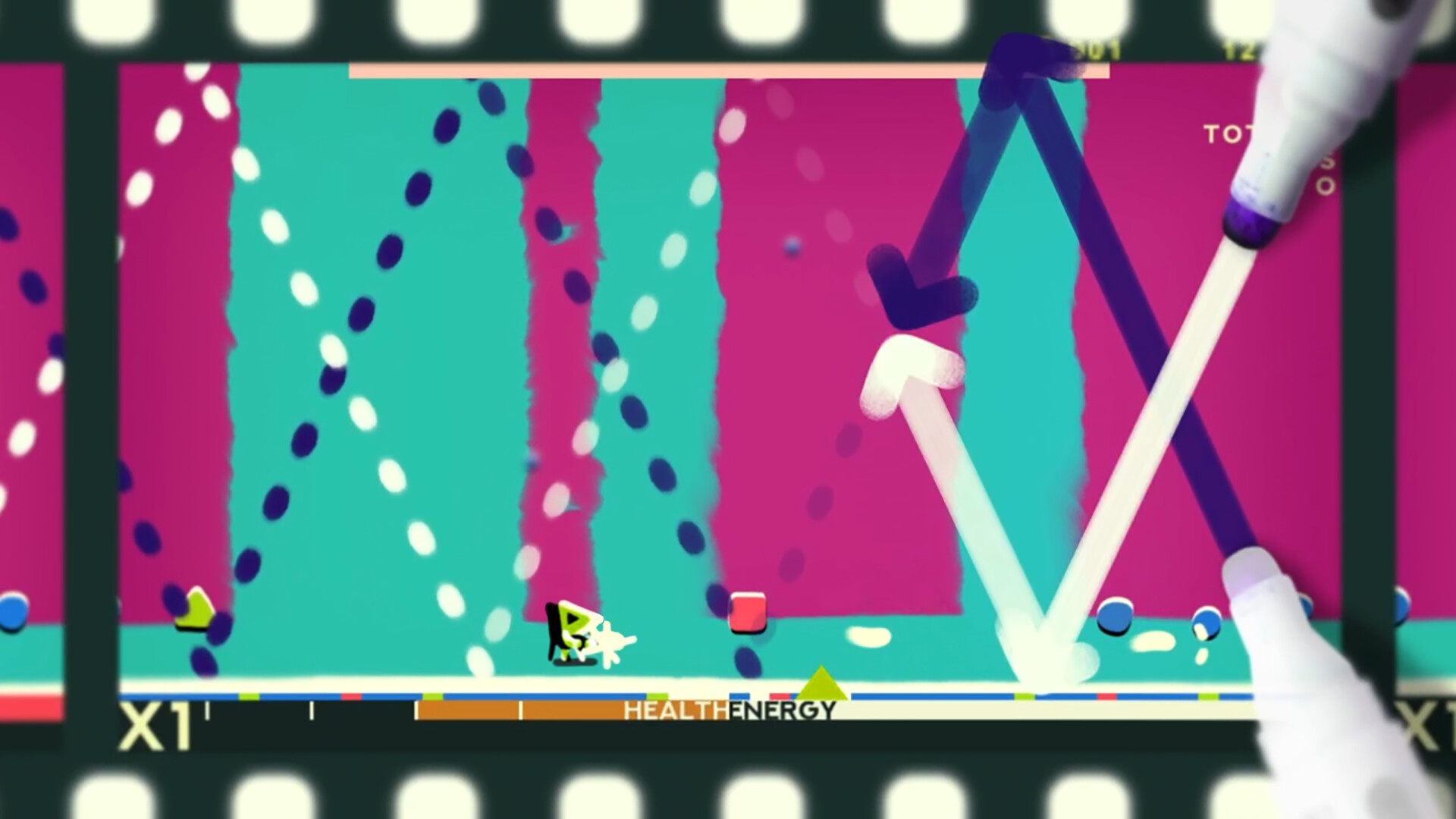
Standard is the thesis. Shoot, dash, pound to the end of the level, take out the Animator’s tools, kill quickly, spend Apples between reels, pop dots so you can keep dashing. It is the mode I would hand a curious friend, because it teaches the shop, the Films, and the bosses as a single argument. It is also the mode most likely to feel repetitive if you only ever play it on one difficulty. Clarity is a virtue until it becomes a commute.
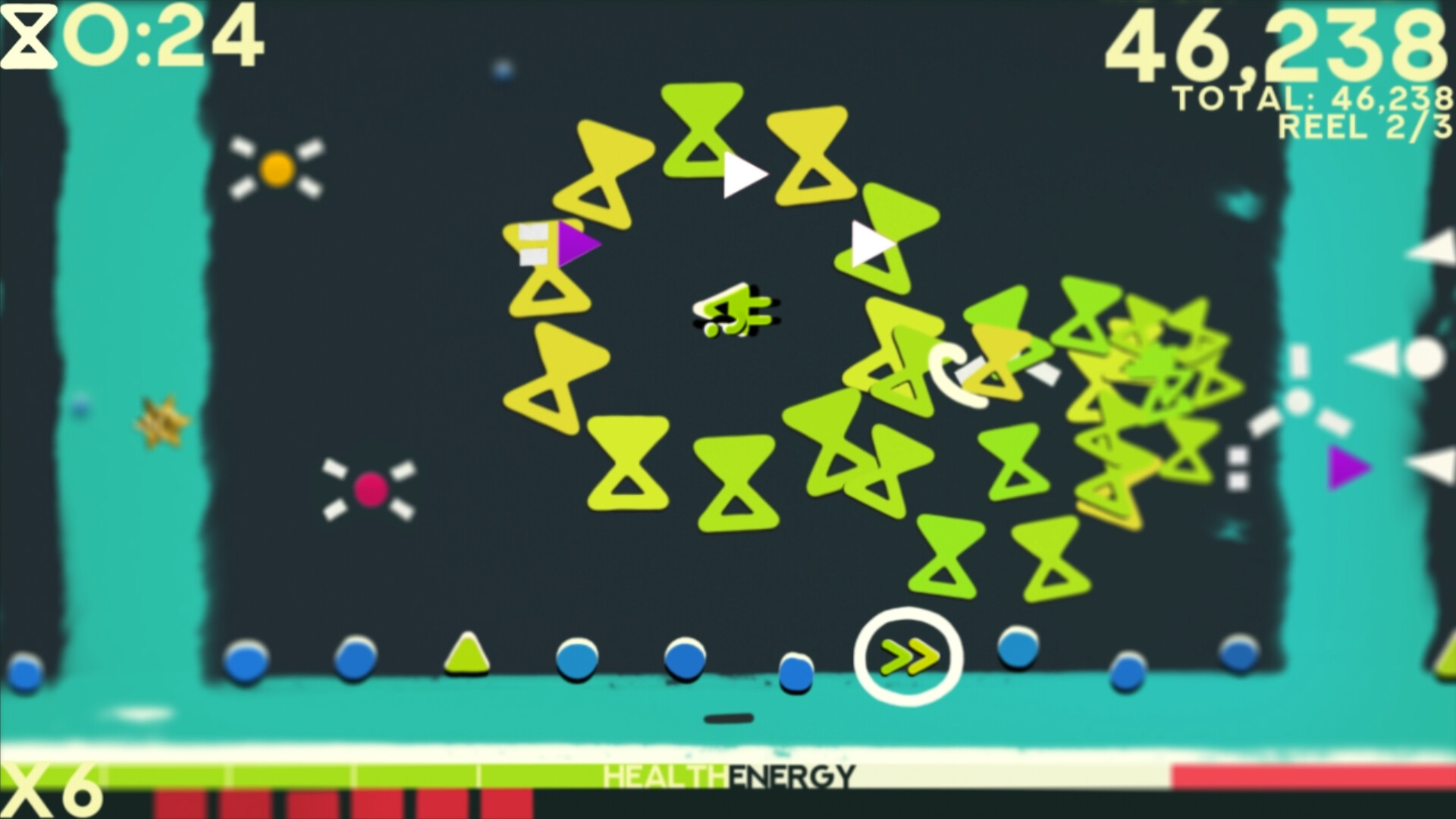
Time attack throws the shop out the window and replaces it with a clock. You race the Animator inside a limit. Dash and pound chains spawn time tokens. Mini boss challenges toss you extra seconds. Power comes from item bubbles you pop in the moment, not from a planned cart of upgrades. I preferred this mode more than I expected. There is no saving Apples for later, only the slightly sick feeling of watching seconds drain while a token sits one dash too far to the left. It is a good remix because it does not invent new verbs. It starves the old ones.
Boss rush is the long argument. All the boss attacks get mixed into one extended fight, and the goal is simple to print and hard to finish: defeat the Animator. After you have learned each Film’s boss as a chapter ending, seeing their habits stacked and shuffled is the closest the game comes to a final exam. I will not pretend I boarded it on the first try. Once you know the individual tells, the mix feels fair. The Animator is not cheating. The Animator is just using every pencil at once.
Online and local leaderboards sit under all three modes and all three difficulties. That is the replay plan, and it is an honest one. ZOE Begone! is not hiding a forty-hour story behind a craft bench. It is a score toy with a look you will remember in a year. If that is not what you want from ten dollars, you will bounce. If it is, switch modes instead of grinding Standard out of habit. Single player only. Fine. This is a conversation between you, a triangle, and a pest with a pencil.
When Colour Erupts and the Piano Will Not Sit Still
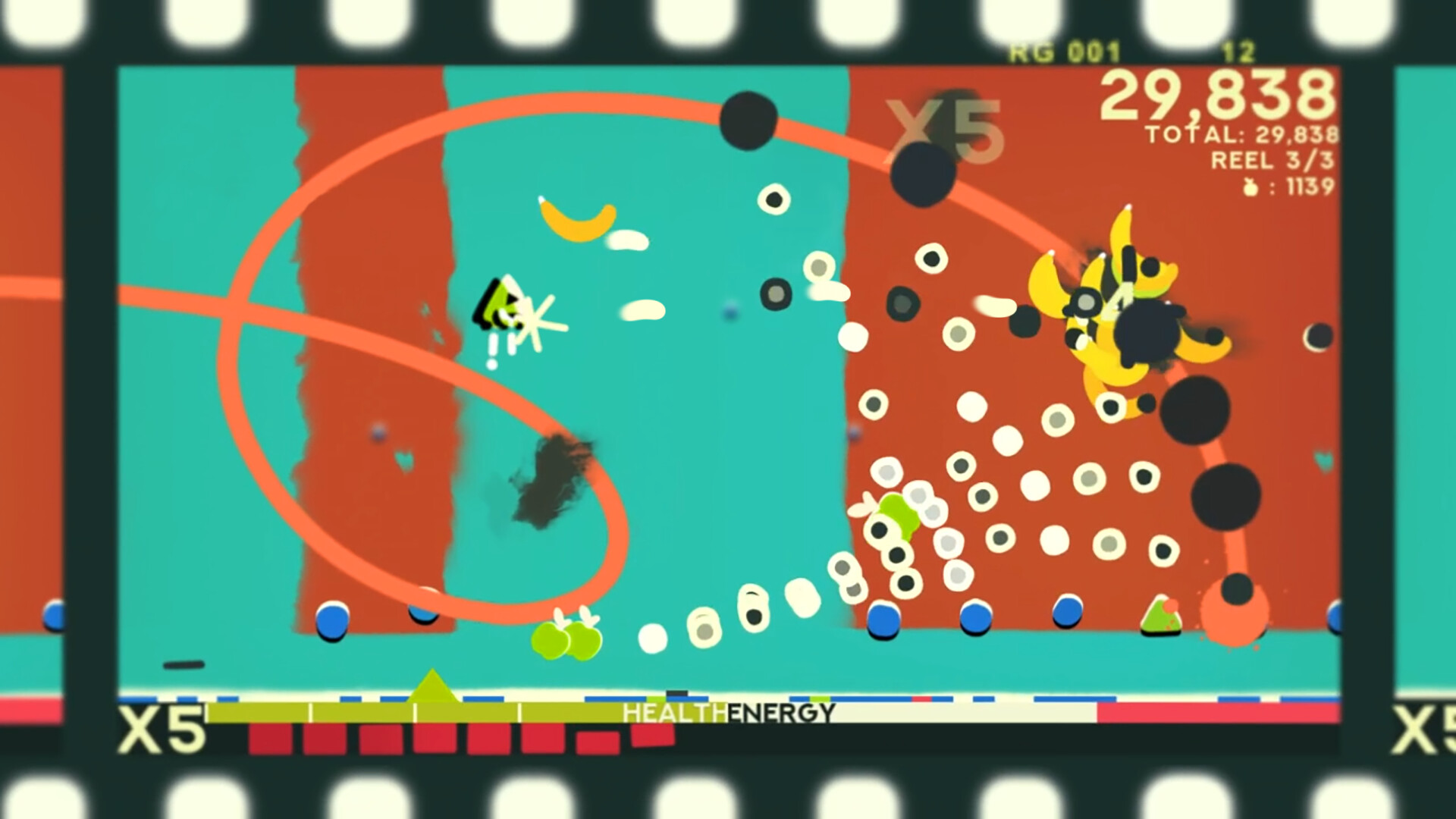
I have played a lot of indie shooters that announce a unique art style and then deliver a pleasant palette with nicer outlines. ZOE Begone! is doing something rarer. It looks, moves, and sounds like the same idea. The picture is 1930s drawn-on-film thinking, jitter and scratch and sudden floods of pointillist colour. The action is high-octane hand-drawn bullet hell. You dodge and attack at a blistering clip, then the screen erupts, dazzling the eyes and punishing the thumbs. The soundtrack is boogie, old-timey jazz with a grin, composed, performed, and finished by Tom Pegg. Sixteen tracks if you buy the album. In the game, the music makes panic feel like a dance. You get piano that sounds like it is late, slightly drunk, and very sure of itself.
That unity is why the game feels expensive at ten dollars even when a reel starts to look familiar. The enemies are hand-animated, not just hand-tinted. A wiggly line has a different threat personality than a seeking arrow. Bosses are where the drawn-on-film idea becomes choreography. They fill the screen the way a painted frame fills a projector. When a fight finally breaks and the colour showers across the reel, it is not a loot explosion. It is the picture celebrating that you shut the Animator up for a few seconds.
Because every Film has a distinct look, your first trip through the set is a delight. Your fifth trip, hunting a better chain, is still handsome and slightly less surprising. Style is not infinite ammunition. Pegg’s boogie keeps the tenth reel from feeling like homework. I restarted runs less because I died and more because I wanted the music to take the tune from the top. Hawkins has talked about embracing imperfection, every jitter of ink, every ragged edge, every chaotic bullet. You can feel that philosophy in the way Zoe moves and in the way a background seems to tremble. It is not sloppiness. It is a decision to let the medium show.
The Animator Always Has Another Tool
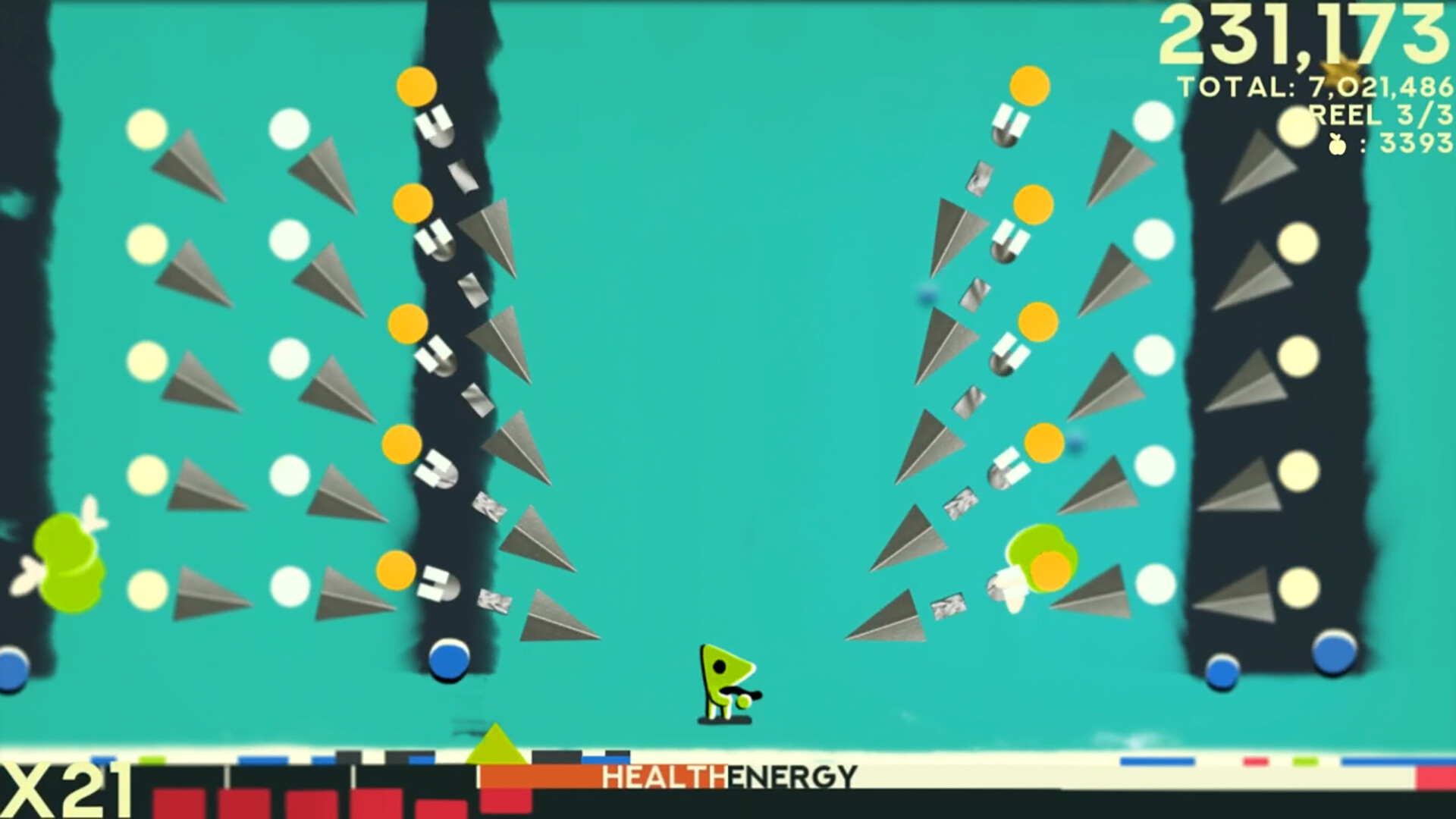
The loop in Standard is tight enough to addict and tight enough to repeat. Once you know the shop’s handful of goods, you are not discovering systems so much as executing them with cleaner hands. That is authentic arcade design, and it will bore anyone who wanted a metroidvania hiding under the jazz. The air-versus-ground shot difference is smart, then occasionally awkward, especially when a pattern demands coverage you only have on the floor and mobility you only have in the air. I died more than once to indecision about posture. That tension will irritate some players for the entire runtime.
Special weapons can also flatten a reel if you buy them early and the difficulty is not pushing back. The better answer is to climb difficulty or switch to time attack. Leaderboards will sort the people who used a crutch from the people who used a tool.
None of that knocks the craft into a lesser tier. A solo Scottish developer made a complete arcade object with three modes, three difficulties, a coherent visual thesis, a real soundtrack, and a scoring system that knows what it wants from you. PM Studios did the unglamorous work of getting that object onto living-room hardware without sanding off the jitter. At this price, the complaint that there is “only” a compact campaign is a category error. You are buying a cabinet that fits on a shelf and still has the nerve to look like 1938.
When the Reel Finally Holds Still
ZOE Begone! is the rare small shooter that leaves a memory attached to it. I will remember the triangle, the rude pencil, the way a reel changes colour when you finally shut the noise down, and the particular satisfaction of a dash-pound chain that feels like jazz you can aim. I will also remember a few evenings where I played one more Standard Film out of habit and felt the loop tap me on the shoulder. That is a fair trade at $9.99.
What Hawkins and Retchy Games have made is not a nostalgia replica and not a museum piece about McLaren. It is a modern arcade argument that happens to be drawn in a very old ink. Twin-stick motion, chain scoring, a shop that is short and pointed, a time attack that starves your planning, a boss rush that spends every idea at once, leaderboards for the addicted, a demo for the cautious. The picture is the headline. The boogie is the pulse.
I am scoring it 8.5, Great, because the identity is this strong and the limitations are the limitations of a focused cabinet, not an unfinished one. If you want a long narrative, look elsewhere. If you want to fight an Animator for a triangle’s right to sleep, and you are willing to get better at being rude about it, this is an easy recommendation. Distinctive 1930s drawn-on-film art, a tight twin-stick bullet hell, three modes that actually change the conversation, a boogie soundtrack with a spine, and the fingerprints of one stubborn Scottish animator are a lot of game for a ten-dollar ask. The repetition in the Standard loop is real. So is the grin when a reel finally goes quiet.
Zoe still wants peace and quiet. After a few hours, you will understand why she has not gotten it, and why you keep hitting start anyway.
We prepared this review with a digital copy of the ZOE Begone! for the PS5 version provided by PM Studios.