
Age of Empires IV did not tiptoe onto PlayStation 5. It marched in with a renamed Anniversary Edition on the store tile, four years of post-launch work already in the crate, and a Premium bundle that treats the living room like a late invitation to a war that never ended.
Relic Entertainment, World’s Edge, Forgotten Empires, and Climax Studios share the developer line. Xbox Game Studios publishes it. The public PlayStation 5 day is November 4, 2025. Premium owners unlocked the game on October 30. This review is dated to that public morning, because that is when the rest of the room is allowed to sit down. I played the PS5 Premium Edition, the $69.99 Anniversary Premium SKU, which arrives with every previously released expansion in the crate and Dynasties of the East waiting for the same public day.
The store is not shy about the full name. Age of Empires IV: Anniversary Edition is the product on the tile. The base Anniversary Edition is $39.99. Premium folds in The Sultans Ascend, Knights of Cross and Rose, exclusive in-game items, five days of early access, and Dynasties of the East at no extra cost once that expansion unlocks on November 4. Buy Dynasties later on its own and it is $19.99. Those are the official U.S. list prices. None of them shrink the map.
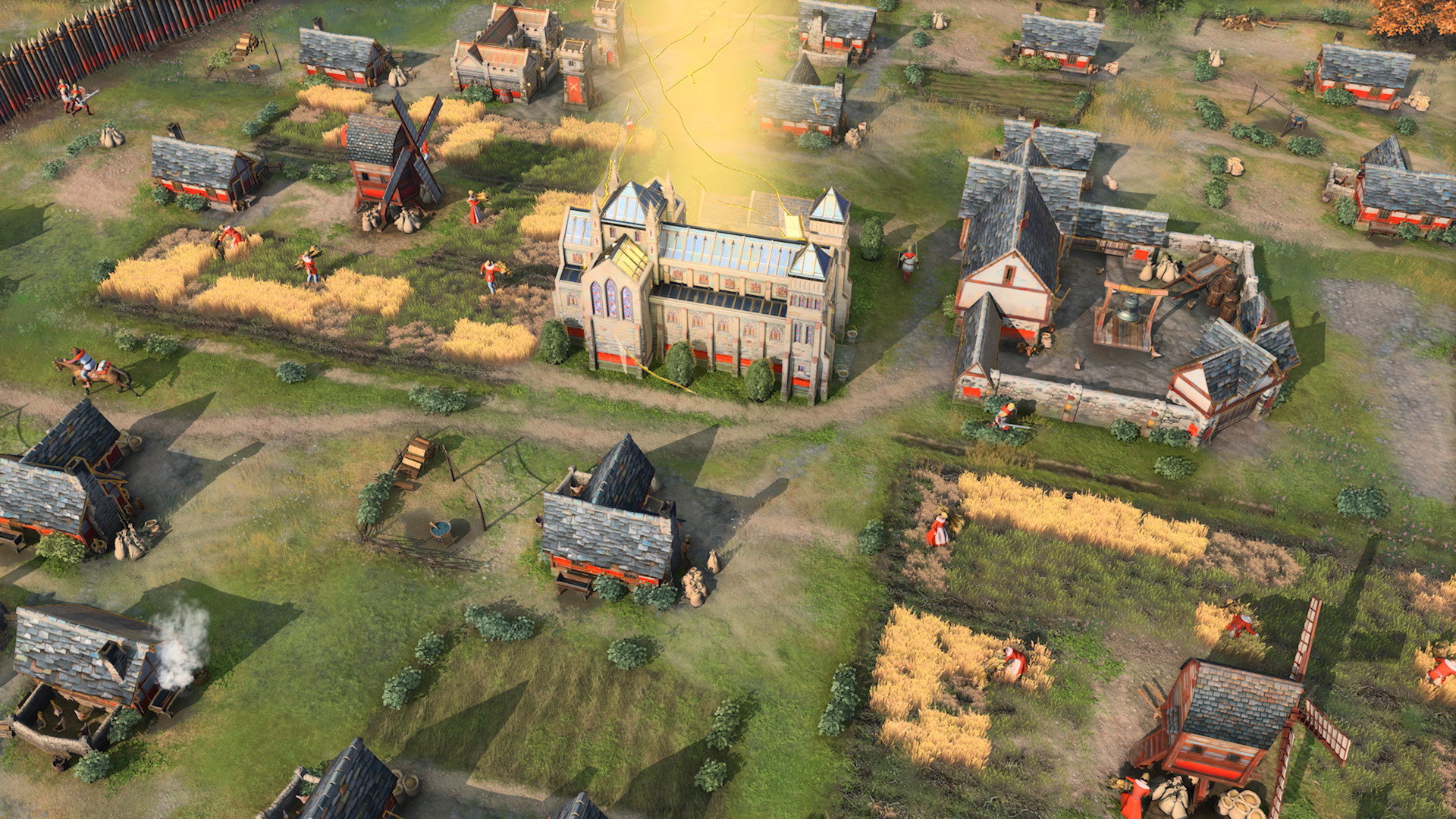
The pitch is the same one this series has been making since the late nineties, only the camera is prettier and the civilizations argue with each other more. You gather food, wood, gold, and stone. You raise a town. You age up. You pick a fight you may not have scheduled. Anniversary copy talks about 4K visual fidelity, and the battlefields do look like paintings that learned to panic. What matters more is how much history now lives in one install, and how willing the game is to teach you before it starts grading you.
Four Resources and a Temper
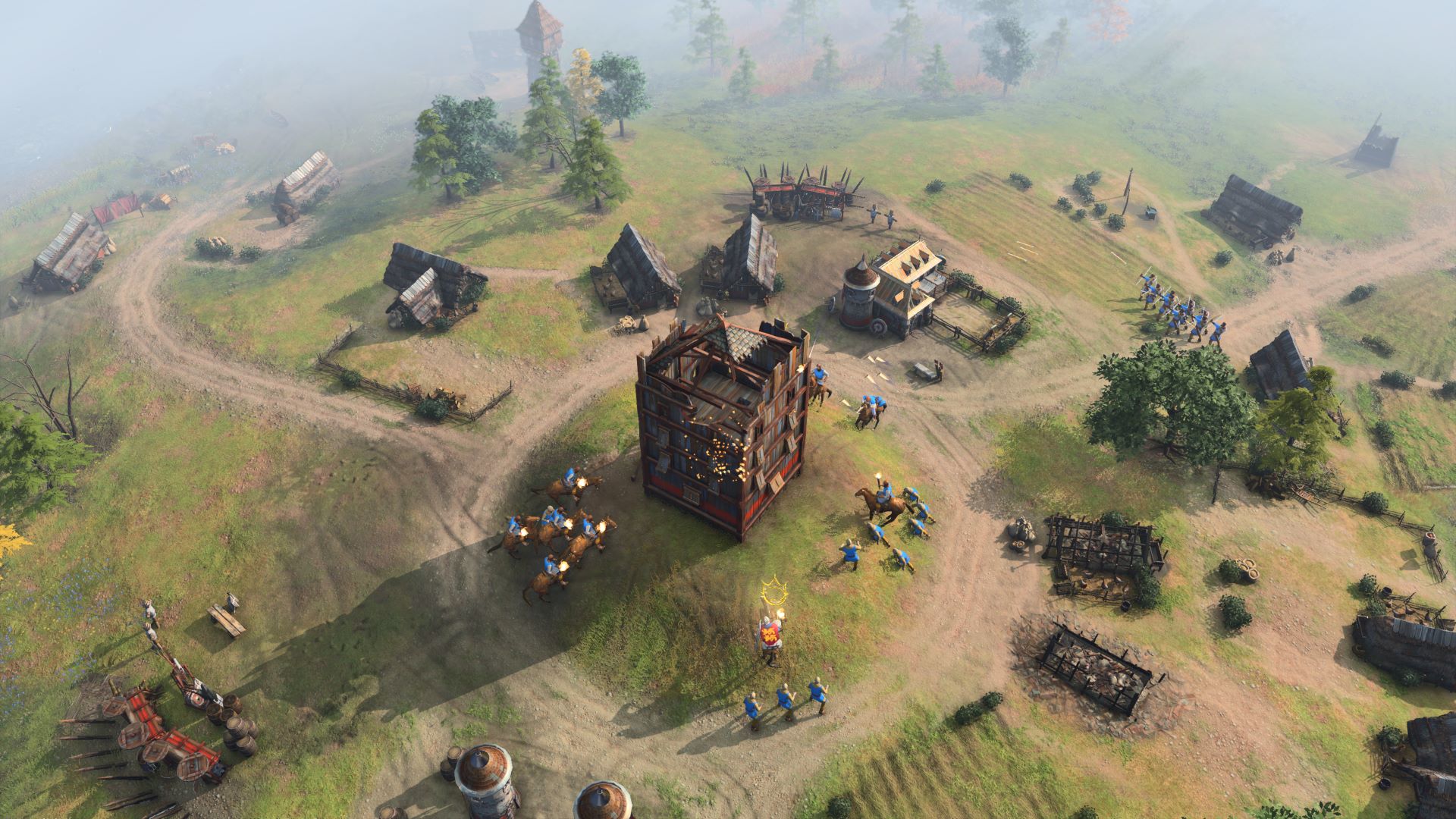
Every match still begins as a small, slightly rude economy. Sheep do not introduce themselves. Trees do not volunteer. Gold sits in the open like a dare. Stone waits until you are already late. Age of Empires IV wants you to feel the weight of a village before it lets you feel like a king, and that first stretch is where the game either clicks or starts looking like homework.
Landmarks replace the old identical aging ritual with a civilizational argument. You do not just pay a fee and glow. You pick a building that changes how the rest of the age will behave, then you defend that choice with whatever army you can afford. It is a cleaner fantasy than a tech tree that only exists to be completed. It is also a trap for anyone who ages up because the button is lit. I have lit that button too early, then watched a pretty landmark become the most expensive gravestone on the map.
The loop is old and still mean in the useful way. Villagers walk into wolves as if they booked the meeting. Armies clump at a choke point and call it a plan. A navy looks optional until a trade route dies and your gold income starts whispering. The fight in the middle of the screen is never the whole job. The town behind it has to survive the next two minutes of bad habits.
Campaign Story Mode exists for people who want the history without the sadistic setup. Skirmish against AI exists for people who want the setup without the history. Ranked seasons exist for people who want both, plus a number that will haunt them. The Anniversary package also brought masteries, challenges, taunts, and cheats, which is a polite way of saying some nights are for practice and some nights are for making a scout do something undignified.
Forests have a weight. Shorelines have a job. Sacred sites and trade posts turn geography into an argument instead of wallpaper, which sounds lofty until a single unused gold pile decides the game for you.
Campaigns That Treat History Like a Script
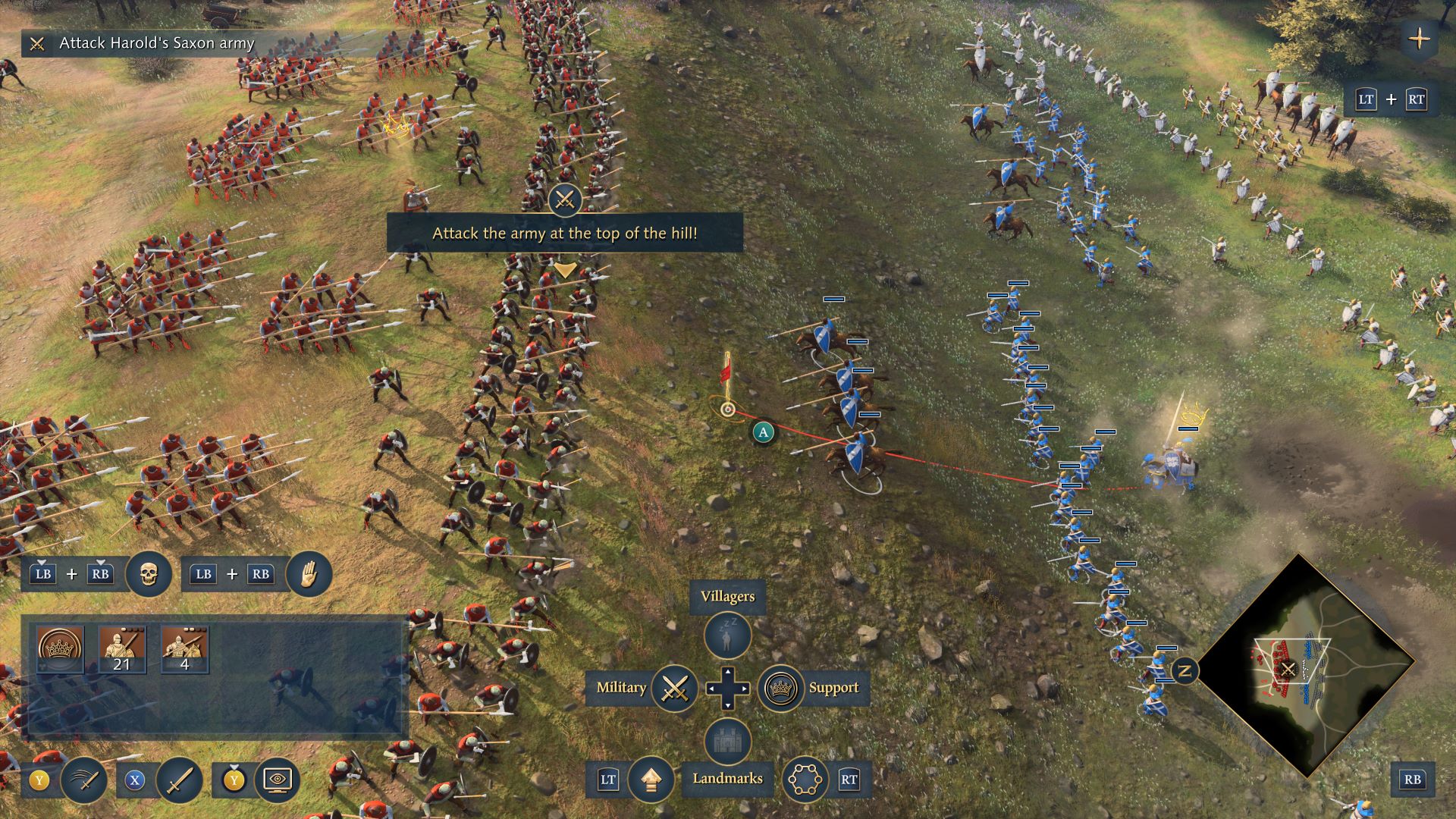
The campaigns are the reason this series still has a soul. The PlayStation 5 launch copy puts five campaigns and 43 missions in the Premium install, expansions included, spanning 500 years from the Dark Ages to the Renaissance. The Anniversary base itself is four campaigns and 35 missions. The Sultans Ascend adds the fifth, eight missions set in the Middle East during the Crusades. I will not invent a clock for any of that. The missions are long when they want to be dramatic and short when they want to be cruel.
Rise of a King is the five-mission prelude covering the twenty years before Hastings, then it hands you to the Norman campaign. The training wheels do not squeak as much as they should. You learn to build, gather, fight, and stop treating the camera like a tourist. Then William of Normandy starts the hard part: conquering England, surviving his own family, and discovering that a crown is just a landmark with better public relations.
The Hundred Years War campaign lets France spend a century getting raided, then finding a peasant girl named Jeanne d’Arc and, later, the kind of cannon fire that makes chivalry look like a hobby. The Mongol Empire campaign is Genghis Khan turning scattered tribes into the largest contiguous land empire on the board, with tactics standing in for the resources they did not have. The Rise of Moscow starts as a riverside outpost and ends as a superpower, if you can survive the Mongol half of that sentence first. These are not documentaries. They are directed levels that borrow real faces so your build order has somewhere to point.
The Sultans Ascend campaign flips the usual Crusade camera. You play the Muslim resistance, follow historic leaders through their fights with European holy orders, and eventually deal with the Mongols again, because the thirteenth century had a talent for repeat guests. Templars, Hospitallers, and Teutons show up as problems rather than costumes. It is the expansion that most clearly says the Premium crate is not just extra civilizations. It is another whole script.
Knights of Cross and Rose skips a new campaign spine and stages Historical Battles instead. You take the Knights Templar through Montgisard against Saladin. You try to keep the House of Lancaster alive after Towton, which is a polite way of saying the Yorkists already had their fun. These missions play like short, loud arguments. They are not a substitute for a new campaign. They are a reminder that the series can still stage a single day and make it feel expensive.
The campaigns teach civilizations without turning into lectures. A mission that wants you to understand French knights will not hide that behind a tooltip. A mission that wants you to feel a Mongol raid will not wait for you to open a menu. The writing is earnest, sometimes a little polished, and better when a battlefield finishes the sentence. Skip all of this for ranked 1v1 if you must, and you skip the part that remembers why the franchise is not called Age of Ladders.
Civilizations That Refuse to Share a Build
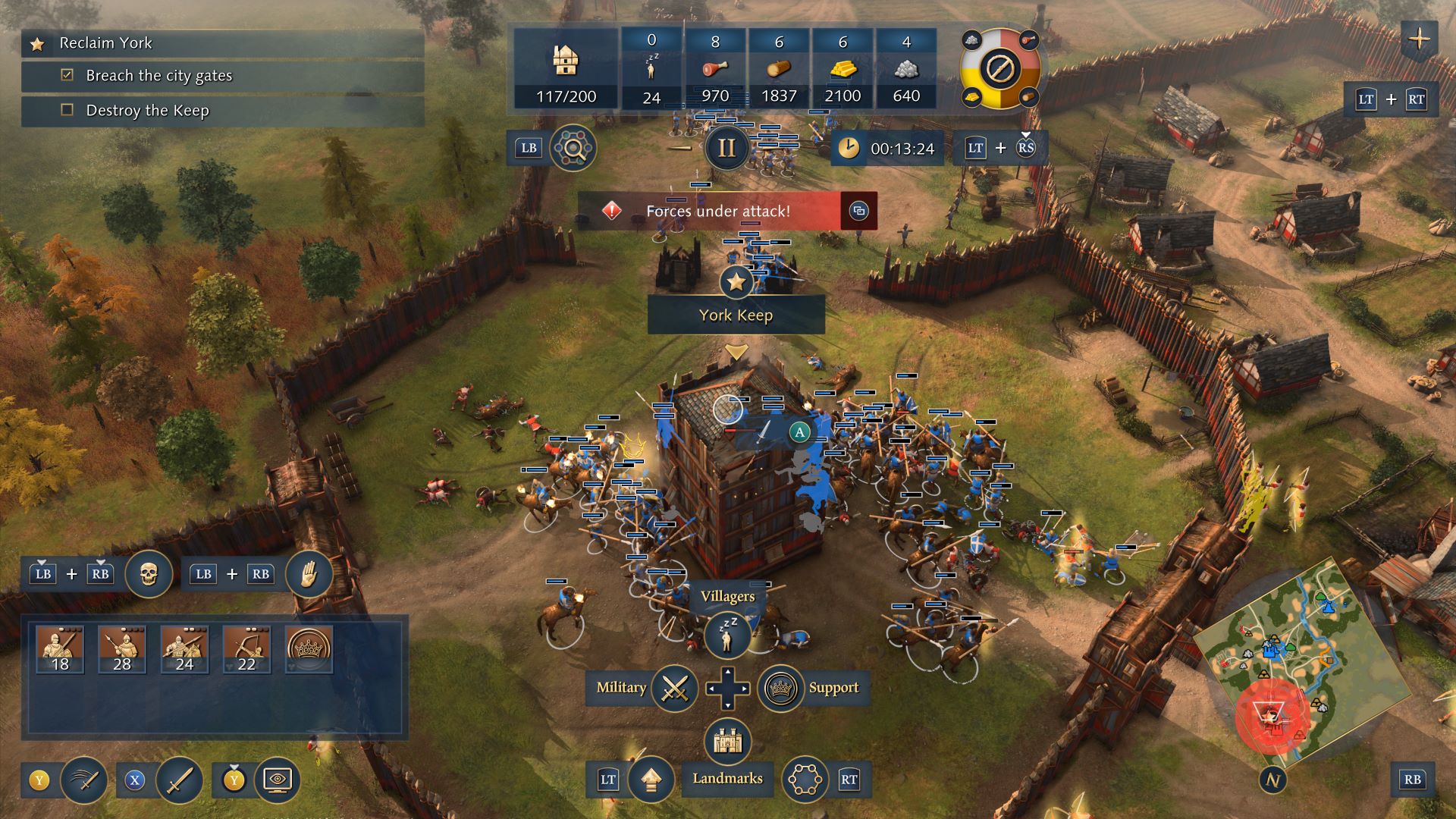
Anniversary Edition starts you with ten civilizations, from the English and the Chinese to the Delhi Sultanate, plus the Malians and Ottomans that arrived as the anniversary gift. The Malians are a West African trading power that would like you to care about mines and gold the way other people care about farms. The Ottomans bring a drilled military and the Great Bombard, which is not a subtle instrument. It is a cannon that treats walls like a rumor.
The Sultans Ascend then hands you two full civilizations and four variants. The Japanese lean on a Daimyo manor that turns a Town Center into a neighborhood argument, plus banner-bearing samurai and a Shinobi who would like to be a villager until the moment he is not. The Byzantines build aqueducts, generate Olive Oil, hire mercenaries, and remember that Greek Fire is a personality. The variants re-cut civilizations you already know: Ayyubids out of the Abbasid Dynasty, Jeanne d’Arc out of the French, the Order of the Dragon out of the Holy Roman Empire, Zhu Xi’s Legacy out of the Chinese. They are not palette swaps. They are the same country after a different historian got the pen.
Knights of Cross and Rose adds the Knights Templar and the House of Lancaster. Templars want pilgrimage, commanderies, and the kind of military religion that turns a map into a route. Lancaster wants manors and English stubbornness with the serial numbers filed off. Premium owners get both the moment early access opens. They are part of the crate, not a later handshake.
Dynasties of the East is the November 4 package, and it is real content, not a sticker. Premium includes it. It does not unlock during the October 30 early window. On the public day you get four more variant civilizations: the Golden Horde, the Macedonian Dynasty, the Sengoku Daimyo, and the Tughlaq Dynasty, each with unique units, tech trees, and new ways to be inconvenient. You also get eight maps and six biomes, from alpine spring and temperate fall to black sand beaches, tropical swamp, Greek islands, and rainforest. Nomadic Tarns and Ocean Gateway are the two maps the launch notes bother to name.
The danger of a roster this wide is tourism. You can spend a week sampling civilizations and never learn one. Age of Empires IV is at its best when a civ stops being a costume and starts being a habit. English longbows want a different patience than a Mongol pack-up. A Byzantine aqueduct is not a decoration. A Malian gold plan is not a side quest. The game is generous about letting you dabble, then honest about punishing dabbling once someone on the other side has a real opening. Not every variant feels as necessary as a full civilization. Some are brilliant side doors. Some answer a question only a ladder player asked. Premium is a collection, and collections are allowed to have rooms you visit twice a year, so long as the rooms exist and shipped with the code.
The Radial Menu Is the Real Landmark
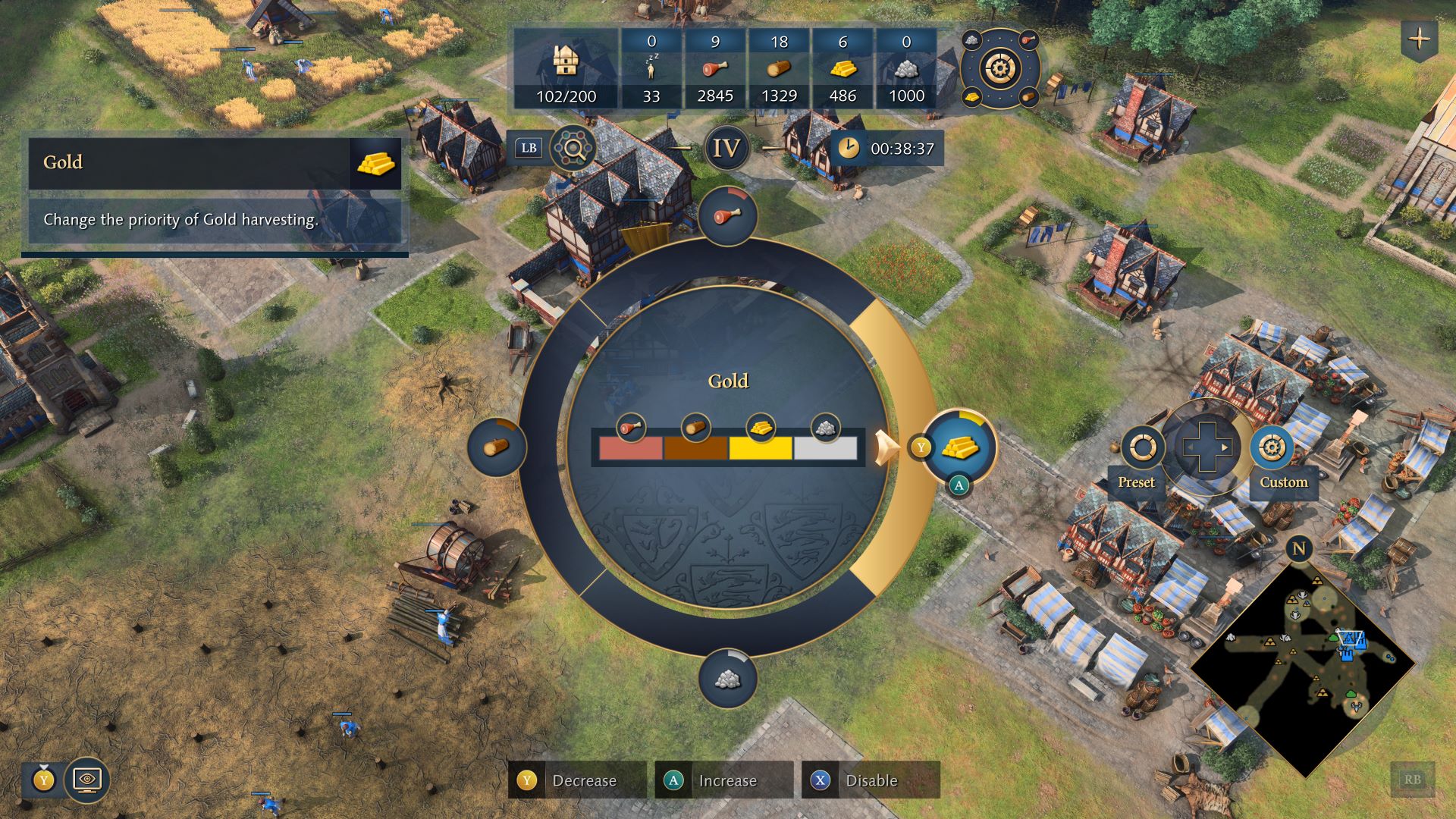
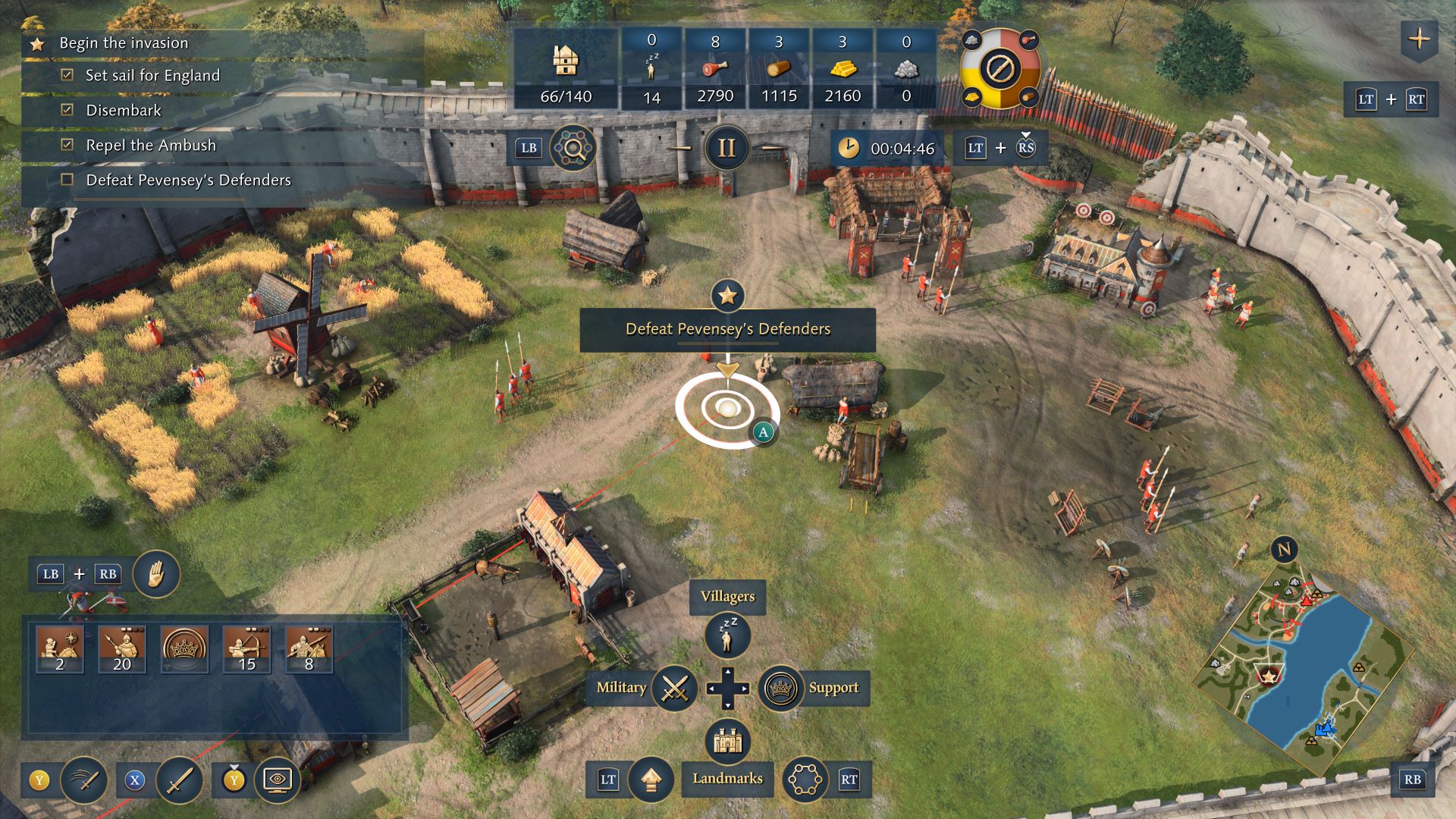
Real-time strategy on a controller used to be a dare you accepted out of loyalty. Age of Empires IV on PlayStation 5 is the first time in a while I have felt the dare get redesigned instead of translated. The interface was built again from the ground up for a pad. Dynamic radial menus, intelligent building placement, and a cleaner layout keep the strategy in front and the finger yoga in the back. It is not invisible. It is polite. Polite is a high compliment in this genre.
Two systems do the heavy lifting. The Villager Priority System lets you hand the economy to presets, including ones borrowed from serious play, or to a custom mix you actually understand. One command sends villagers toward the resources the plan wants. They look for better nodes as the map changes. You can still micromanage if you enjoy suffering. You can also stop treating idle villagers like a second job and go look at the army that is about to ruin your afternoon.
The Site Menu System is the quieter revolution. Highlight berries and the game suggests a Mill. Confirm it and a nearby villager walks over, builds, and starts gathering. Because Age of Empires IV is wildly asymmetric, the menu only offers what your civilization can actually do. That sounds small until you remember how many console RTS ports made you hunt a unique building through a list designed for a mouse. Here, intent and action sit closer together than they have any right to.
The DualSense is not just a passenger. The light bar changes color when you are ready to age up, when you have hit population cap, or to show your player color in skirmish and multiplayer. Haptics tap you during combat and construction. It is tasteful, which is not the word I expected to use for a medieval war game. Keyboard and mouse are fully supported if you want the old religion. I bounced between both. The pad is good enough that I stopped treating the keyboard as an apology.
Rise of a King exists because those systems still need a guided first week. The tutorial is five missions, it is revisitable, and it is the difference between a new player founding a town and a new player founding a traffic jam. After that, the game is still an RTS. You will drop units. You will lose a scout in fog. You will open a radial and forget which slice is the siege workshop. The design does not erase that friction. It prices it fairly.
Cross-play is on, with a Microsoft account as the visa stamp, and it does not care whether your friends are on Xbox or PC. There is a separate 1v1 ranked ladder for controller players, which is the honest way to keep a pad out of a mouse fight at the top of the table. PvP and PvE both go up to seven friends. Observer mode lets you watch a match in progress, which is how you learn that your favorite opening is a public embarrassment. Mods are a curated download library on the console. The editor stays on PC. Progress and trophies do not move over from a prior PC campaign, so veterans should not expect their old save to greet them at the dock.
Dynasties Wait for the Public Day
Dynasties of the East is the piece of Premium that refuses to arrive early, and I respect the stubbornness. October 30 gives Premium owners the base game and the older expansions. November 4 gives everybody, including those same Premium owners, the new eastern variants, the new biomes, and The Crucible. There is no secret campaign hour count hiding in the crate. There is a new way to play when you are tired of the old briefings.
The Crucible is a single-player roguelite layered onto the same real-time bones. Enemy waves stop introducing themselves. Objectives shuffle. Upgrades persist in that meta way that makes a failed run feel like tuition. You defend a Wonder, unlock Perks, and try not to treat every decision like a reload. Official notes say no two matches are the same. In practice, the sameness is the panic. You still have to age up. You still have to keep villagers alive. You just do it while the scenario writer hides behind a dice tray.
I did not want to like a roguelite bolted onto Age of Empires. The campaigns already have personality. Skirmish already has infinite maps. Then a run went sideways because I spent a perk on the wrong appetite, and I understood the pitch. The Crucible is for the nights when you want Age of Empires IV to surprise you without asking a friend to be online. It is not a replacement for the historical scripts. It is a pressure cooker for the systems those scripts taught you.
The rest of Dynasties is roster work. Golden Horde, Macedonian Dynasty, Sengoku Daimyo, Tughlaq Dynasty. Four more answers to how a familiar culture behaves when you tilt the tech tree. Eight maps that run from competitive lanes to chaotic toys. Six biomes that make the same woodline look like a different century. If you bought Premium, this is part of the $69.99. If you bought the $39.99 Anniversary Edition, it is the $19.99 question you can answer later. Everyone gets the new dynasties on the same public day. Premium just means you did not have to buy them twice.
Online, the game is still a social machine: compete, cooperate, spectate. Ranked seasons turn a civilization into a personality you defend in public. A Microsoft account is the cover charge for that whole floor. The medieval world is now a Microsoft neighborhood, even when the box says PlayStation.
Final Thoughts
Age of Empires IV: Anniversary Edition is a mature real-time strategy game that had years to become itself, then arrived as a collection instead of a sketch. The campaigns still do the emotional work. The civilizations still refuse to share a plan. The new eastern dynasties and The Crucible give the public launch a second door instead of a recap. Premium is the honest way to buy that pile if you want every expansion in the crate on day one. The $39.99 Anniversary Edition is the honest way to buy it if you want the town first and the extra rooms later.
It is not a small game pretending to be huge. It is a huge game that stopped waiting for permission to keep growing. The economy still has a temper. The landmarks still punish vanity. The variants will overwhelm anyone who treats the roster like a buffet and never sits down to a meal. That is a criticism of appetite, not of the kitchen.
I would not sell this as a weekend toy. I would sell it as a system you live in. Play a campaign if you want the series to mean something besides a ladder. Play The Crucible if you want the systems without the briefing. Play other people when you are ready to have your favorite opening explained back to you, slowly, with cavalry. At $69.99 for the Premium crate, or $39.99 for the Anniversary base, the price is doing the rare thing prices sometimes do. It is describing the object.
Score: 8.5. The hunger is still there. The villagers are still walking the wrong way. The century is still available to be rewritten, one mill at a time.
We prepared this review with a digital copy of Age of Empires IV for the PS5 version provided by Assembly Inc.