There is a particular kind of homesickness, rare in a genre that usually hands you a mansion and a tragic flashback, in coming back to a childhood ranch and discovering that home is a word with a flashlight in it. The ink is still ink. The night is still night. The first thing that hunts you by sound is not a metaphor. I Hate This Place, the isometric craft-based survival horror from Rock Square Thunder, is built on that homesickness, and the homesickness is ruder, funnier, and more useful than a thirty-dollar comic has any right to be.
I played the PlayStation 5 version, the 29 January 2026 launch that Feardemic walked onto living-room hardware the same day Steam asked $29.99. The console ask is $29.99. You scavenge, you craft, you put a workbench on a clearing, and you learn that Rutherford Ranch has already hired a night shift. Haunted forests, a derelict town, infested bunkers, a campsite that wants scrap, outposts that want rebuilding, and creatures that would rather hear you than see you. Thirty Steam achievements sit in the background. The Steam sample is Mostly Positive, 93 positive of 130, which is the honest weather report and not a dare. Great, not glossy, and very much a weekend I would recommend you spend if you like a survival horror that knows it is a panel.
Rutherford Ranch Does Not Care Why You Came Back
Most survival horrors begin with a tape. I Hate This Place begins with a bad idea about a Horned Man. Official copy on Steam says you will need to scavenge, build, sneak, and fight if you want to make it out alive. The story prefers Elena, a friend named Lou, and a childhood house that should have stayed closed. Both versions agree on the next sentence. Lou vanishes. Something ancient starts hunting. There is no time for panicking. Surviving is your only option.
That is not flavor text. It is the design refusing to pay for a cinematic when a ranch will do. You start gathering resources, crafting gear, and upgrading a campsite because the alternative is becoming a rumor the night already filed. The first creature is staged like a punchline that forgot to be funny. It hears you. You freeze. It is gone for now. The script, still a little breathless, asks who can assure it was the only one. Nobody can. That is the rest of the map.
I like a premise that prices curiosity as a hazard and then lets you walk toward it anyway. Inspired by the award-nominated comic series created by Kyle Starks and Artyom Topilin, the game comes to life with bold colors, a punchy retro comic book style, and a heavy dose of 80s flair. Official copy calls it a unique blend of horror, dark humor, and just the right touch of camp and gore where unsettling dread meets stylized charm. That sentence is both a promise and a warning. If you wanted a photoreal bunker that never winks, you will feel underemployed. If you wanted a weekend that turns a panel into a campsite, you will feel hired.
The fantasy is not mastery of a lore bible. The fantasy is competence arriving about half a day after you invent a bat. You will die in ways that would be funny if the walk back were not so sincere. You leave your plan. You walk back. You become the kind of person who thinks a flashlight is a personality.
Day Prepares You, Night Hunts You
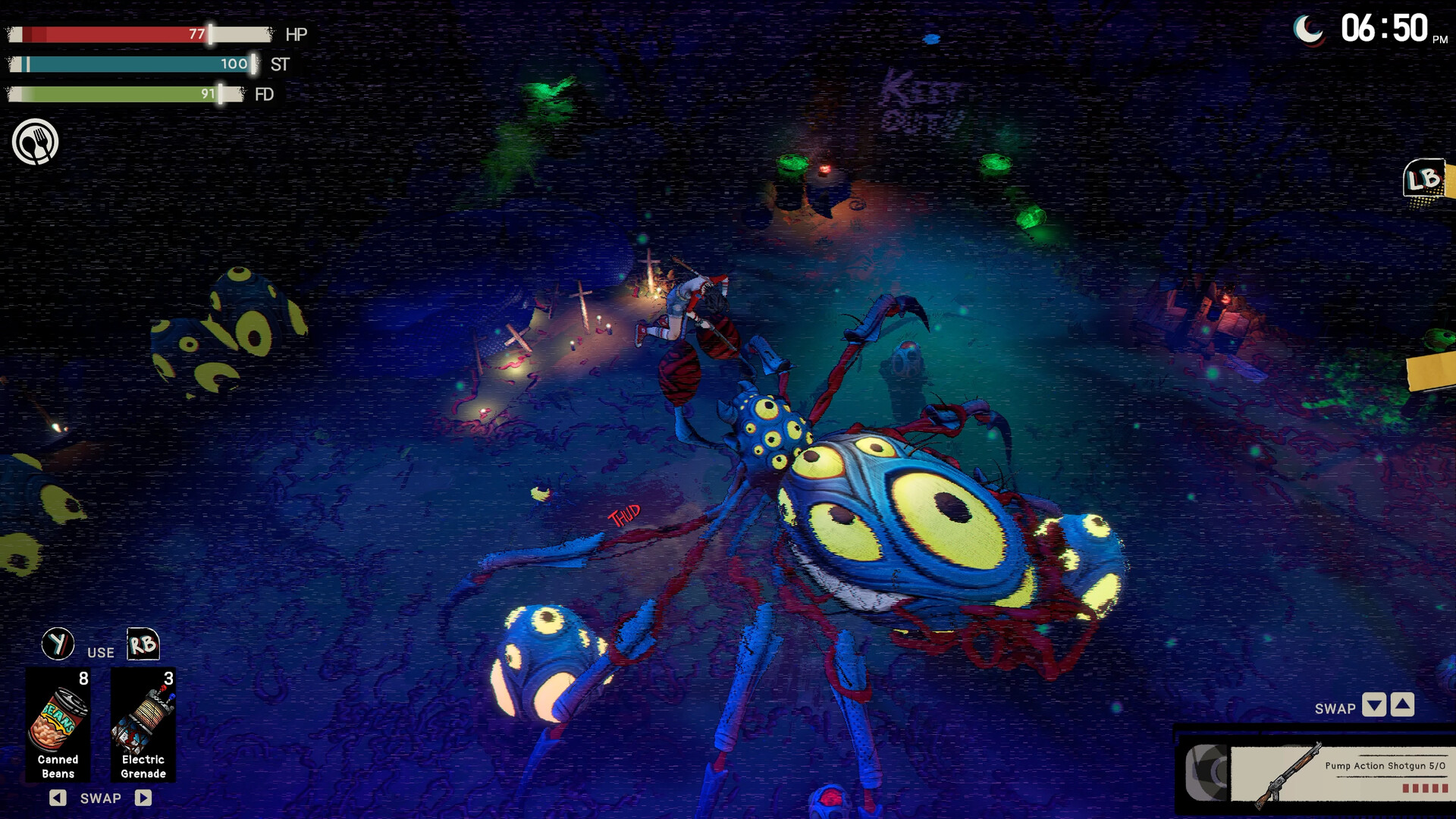
The loop is the old religion of day-and-night survival and Rock Square Thunder does not pretend otherwise. Official copy says a dynamic day-night cycle changes the world. Use daylight wisely to explore, scavenge supplies, craft what you need, and prepare for what is coming. When night falls, the real nightmares come out to play. More enemies appear, stronger and more aggressive than before. The landscape becomes harder to navigate with just your flashlight. Sometimes your best hope is to find shelter and hunker down till morning.
None of that is a revolution. All of that is the sentence the rest of the toybox has to live in. Day is a grocery run with a comic filter. You hit trash cans, lockers, storage boxes, the usual ranch groceries. Blueprints hide like dares. Scrap wants to become a workbench. Black powder wants to become a bottleneck. Night is the temperature change. The same path that felt like a commute at noon becomes a rumor at dusk. I left the ranch at golden hour like a person who had mail. I came back like a person who had been edited.
I have played a lot of games that treat the first night as a tutorial and the hundredth night as a spreadsheet. I Hate This Place is shorter than that on purpose. A campaign you can finish in a long weekend is not a cop-out if the nights are worth the walk. Some nights they are. Some nights the flashlight is a myth and the doorway is a theology problem. Both nights are I Hate This Place.
Procedural manners are not the hook. Pressure is the hook. Points of interest sit on the map like panels you have not inked yet. You loot them. You leave. You come back when you have a better shirt. The ranch can be turned into a to-do list if you would like the sandbox to behave, which is a kindness for people who freeze when a cursed land says do what you like. I left the list on for an evening and off for another. The ranch did not mind. The night minded either way.
They Hear the Scream of Boots
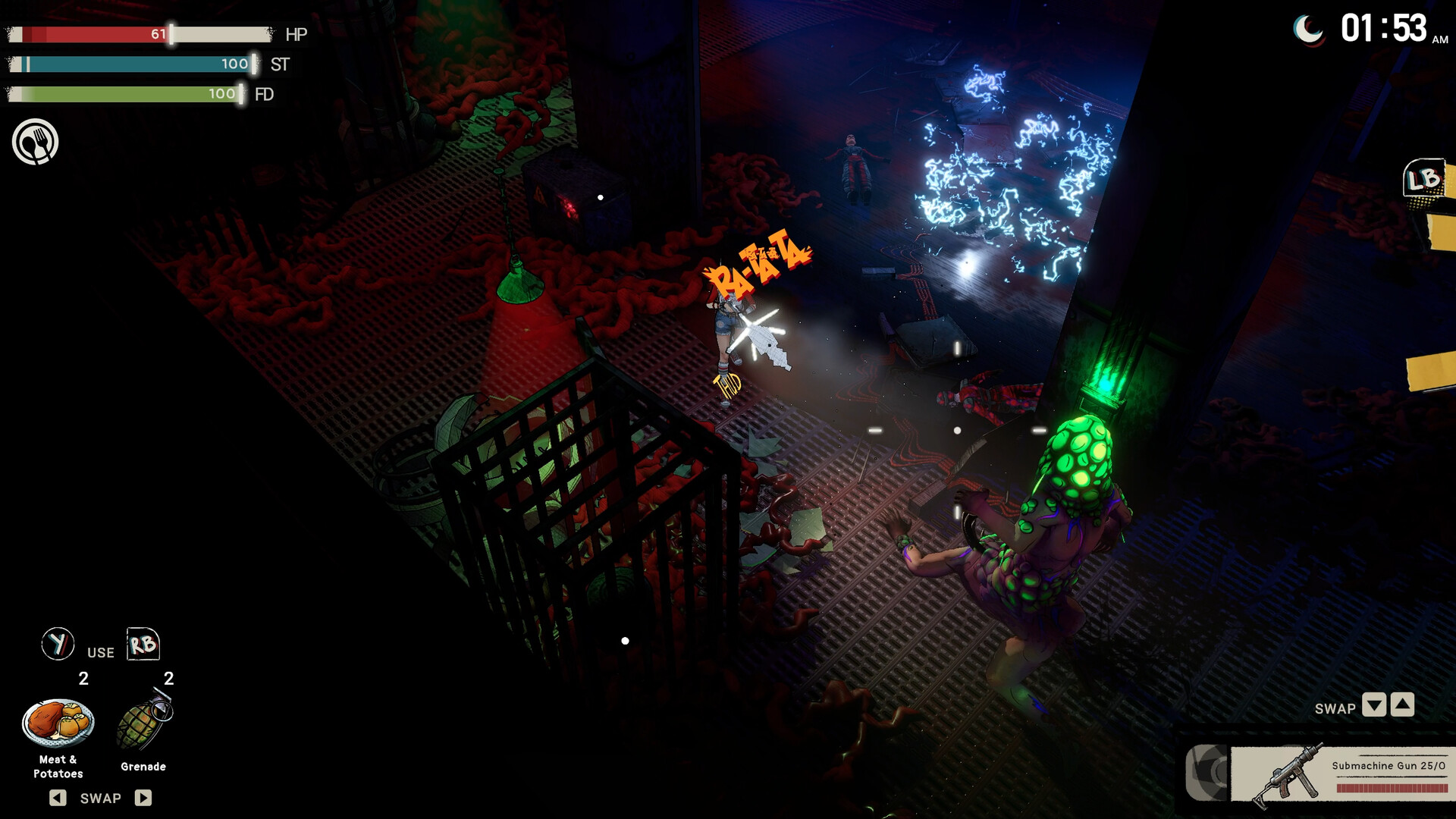
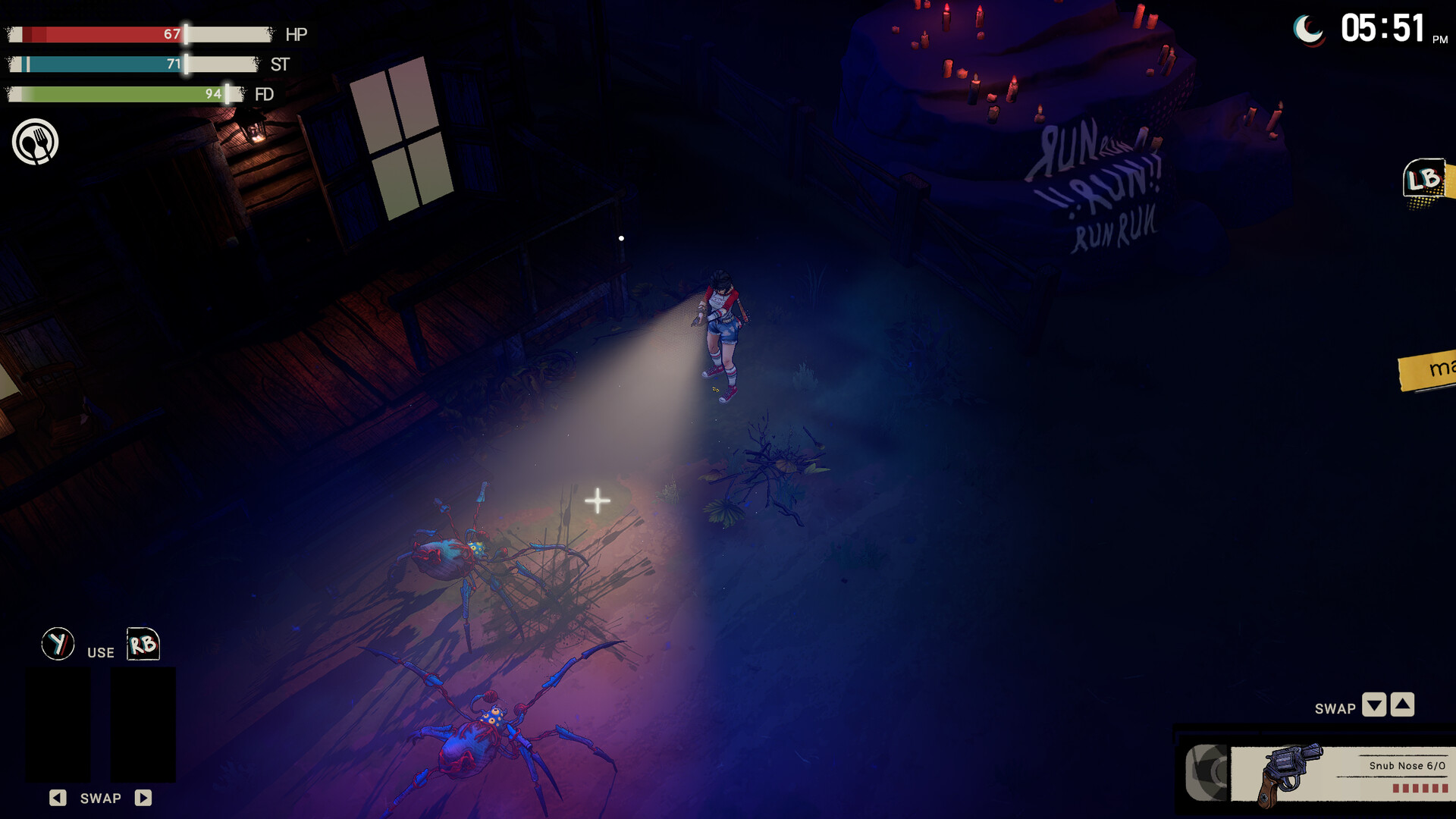
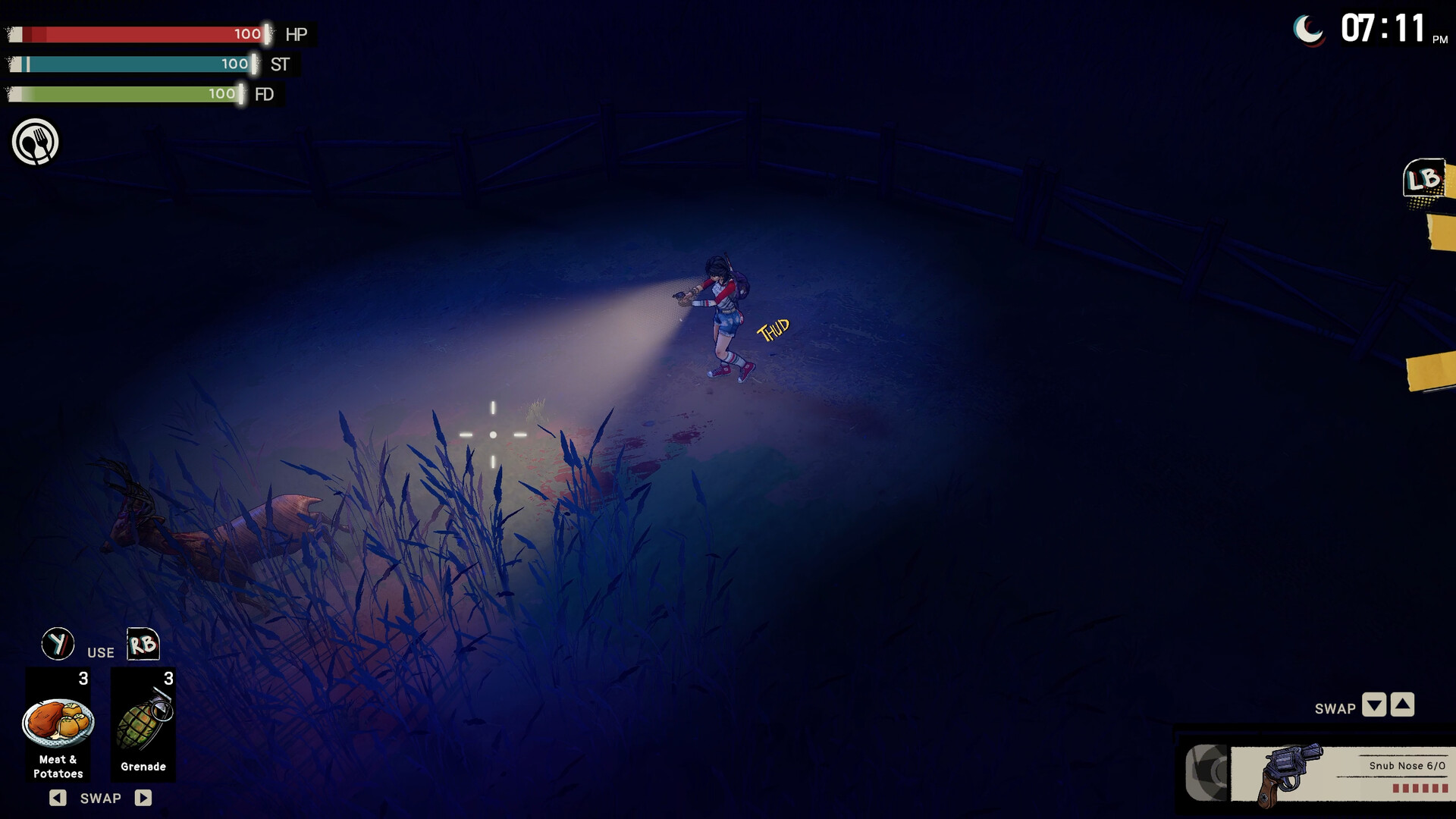
Combat is the other half of the short description and the fussier half of a walk. Official copy says stealth and combat go hand-in-hand here as many of the twisted creatures in Rutherford Ranch hunt and stalk you by sound alone. Brute force will often just land you in an early grave. Use sound to your advantage, luring creatures away from your path or cleverly leading them straight into deadly traps you laid.
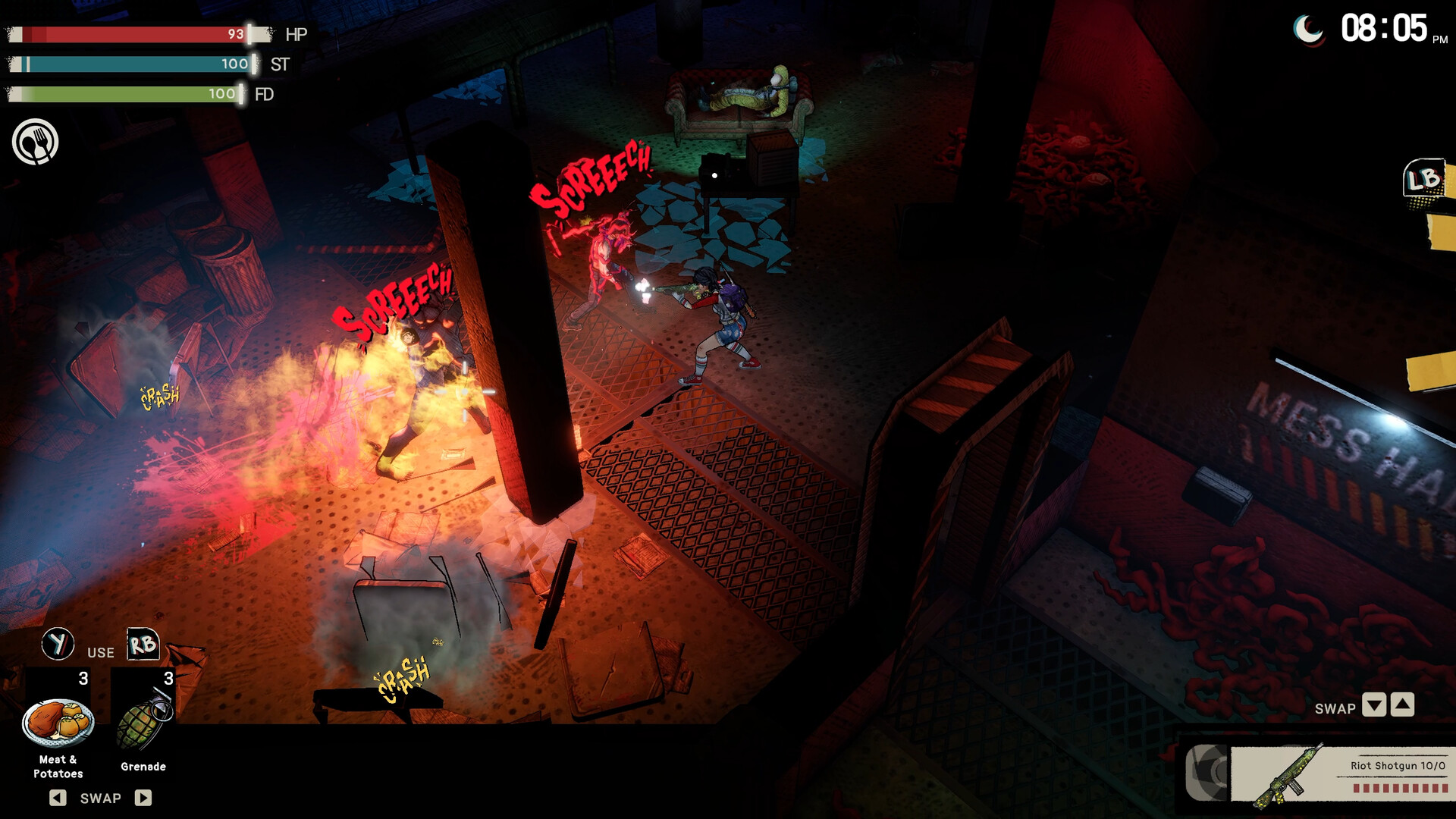
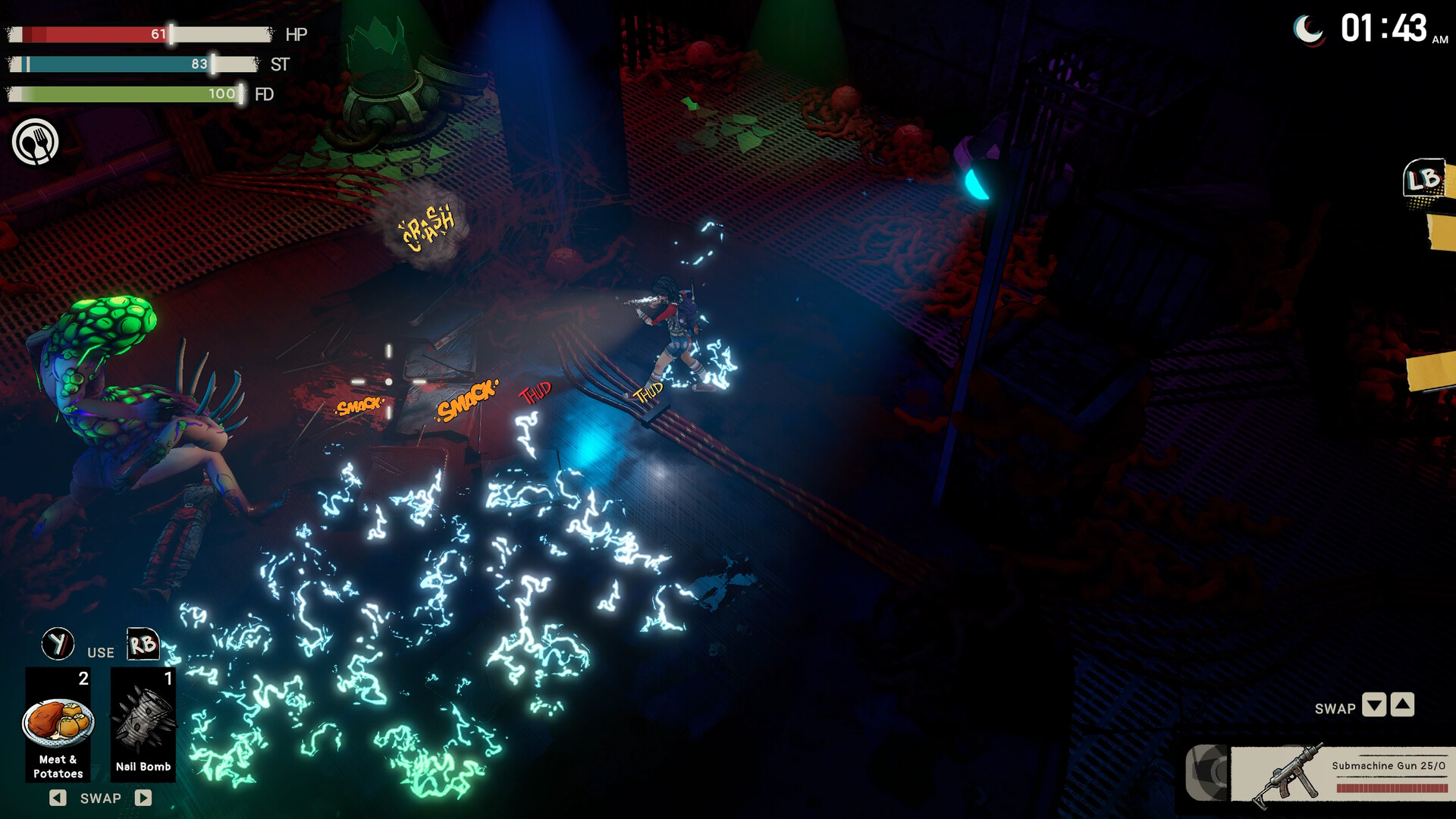
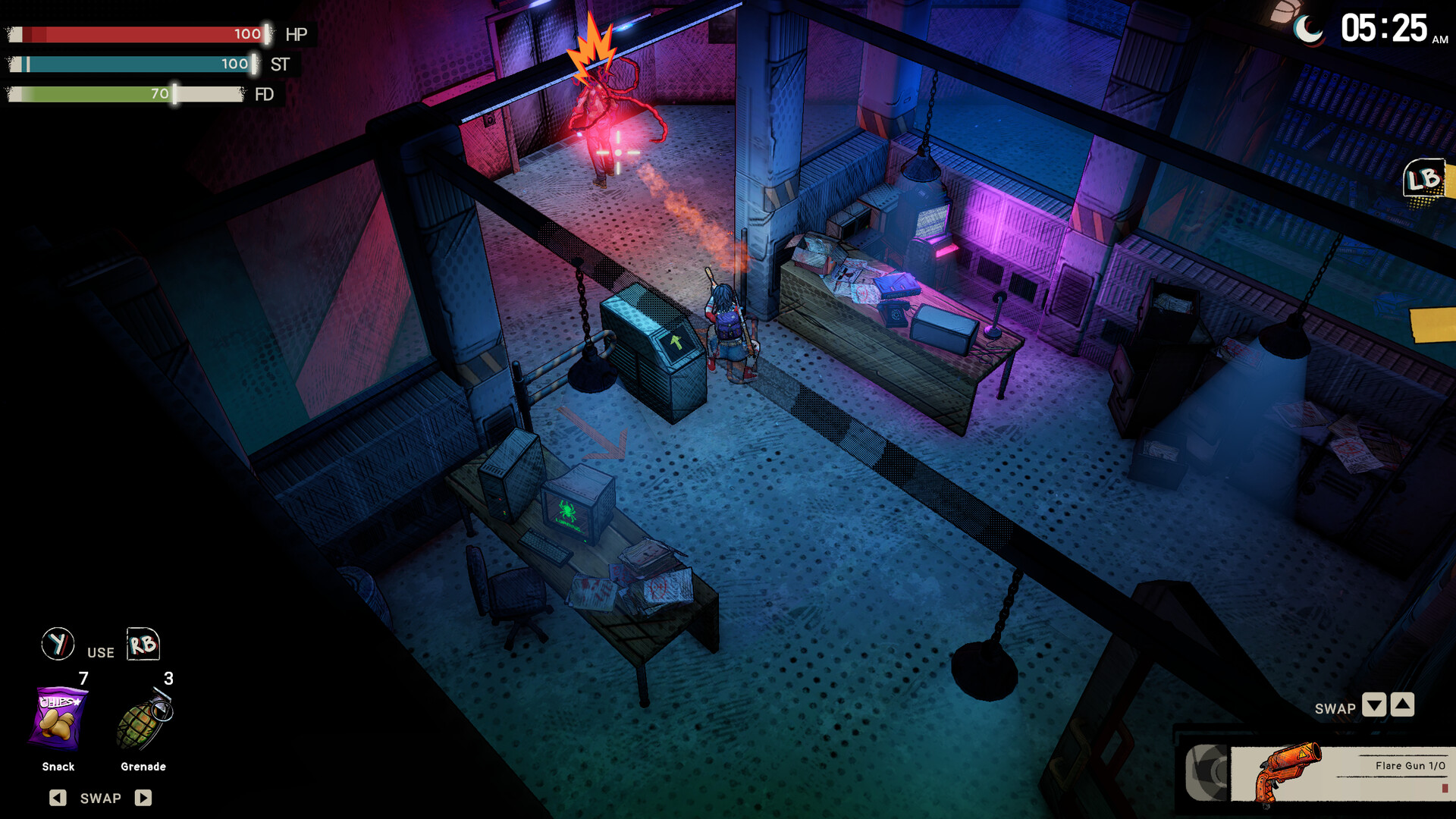
That is not flavor text. It is the design putting onomatopoeia on the floor. Comic-style sound text shows how loud you are, so you can see the difference between a crouch and a sprint. Broken glass and slimy red tentacles amplify footsteps regardless of how slowly you mean to be polite. I spent a lot of time watching patrols, tossing a lure, and slipping past a doorway like a person who has decided civilization is a whisper. Enemies follow simple routes more often than pride would recommend. Patience is a strategy, not a cowardice.
When the whisper fails, the toybox gets louder. A baseball bat starts the conversation. Blueprints later invent pistols, shotguns, rifles, SMGs. Grenades, nail bombs, Molotovs, dynamite. Ammo is crafted, not found like candy, and black powder is the ingredient that teaches you manners. Melee can feel like two people agreeing to take turns being disappointed, especially when the camera is looking down from heaven and the thing you want to hit is under the aiming arc. Guns are the better joke. Distance helps. A trap helps more.
I will not invent a highlight reel with fake timestamps and tidy kill counts. The nights that stay with you are the ones where you thought the outpost was finished, then something started listening in a rhythm that was not weather, and then you were on the wrong side of your own architecture. Investigation scenes later turn a room red and hand you a lamp to swat ghosts while you collect evidence, which is a comic-book seance with better lighting. Bosses exist. They are fewer and kinder than the store page’s nightmares suggest. Pressure is still the variety.
Scrap, Blueprints, and a Camp That Learns to Hum
Base building is the moment the ranch changes tense. Rutherford Ranch is your hub, your safe space, and your crafting argument. Official copy says you gather vital resources, craft essential gear, upgrade your campsite, and rebuild outposts to have somewhere to hide. Workbenches, water towers, gardens, processing plants if the scrap agrees to exist. Uncle is on the property if you would like the fantasy of family without the spreadsheet. He will talk. The ranch will listen.
Crafting is straightforward in the way a good workbench is straightforward. You are not drowning in menus. You are looking at a recipe and deciding whether you have been useful enough today. Facilities generate resources if you keep showing up, which is a polite way of saying the clearing can grow up. I have a rule for cheap-to-mid survival. If a camp is worse than a checklist, it is broken. If it is only good as a checklist, it is honest. I Hate This Place is honest, and that honesty should sit next to the price.
The honesty has a downside you can exploit. Invest heavily in exploration and construction and you can walk into later nights with a backpack that has already won. Dozens of medkits, hundreds of bullets, piles of explosives. Survival tension becomes a rumor you used to believe. That is not a crime in a game this short. It is a warning for anyone who wanted the ranch to stay hungry. I sold things I was sure I needed and then needed them, which is the oldest merchant joke in the book. Here the merchant is a workbench and the currency is scrap.
Blueprints are the other vehicle. Weapons do not arrive as loot piñatas. They arrive as ideas you have to build, then feed. That shift is the closest I Hate This Place comes to a power fantasy, and I like it more than a new silhouette. Mastery, here, is logistics. You scavenge, you stash, you craft a louder argument, and you walk back into a bunker that tried to eat you last week like a person who has mail. The map does not get smaller because the developers deleted land. It gets smaller because you invented commuting.
Comic Ink, Camp, and a Horned Man
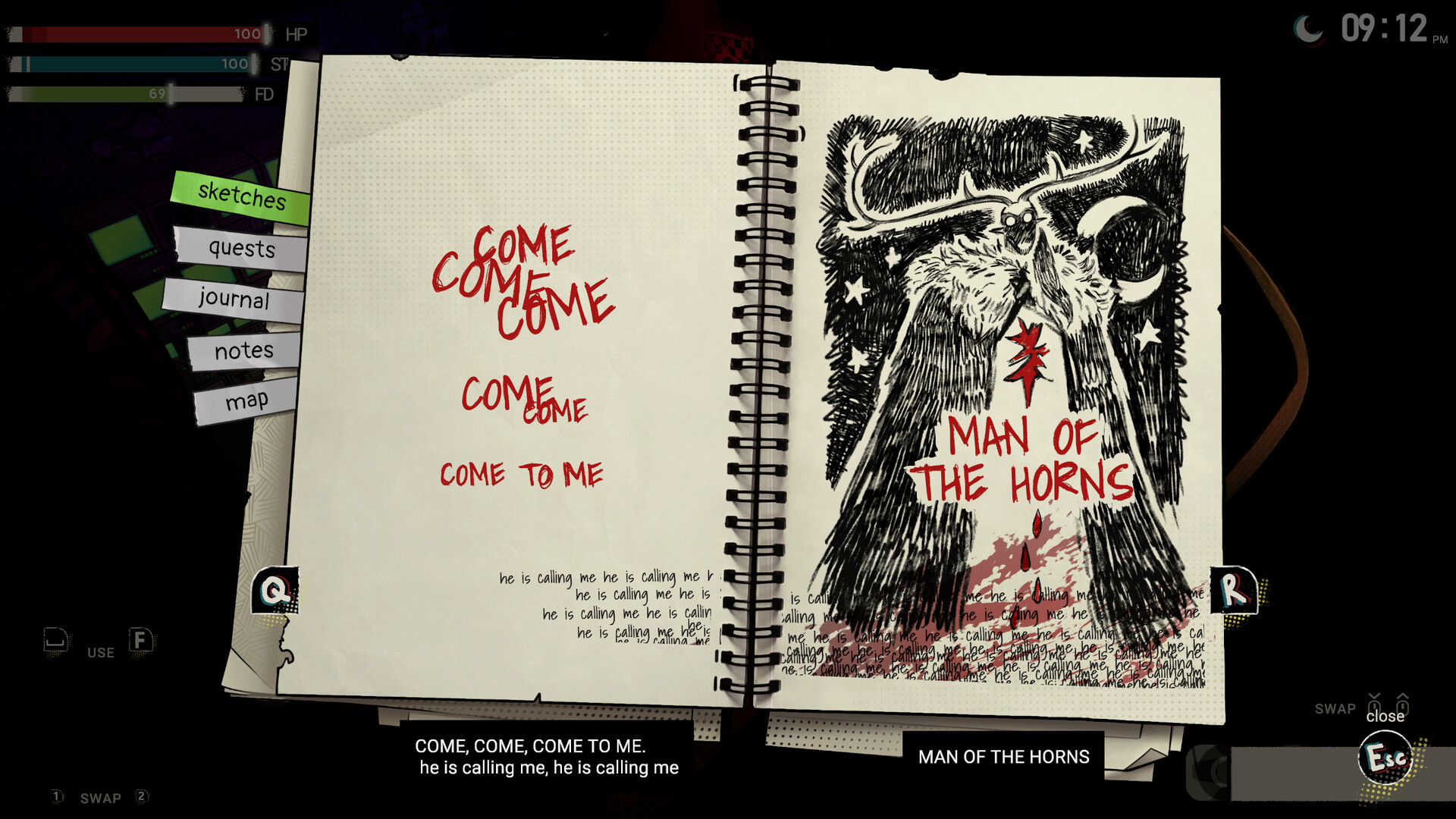
Presentation is the reason you stay after the first clumsy swing. Bold colors, punchy retro comic book style, 80s flair that would like a VHS rental and a pizza. Sound design does the other half of the scare. You can tell a forest from a town from a bunker at a glance. If you cannot read a biome, the hunt dies and the camp becomes homework. These spaces are atmospheric enough to carry a scare and clear enough to carry a plan. You always know where you are. You do not always know why the Horned Man is already there.
The story is a new narrative in the comic’s universe, not a panel-for-panel adaptation, which is the right instinct. Elena comes home with Lou to face unresolved memories. The Horned Man is the childhood rumor that learned to stand up. Cults, rituals, shadowy science, the usual ranch hospitality. Voice acting is better than a game this size budgets for. Dark humor keeps the gore from becoming a lecture. I will not spoil the seance. I will say the script has the nerve to be sincere in a game that is otherwise a comic that learned to sneak.
I should be clear about the friction, because it is real and it is not a footnote you hide after the score. I Hate This Place looks like a game that was built by a small shop that wanted a mood more than a showcase. Combat can be stubborn. Aim from heaven can miss a thing that is clearly under the reticule. Enemy variety is not a bestiary novel. Checkpoints can be stingy. Direction can sulk. The ranch sometimes forgets to explain the next errand and then shrugs like weather. I will not invent a mud census. I will say the comic sometimes forgets to stock the ingredient you need.
Technical manners on a living-room build can stutter when the game decides to remember itself. Enemies can get philosophical in a doorway. Autosaves have a way of announcing themselves. None of that is unique to this ranch. All of that is the tax on an isometric survival that arrived in January still wearing some of the same boots as a first horror from a puzzle-and-platform studio.
English is among the languages, with a full set of others riding along, and full audio on English and Simplified Chinese. I will not turn this into a localization seminar. The voice of the game is the ranch, and the ranch talks in scrap, weather, and the occasional undead knock. Thirty achievements sit behind the loop for people who like a receipt. None of them change the central truth. You are here to build a light and then find out what the light is for.
Short by Design, Clunky by Habit
I have a rule for mid-priced horror. If a game is worse as a weekend than as a checklist, it is broken. If it is only good as a weekend, it is honest. I Hate This Place is honest, and that honesty should sit next to $29.99.
A solo night is a competent weekend. You punch the trash, you invent the kitchen, you lose a plan, you walk back, you put a better lock on the joke. A careful night is the version the systems were quietly designed around. Someone crafts. Someone lures. Someone learns, too late, that a sound zombie does not respect architecture. The ranch becomes a shared instrument instead of a commute, even when the only crew is you and a flashlight.
The Steam sample around a game this small is always going to look modest. Mostly Positive is the official weather, 93 of 130 on the side of yes, and that split is fair. Players who wanted a deeper tech tree, a prettier fight, or a resource economy that never hides the powder bounce off. Players who wanted a lightweight comic adventure with a ranch and a bad idea about night stay. I am in the second camp with caveats, which is the only honest place to stand.
Compared with the giants of the survival-horror business, I Hate This Place is not trying to be a career. It is trying to be a place. The developer wrote the loop into the store page with the candor of a person who has already chosen style over a spreadsheet. Craft. Sneak. Wait for morning. That is not a cop-out if the place is worth the walk. Some nights it is. Some nights the workbench is a myth and the doorway is a theology problem. Both nights are I Hate This Place.
Still Standing After the Night
I Hate This Place is a rare mid-priced survival horror that understands its own joke and then has the nerve to make the joke a campsite. Rock Square Thunder built a ranch about homesickness, a night about teamwork with a lure, and a toybox that looks a little homemade and plays a lot more sincerely than that sentence suggests. The loop is the hook. The sound is the spine. The walk from a bat to a blueprint is the grin.
It is better as a weekend than with a checklist. Combat is clunky in the way a lightweight fight is clunky. Resources can sulk or overflow. The presentation has indie fingerprints, from the stubborn aim to the story that would rather be a panel than a cutscene. All of that is true, and all of that is already priced in at $29.99. You are not buying a decade. You are buying a weekend that can turn into a couple of weekends if you like being a coordinated disaster, or being the person who has to explain the disaster to an uncle.
I am scoring it 8, Great, because the identity is this clear and the limitations are the limitations of a focused survival, not an empty one. I would recommend it to anyone who likes a workbench that has weight and a map that is allowed to be rude. Distinctive comic weather, a night that shrinks the horizon, stealth that turns scrap into conversation, and a price that respects your week are a lot of game for the ask. The systems repeat their manners. The manners are still useful.
The ranch is still out there, still hiring a night shift, still asking what the Horned Man was for. After a few doors, you will understand why the job is not finished, and why you keep waking up on the property anyway.
We prepared this review with a digital copy of the I Hate This Place for the PS5 version provided by Pressengine.