There is a particular kind of courage, rare in a medium that usually hands you a chosen one and a prophecy, in sending a kid who cannot read the glyphs to save the world from a demon invasion. Folly Of The Wizards, the comedic 2D roguelike action game from UpFox Labs and Numskull Games, is built on that joke, and the joke is sturdier than a wacky cult has any right to be.
I played the PlayStation 5 version, the living-room edition that arrived on 19 September 2025 alongside PC, Switch, and Xbox. UpFox Labs is a tiny studio putting out its first public game after a couple of years of stubborn work. At $29.99 it is priced like a full roguelike you can live in for a week, which is both the compliment and the warning. You pick one of four clumsy wizard apprentices, join a cult that should have done a better interview, and climb five floors drawn from nine biomes plus a secret the box will not name. A pool of 130 relics, tomes, and scrolls rewrites the run. Four elite wizards rewrite your social life. Twenty-two bosses and seven endings sit at the top of the tower, waiting to grade the relationships you kept and the ones you burned. Great, not tidy, and very much a cult I would recommend you join.

The Elders Clocked Out, the Demons Clocked In

The premise is a comfort blanket of failure worn with the sincerity of people who still think failure is funny. The world is in danger again. The elder wizards are too old, too tired, or too busy being legendary to walk the floors themselves. That leaves the apprentices, a gaggle of underpowered spellcasters who barely know which end of the scroll is the dangerous one. You play as one of those hapless heroes, and the game makes sure you feel the underdog status before the first room has a name. The cult is a workplace that hired the wrong kid and then handed that kid the fate of the world.
Story is functional and stingy, which is the right instinct for this kind of object. You are not reading a novel. You are scavenging a disaster that happens to have a punchline. Evil was vanquished once by a coalition of wizards. The coalition disappeared. The evil came back. The fiction tests whether you prevail or whether the title becomes a warning. Folly Of The Wizards leans on tone more than plot, and the tone is a grin with a bruise under it. Elite wizards bully the apprentice along the way. The language can be rude. The game itself pokes fun at you after a death, gently reminding you that your wizard really is not very good. Harsh, oddly motivating, and more adult than a cartoon robe has any right to be.
Four playable wizards sit on the select screen, each with strengths, weaknesses, and spellcasting quirks. The game is happy to tell you they are all terrible, which is a nice little courtesy. Pick one. Live with the kit. Success demands more than brute force. You need quick reflexes, a little cleverness, and a touch of luck. Keep your wits about you and make the most of the resources bestowed upon you, and you will be fine. Probably. That last word is the thesis. The fantasy is not mastery. The fantasy is competence arriving by accident, usually about half a second after a misfire that should have killed you. You will be roasted, exploded, bullied by a master mage, and flattened by a boss in the span of a single floor, and the correct response is a laugh rather than a groan. I laughed more than I expected. I also died more than I expected. Both are the product.
Relics, Tomes, Scrolls, and the Beautiful Accident
Combat is twin-stick in the living-room sense. You aim with the stick, fire a basic spell, and try not to stand in the thing that wants you dead. The kit starts generous on paper: jump, double jump, dash, a primary attack you can spam, and a secondary that arrives later as a cooldown tantrum. Movement has vertical and horizontal opinions. You can dash in a line, at an angle, through a crowd if you timed it, into a pit if you did not. Platforms split the arenas into elevations, so a fight is a conversation about height as much as aim.
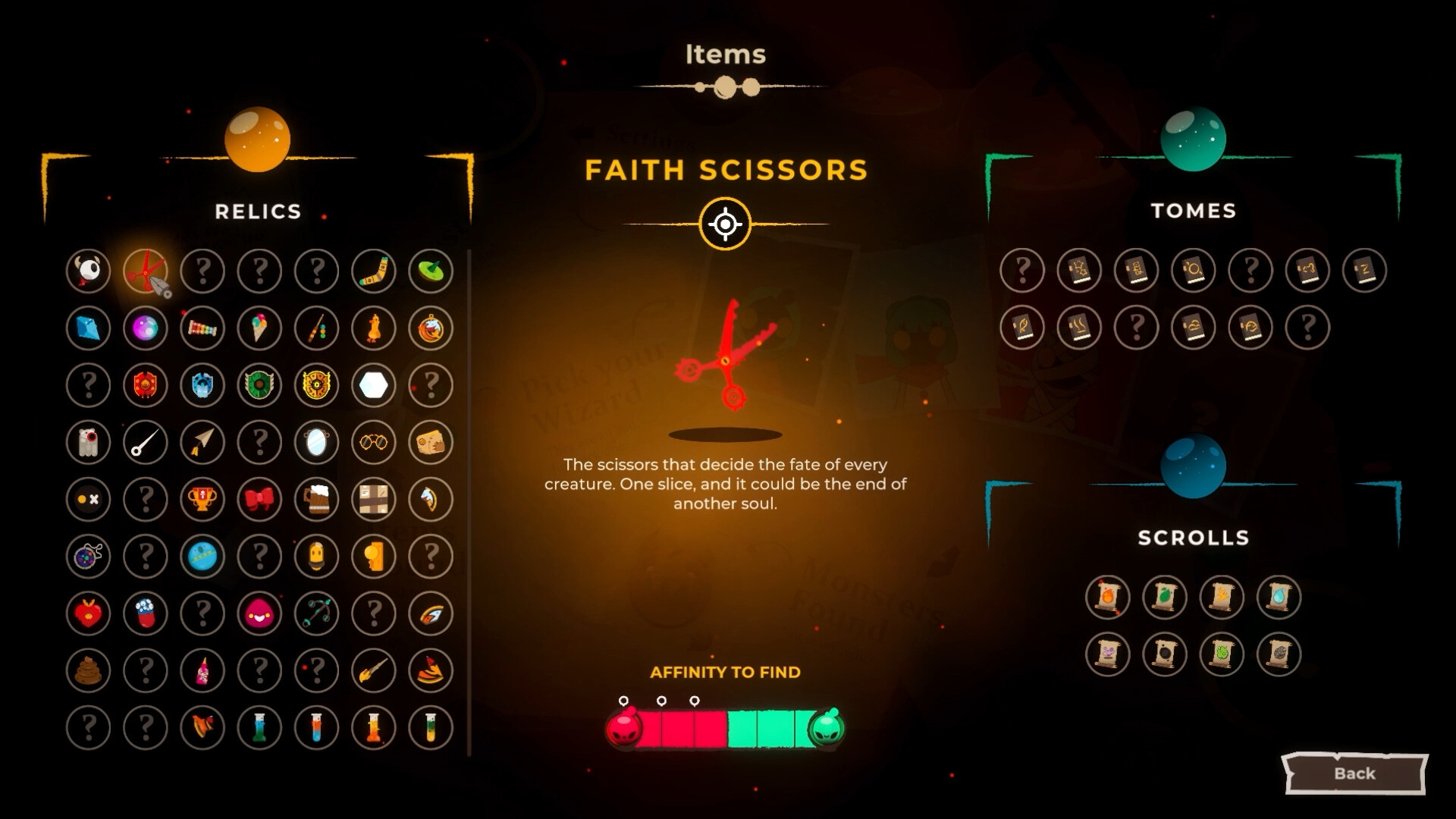
The build is where the game finds its identity. Each run draws from a pool of 130 relics, tomes, and scrolls. Relics provide passive buffs and augments, the quiet habits that make a later floor feel like a different person. Tomes alter the elemental damage of your basic attacks, so the same poke becomes fire, water, lightning, or some unholy cousin you invented by stacking the wrong books. Scrolls grant access to powerful spell cooldowns, the punctuation that turns a messy room into a sentence.
Elemental weaknesses give the toy a grammar. Some creatures wilt under water. Some shrug it off. You can collect elements and, if the night is kind, combine them into something new. I found myself experimenting more than I planned to, chasing goofy-but-powerful combos that turned a clumsy apprentice into something resembling a threat. The best evenings were the ones where two relics interacted in the dumbest, most beautiful way and I felt like an accidental genius for about four rooms. The other half of that sentence is confusion. Descriptions can be vague in a way that feels like a design choice and then, after the third unreadable relic, feels like a missing tooltip. You pick something up and have only a rumor of what it does. You might grab a gift that accidentally replaces a favorite secondary, and there is no polite way to get the old one back. I respect a game that wants you to think. I resent a game that wants you to guess in a language it has not taught.
Four Friends You Can Afford to Lose
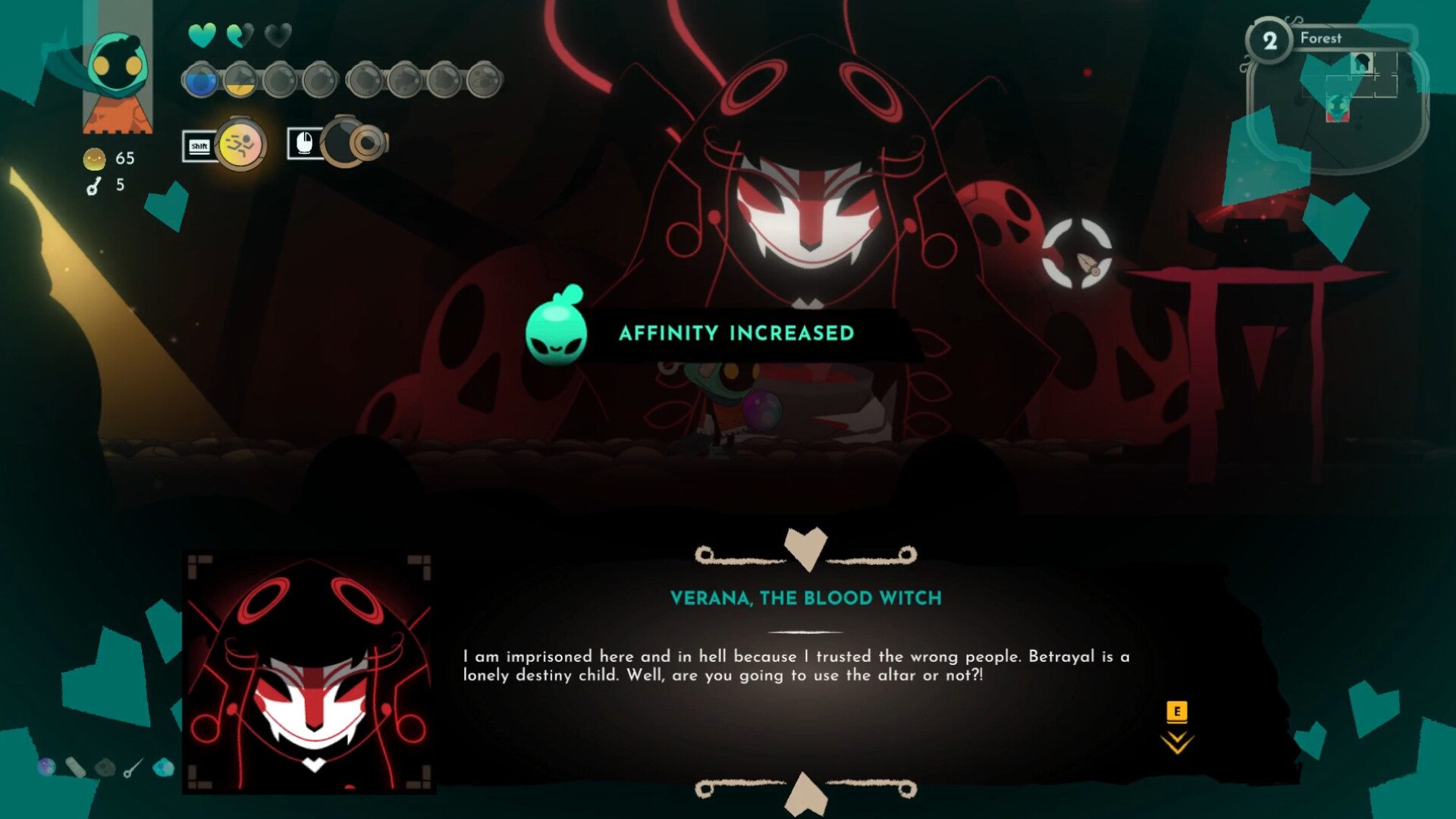
Social skills are not flavor text here. They are half the engine. Will you befriend the elite wizards and gain powerful allies, or will you stand up against them and face their wrath? Every decision and conversation can shape a relationship and alter the course of the adventure. The four affinities have names and jobs. Larn is the merchant, a coin conversation with a smile that has a price. Mingo supplies a scroll when you visit, a page you may or may not be able to read. Niro offers a relic, the quiet bribe that rewrites a build. Verana trades sacrificed health for possible rewards, a bargain you should only make if the next room is not already a funeral.
Dialogue options lean positive or negative. Stay consistent and a relationship becomes a tool. Flip-flop and you become a tourist with a worse shop. Affinity changes the items that appear, the maps that open, the bosses that wait, and, eventually, which of the seven endings you earn. I was not expecting a relationship system in a game that looks like a magical cartoon meltdown. It works. It adds personality to every run. It also remains, for longer than it should, a little opaque. You are largely guessing which line will please Larn and which line will make Verana decide you are a snack. The writing is charming enough that the guess is still a conversation. The systems behind the conversation could use a subtitle.
Eighty-three quests sit under that social layer, small jobs and longer grudges that give a run a reason besides the next floor. The elite wizards are the other reward for talking like a person instead of a calculator. They are powerful, insufferable, and willing to become allies or final exams depending on how you treated them. Maximize a bond, or maximize a grudge, and the tower notices. I have flattered my way into a kinder shop. I have insulted my way into a boss I was not ready to meet. Both nights were better than a run where I treated every NPC like a vending machine.
Nine Biomes, a Secret Floor, and Twenty-Two Arguments
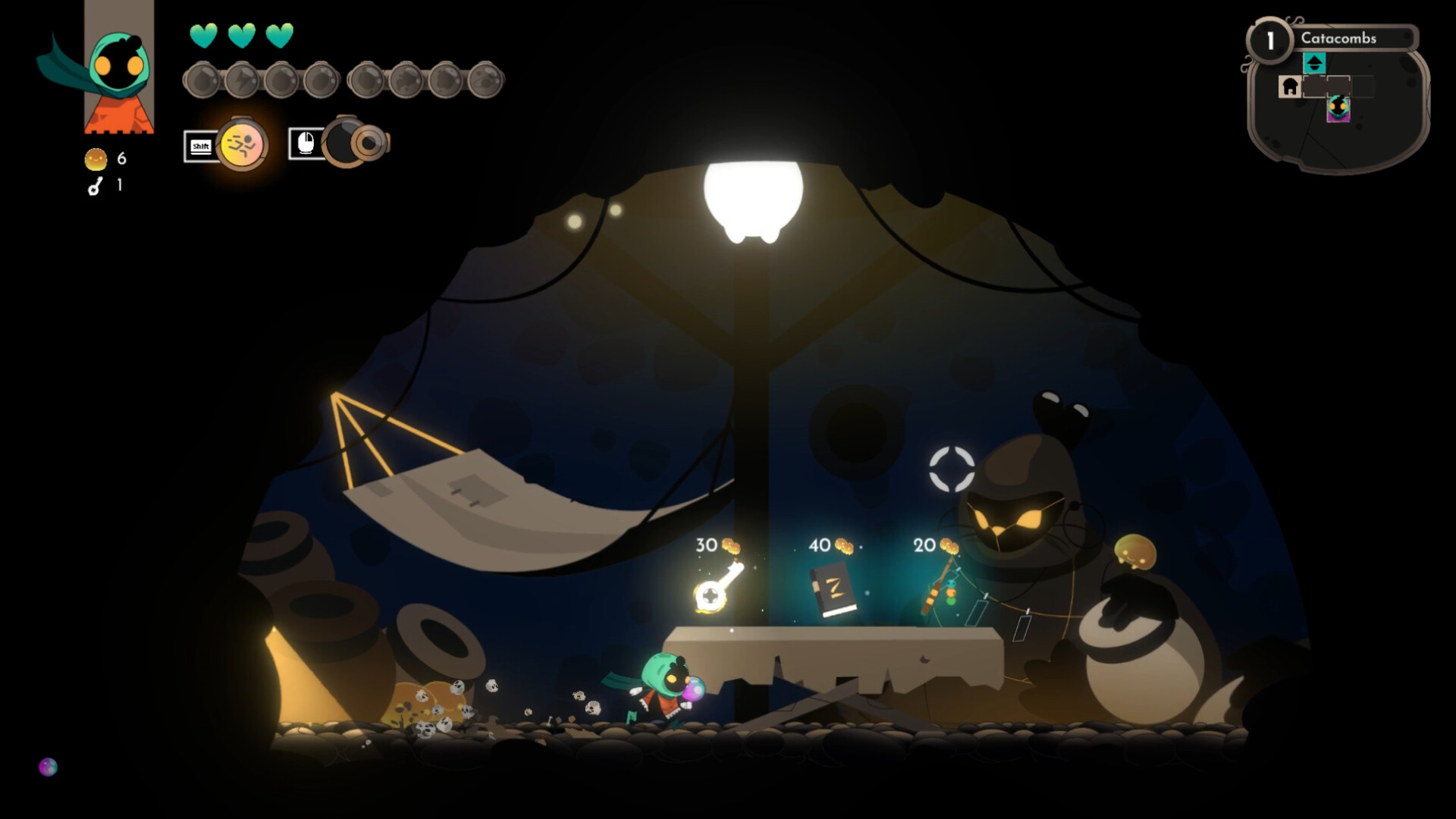
The climb is five floors drawn from a possible nine biomes, plus one secret the marketing department will only whisper about. The named rooms have handwriting. Wizard Palace still looks like a workplace that had a schedule. Ancient Catacombs remember a burial they have not finished. Enchanted Forest hides noxious clouds and things that would like you to stay. Desert Sands erupts with demonic worms. Tundra Caves make the air feel expensive. Lost Market, Forgotten Runes, Souls Kingdom, and Hell take the costume changes further, each with an enemy set that refuses to be a reskin of the last. You always know you have changed neighborhoods. You do not always know whether the neighborhood has agreed to let you leave.
Procedural generation is the other half of the personality, and it is not wallpaper. Rooms shuffle. A door that was a shortcut becomes a dare. When one type of enemy proves difficult, the next attempt might hand you a different, slightly kinder crowd, or a worse one, because the tower does not owe you a curve. Variety across the board is why starting from scratch does not always feel like a kick in the teeth. Familiarity is why, after enough evenings, a shuffled room can still feel like a commute with better lighting.
Twenty-two unique bosses grade the climb. The encounter you get depends on the biome and the affinity choices you have made along the way, which is a delightful way of admitting that your social life has a hitbox. Some fights are creative and memorable, gimmicks that elevate the room into a stage. Elite wizard bosses wait in the Catacombs, the Forest, the Tundra, the Desert, and in the personal grudges you kept with Larn, Mingo, Niro, and Verana. The fights stayed fair in the way a good action game is fair: if you got hit, you usually knew whose fault it was.
A demo exists if you want to test the language first. Ninety-three achievements sit in the background like a second tower. The real checklist is the next ending, the next biome, the next affinity you have not maxed in either direction. Seven endings is a healthy spread, not a career.
Hand-Drawn Robes and a Soundtrack With a Grin

I have played a lot of indie roguelikes that announce a unique art style and then deliver a pleasant palette with nicer outlines. Folly Of The Wizards is doing something rarer. It looks, moves, and jokes like the same idea. The picture is charming hand-drawn work, bold color, quirky silhouettes, the kind of wizard who looks like they wandered out of a retro sprite sheet and then got a better animator. Characters, NPCs, bosses, and enemies all have unique looks. You can tell a forest from a desert at a glance, which matters, because if you cannot read a room the combat dies.
Biomes do the rest of the presentation work. Demonic worms, noxious clouds, fireball flyers, things that tunnel and then arrive like a punchline: the menagerie has handwriting. Boss arenas get extra care. They feel like stages, not wider hallways. When a fight finally breaks and the screen celebrates, it is not a loot explosion. It is the picture admitting you shut something up for a few seconds.
The soundtrack has a grin and, when a boss arrives, a spine. Each area wears its own track, so the climb has a sense of travel even when the room geometry is a cousin of last night’s room. Combat hits could be meaner. Projectiles and enemy contacts sometimes sound like they are being polite in a fight that is not polite. The music covers a lot of that gap. None of that stops the picture from working. You always know where you are. You do not always know why a frog in this cult belches gas, and that confusion is the charm.
When the Glyphs Stay Unreadable

I should be clear about the friction, because it is real and it is not a footnote you hide after the score. The controls on a pad ask you to rewire habits you have spent a decade building. Jump lives on a shoulder. The design choice is understandable, since you are aiming with the right stick while platforming, and a face-button jump would fight the aim. In practice, the first hour is a tutorial in humility that has nothing to do with demons. Aim sensitivity feels high, and you cannot change it. You cannot remap the layout in the menu.
Health is tiny. Enemies hit hard. Invulnerability after a hit is short, which means a crowd can lecture you twice before you have finished flinching. Pickups are rare. Currency arrives slowly. There is no difficulty slider. The relics you collect, the wizard you unlock, and the hours you put in are the slider. Early runs are poor on purpose. Later runs are still capable of handing you a room that is a lecture. I accept that trade in a roguelike. I do not accept it silently when a vague relic and a cheap hit chain combine to end a good climb for a reason I cannot name. Movement can feel floaty and grounded at the same time, a weird weight that wants to be graceful and then remembers the apprentice is clumsy. Combined with the shoulder jump, a dash that wants a diagonal, and a boss that swoops, the kit can turn a readable pattern into a custody battle with your own hands.
The loop repeats its manners. New biomes, new elites, new affinity endings, and still, after enough evenings, a hallway that is a rearrangement of an earlier hallway. Procedural pathways are a spice. Spice is not a meal. When the same category of surprise sits in a new costume, the surprise becomes a commute. Systems remain under-explained for longer than a thirty-dollar ask should allow. None of this knocks the object into a lesser tier. A small studio made a complete comedy with a social spine, a build toy that can still surprise, and a visual thesis you will remember. The limitation is the limitation of a focused, slightly stubborn debut, not an unfinished costume.
Still Climbing After the Cult Laughs

Folly Of The Wizards is the rare mid-priced roguelike that understands its own joke and then has the discipline to make the joke a system. UpFox Labs built a climb about incompetence, a cult that hired the wrong kid, and a tower that keeps rewriting the hallway while four elite wizards keep score of how you spoke to them. The hook is a clumsy apprentice with a wand and a bad attitude. The spine is the way relics, tomes, and scrolls turn a failed run into a different kind of accident. The scar is the night the glyphs stay vague and you climb anyway, because the next boss has a face you have not finished arguing with.
It is better as a comedy with teeth than as a mechanically tight cathedral. The biomes have enough costume changes to prevent the second hour from feeling like the first, and not always enough to prevent the eighth from nodding at the third. The affinity system stays the reason the endings feel like they belong to you. The build pool stays the reason you start another run after a death that should have been the last. The repetition is real. So is the grin when two relics become friends and a room that wanted you dead becomes a punchline you aimed.
I am scoring it 8, Great, because the identity is this strong and the limitations are the limitations of a focused debut, not an abandoned one. At $29.99 you are not buying a decade of extra chapters. You are buying a cult, a climb, a relationship system that actually changes the tower, and a secret floor the box will only whisper about. I would recommend it to anyone who wants a roguelike that lets you experiment, laugh at your own incompetence, and occasionally feel like an accidental genius. The systems hide behind handsome rumors. The rumors are still worth learning.
The elders are still too old. The demons are still on the clock. After a few climbs, you will understand why the cult hired the wrong kid, and why you keep putting the robe back on anyway.
We prepared this review with a digital copy of the Folly Of The Wizards for the PS5 version provided by Numskull Games.