
There is a particular kind of pride, rare in a medium that usually hands you a vehicle and a map, in watching a machine you bolted together five minutes ago carry a watering can the size of a bungalow across a ridge that did not exist last contract. The can sloshes. The ridge lies about its slope. The rover, which looked like a triumph in the editor, becomes a suggestion. You flip. You laugh. You rebuild the claw two degrees to the left and try again, because the drop-off is a glowing rectangle and the glowing rectangle does not care about your feelings. Mars First Logistics, the open world physics simulation from Shape Shop and Outersloth, is built on that delivery, and the delivery is funnier and kinder than a red planet has any right to be.
I played the PC version, the September 25, 2025 1.0 launch that pulled a two-year Early Access stretch, begun on 21 June 2023, into a finished colony at $19.99. Shape Shop is Ian MacLarty’s Melbourne studio, the small shop behind shapeshop.games, with a taste for systems that behave like characters. Outersloth published alongside them. You design and build mechanized rovers, then you haul awkwardly shaped cargo across procedurally generated Martian terrain. More than a hundred parts wait in the toybox: springs, hydraulic cylinders, servo motors, rocket engines, and, by 1.0, gimbals, a levitating actuator, a gravity suppressor, sensors, and logic gates. Play solo or recruit up to three friends. Unlock parts, buildings, roads, power lines, water pipes, and monorails. Standard mode makes you earn the kit. Creative mode hands you the warehouse. Steam’s sample, 3,463 recommendations deep when I wrote this, leans warm. Seventeen achievements sit in the background like a second clipboard. Great, not tidy, and very much a job I would recommend you take.
Bolts, Springs, and a Workshop That Listens

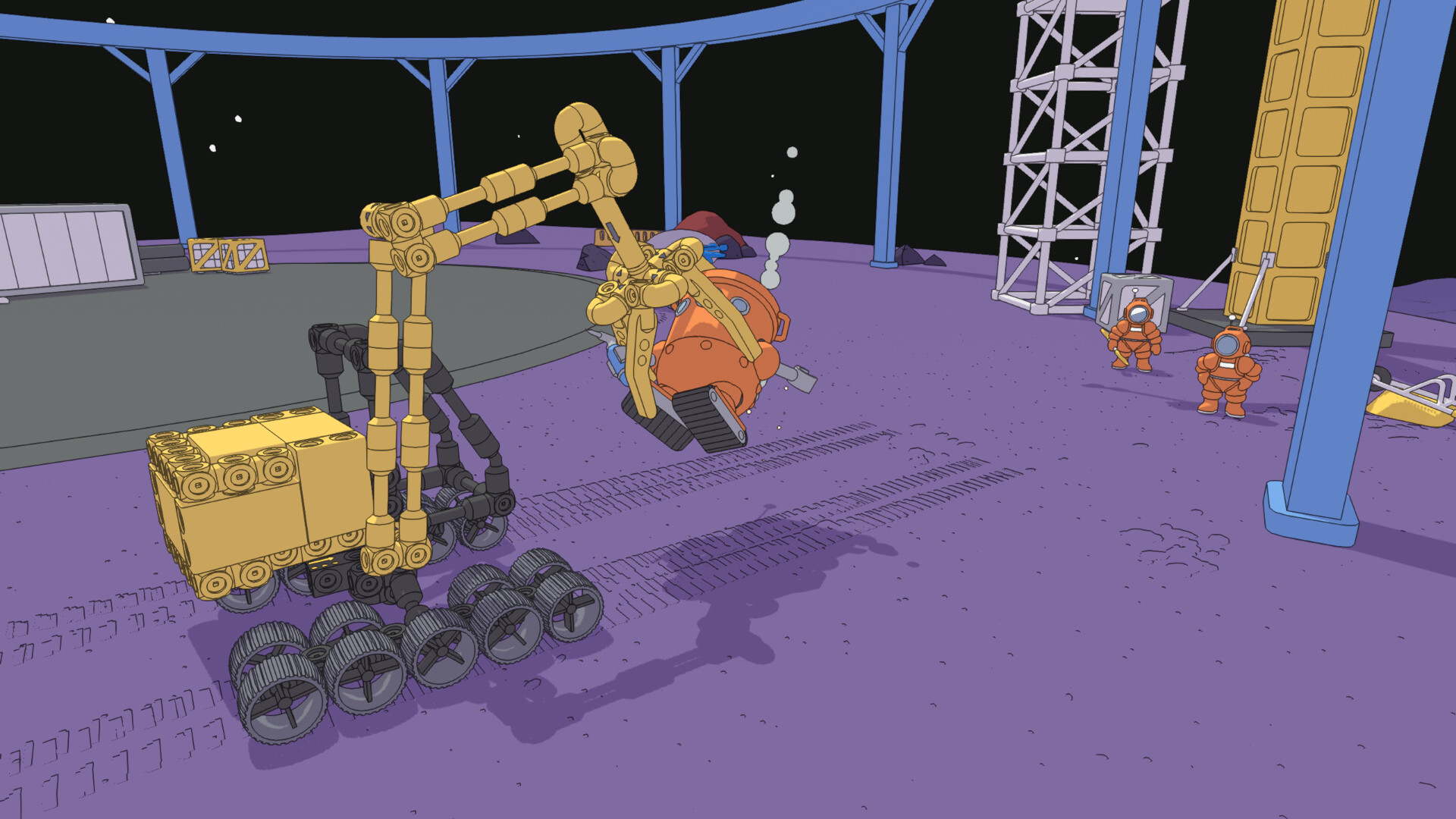
The editor is the reason the planet is worth the commute. It is tactile in the honest sense: you grab, you snap, you rotate, you feel the joint before you name it. You are not filling slots on a loadout screen. You are assembling a sentence out of metal. A simple chassis and a pair of wheels will get a crate across a polite valley. A late contract will ask for a crane that can lean, a claw that can keep its grip on a slope, and a suspension that does not turn a bump into a lawsuit.
Over a hundred parts is not a boast so much as a vocabulary. Springs forgive. Hydraulics lift. Servos turn a wish into an angle. Rockets are the rude option, the one you reach for when a hill has already rejected your manners. Joints let you build things that fold. A gimbal that keeps its angle is a small miracle on a slope that wants to turn your crane into a catapult. The 1.0 kit adds a programming layer that would have felt like homework in a lesser sandbox and feels like a new dialect here. A sensor shouts when it touches something. A relay passes the shout. An AND gate waits for two opinions. You can build a rover that honks when it hits a rock, or one that steers itself around a corner you are too busy to take. Both are valid evenings.
The first hour is a tutorial in humility. Blueprints exist for the early jobs, a courtesy from a game that knows you have not yet learned the language. Then the jobs stop handing you the answer. I like an editor that lets you be ridiculous on purpose. There is no one right rover. Some nights I built a clean truck and felt like a professional. Some nights I built a spider with too many elbows and felt like a person who had invented a new kind of walking. A levitating actuator that holds two ends together with an invisible force is a punchline that also happens to be useful. A gravity suppressor that lightens a crate is the closest the toybox comes to cheating, and I used it without shame. The workshop does not grade style. The planet does.
Cargo With Opinions and No Manners

The cargo is the other half of the personality, and it is not wallpaper. Heavy cargo sits on the chassis like a grudge. Fragile cargo asks you to drive as if the planet were made of glass. Bouncy cargo treats a bump as an invitation. Cargo that wants to float away turns a simple haul into a negotiation with the sky. You never know which new argument is waiting around the next ridge, which is irritating in a serious trucking sim and delightful in a game about inventing the truck.
A greenhouse wants a watering can. A building wants scaffolding. Someone wants tomatoes, and the tomatoes would prefer to remain tomatoes. Open crates spill if you take a corner like a person with somewhere to be. A piece sitting on a high ledge can turn one job into two machines: one to fetch it down, another to carry it home. Delivery is a placement exam, not a dump. The glowing rectangle is fussy in a way I came to respect. That last meter is where a proud rover becomes a clumsy waiter. I have arrived with a perfect haul and then spent five minutes lowering a crate as if it were a sleeping animal.
Flip the rover and a button rights you. Spill the job and a button hands you the cargo again. You will use both. Using both is not failure so much as tuition. Contracts teach without pausing to lecture. Early hauls are about not dropping the joke. Later hauls are about using the very thing that dropped it. Shape Shop designed the cargo to force a new use of the kit, and that mandate is the game’s best idea. A beginner treats the cargo as an enemy that keeps interrupting a driving game. A veteran treats the cargo as the driving game. The reveal is that you were the obstacle.
A Red World That Refuses to Stay Flat

Mars, in this telling, is not a brown commute with better lighting. The cel-shaded picture is bright, graphic, and immediately itself. Valleys read as places you might want to linger. Ridges read as dares. Buildings pop up in colors that refuse the usual rust postcard. This Mars has a handwriting. You can tell a work site from a wild stretch at a glance, which matters, because if you cannot read a slope the physics dies.
The terrain is procedurally generated, a vast argument that rearranges the commute. New challenges sit over every horizon. Mud, ice, little lakes, shading that tries to confess a bump before you meet it: the 1.0 planet is more honest than the Early Access one, and still, some nights, a little hill hides in the stylized light and flips you like a coin. That visibility tax is real. It is the cost of a picture that would rather be handsome than encyclopedic. I accept the trade. I do not accept it silently on the fifth identical yeet into a crater I swear was flatter a second ago.
The camera likes the machine. Wheels throw dust. A rover’s engine changes its tone with the terrain and the load, a small courtesy that makes a heavy haul sound like work. The soundtrack is lofi with a pulse, meditative on a long valley, a little brighter when a new building appears like a reward. I zoned out more than once, which in a physics toy is a compliment. 1.0 opens the map in a way Early Access only promised. A space elevator and Phobos, Mars’s own moon, turn the late game into a new weather. Ten end-game contracts sit up there with a puzzle focus, asking you to combine skills you already unlocked. The colony you have been feeding suddenly has an upstairs. I wanted that upstairs.
Funds, Blueprints, and a Colony That Grows Behind You

Progression is the quiet spine. Each successful delivery pays funds, unlocks parts and blueprints, and opens infrastructure you can actually plant. Roads, monorails, power lines, water pipes: the colony is not a menu that ticks a box. Buildings spring up because you hauled the joke that made them possible. Watch a road appear where your rover used to suffer and you feel the fiction click. You are not only delivering cargo. You are delivering a commute for the next cargo.
Standard mode is the campaign wearing work clothes. You earn the kit. A new servo arrives like a birthday. Creative mode is the warehouse with the lights on, every part available, the planet turned into a sketchbook. You can tweak individual settings if you want a private difficulty. I spent most of my serious time in standard because the unlock is a better teacher than the toybox. I fled to creative when I wanted to build a monster without asking permission. Play your way is not flavor text here. It is the product.
Mining arrived during Early Access and stayed for 1.0, drills and scanners that give the open world a second verb. Workshop support means other people’s blueprints can visit your Mars when your own claw has run out of ideas. I used a stranger’s crane once. I used it badly. I learned more from the bad use than from the clean one. The colony fantasy is gentle and specific. Martians need a home. You are the contractor who shows up with a ridiculous machine and a willingness to flip. You feel the settlement growing because the skyline changes. You do not get a seminar about it. Full controller support is a first-class language. Keyboard is too. Either grammar works.
One Desk, Three Friends, Infinite Bad Ideas

Solo play is a complete object. You can live in this Mars without a second voice. The editor is good company. A quiet night of tinkering, a long drive, a building that appears because you finally set the crate down like you meant it: that loop holds. I will be frank, though. The comedy thickens the moment another human is in the call. Online co-op lets you recruit up to three friends, and four people sharing one physics joke is a different species of evening. Someone builds the crane. Someone drives. Someone insists the rocket is necessary. Someone is already flipping.
Co-op is not a checkbox bolted on after the sandbox was finished. The jobs have enough awkwardness to justify a second pair of hands, and enough chaos to punish a fourth. Communication is not flavor text here. It is the difference between a slingshot and a lawsuit. I have been the experienced half of a lopsided crew. I have been the person who launched a tomato shipment because I got cocky on a ridge. Both roles are funnier than they are fair. A shared editor is a personality test. Some friends want a clean truck. Some friends want a walking cathedral. The drop-off picks the winner.
It is good alone in the way a workbench is good alone. It is great with friends in the way a workbench is great when someone else is holding the other end of the beam. Silence is the one modifier the design cannot buff. A familiar crew produces a better story than a random session, but both can produce one. I would not recommend it as a pure social main course for people who bounce off physics toys. Build, call the angle, drive, apologize. I would recommend it to any group that has worn out the obvious building games and wants a delivery that can embarrass them with manners.
When the Rover Files a Complaint

I should be clear about the friction, because it is real and it is not a footnote you hide after the score. There are stretches, sometimes whole contracts, when the physics decides it knows the line better than you do. You build a sensible crane. You approach a sensible slope. A bump the cel-shading declined to mention turns the sensible crane into a catapult. You try the same idea with more courtesy, and the courtesy is what kills you, because the game wanted a wider wheelbase and you offered a handshake.
That fight is the cost of a physics comedy that is actually a physics comedy. If the rover were polite, the deliveries would be a menu. Because the rover is rude, the deliveries feel invented. I accept the trade. I do not accept it silently on the fifth identical flip into a crater that looked flat from the camera I chose. Terrain readability is the tax you pay for a picture this stylized. Shading helps. It does not abolish the surprise. Some nights the surprise is the fun. Some nights the surprise is why you tap reset like a person settling an argument.
Repetition is the other tax. New parts, a moon, a space elevator, and still, after enough evenings, a haul that is a conjugation of an earlier haul. Procedural terrain is a spice. Spice is not a meal. Scope is the honest limit. This is not a sim you move into for a season of spreadsheets. It is a sandbox you take out, a job you return to, a workshop that will start to look familiar before it stops being handsome. The programming parts and the Phobos contracts do a lot of late-game work. They do not do all of it. At $19.99 that is a fair object. None of this is a broken planet. All of it is why the score stays at Great instead of wandering into the next adjective.
Still Delivering After the Flip

Mars First Logistics is the rare mid-priced sandbox that understands its own joke and then has the discipline to make the joke a system. Shape Shop built a colony about deliveries, a workshop that has to share the frame with a rude planet, and a cargo list that keeps rewriting the punchline while you are still bolting the claw. The hook is a rover you designed five minutes ago. The spine is the way funds and parts turn a failed haul into a better machine. The scar is the night the ridge lies and you rebuild anyway, because the greenhouse still wants its watering can.
It is better as a craft than as a commute. The editor stays the reason to recommend it. The cargo stays the reason you keep the window open. The flips are real. So is the grin when a ridiculous spider clears a ridge a sensible truck refused, and a monorail appears like a receipt. Bring someone who likes a workbench, or bring an evening and a willingness to look foolish. Both are enough.
I am scoring it 8.5, Great, because the identity is this strong and the limitations are the limitations of a focused physics toy, not an unfinished one. At $19.99 you are buying a tactile workshop, a colony that grows when you finish the joke, and a loop that respects the fact that a bad delivery should leave a lesson. I would recommend it to anyone who likes a machine that has weight and a crate that is allowed to have opinions. Distinctive cel-shaded presentation, honest physics, a kit of more than a hundred parts, solo tinkering, and a co-op night that can embarrass a crew are a lot of game for the ask. The valleys rhyme. The rhymes are still sharp.
The Martians are still waiting on a crate that will not sit still. After a few deliveries, you will understand why the job is not finished, and why you keep opening the editor anyway. Rebuild the claw. Take the ridge slower. Let the glowing rectangle win. The colony will be there when you get back.
We prepared this review with a digital copy of the Mars First Logistics for the PC version provided by Outersloth.